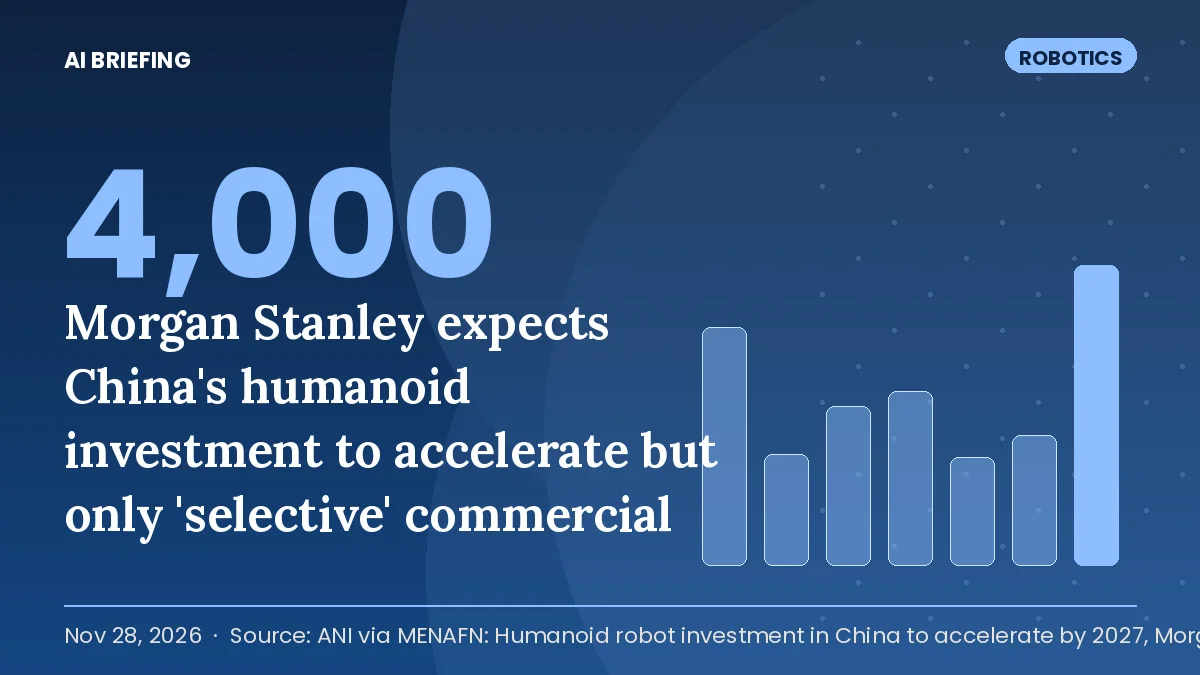
The bank's report, published Friday and covered by ANI, says Chinese humanoid makers will see faster capital inflows and small-scale deployments in chosen applications next year, while broad adoption remains 'some distance away' because of precision machining, equipment supply, skilled labour and production yields. It cites one newer model whose benchmark success rate more than doubled to 41.2% and whose average response time fell 33%, UBTECH's 2026 targets of roughly 4,000 industrial and commercial units and 1,500-2,000 household units, and Geekplus's plan for about 300 humanoids by early 2027. XPeng separately told investors its Iron humanoid will reach Chinese retail locations in Q1 2027 and international ones in the second half.
Executives'Selective commercial use' is the honest phrase. Budget 2027 humanoid pilots as pilots: a few units, one task, a measured cycle time, with the exit clause Volvo built into its Hexagon trial.
FinanceMorgan Stanley's China shipment forecast was raised to 50,000 units in June; this report is about quality of demand, not volume. UBTECH's 4,000 industrial deliveries would make it the volume leader by a wide margin.
SecurityHumanoids in Chinese factories run on Chinese cloud stacks. If you deploy them outside China, the data path, remote-update channel and teleoperation access are the questions to ask before price.
ML engineersA success rate doubling to 41.2% is the real state of the art on general manipulation benchmarks: well under half. Sim-to-real and tactile data, not more demos, are the bottleneck.
DevelopersHardware yields and machining, not software, are the stated constraint. If you write robot policies, expect to target a small number of platforms shipping in volume: UBTECH, Unitree, XPeng, AgiBot.
BeginnersA big investment bank says Chinese companies will build many more human-shaped robots next year but that only a few will do real jobs. The best models still fail more than half their tasks in tests.