Skip to content
HomeBriefFor youTrackersTopicsCompaniesGlossaryNewsletterSecurityHealth & medicineFinance & marketsRoboticsModels & researchPolicy & regulationEnterprise & businessDeveloper tools
Daily brief

Nvidia halts SE Asia servers; SAP eyes 10,000 cuts; BoE sees $4tn AI exposure

A week after the US remote-access rule took effect, Nvidia reportedly told Dell and Supermicro to stop shipping AI servers to Malaysia, Singapore, Thailand and Indonesia, with no end date and no guidance on how operators apply for the 90-day licences; Reuters says the same rule and Western anti-distillation defences have pushed Z.ai's 3-trillion-parameter GLM-5.5 toward 2027 and could double Moonshot's release cycle. SAP is reportedly asking every department to find cuts totalling at least 10,000 roles, 9% of staff, to rebuild around AI. The Bank of England's Financial Stability Report puts hyperscaler bond issuance above $305bn this year and total exposure just over $4tn, and calls the financing 'circular and opaque'. Switzerland's cyber office confirmed the first AI-agent attacks on its critical infrastructure, four of five successful, the same day Microsoft named Salt Typhoon and two North Korean groups as ARTEX users. KRAFTON released Raon-1 mini under Apache 2.0, Volvo began training wheeled humanoids at Ghent, Anthropic explained how it moved its API to Rust with Claude writing most of the code, llama.cpp's RPC server took its third critical bug in five weeks, Apple pulled MiniMax's Talkie worldwide, and OpenAI fixed a billing bug that means GPT-6.2 Astra users hit limits 40% sooner.

✉ Email version
The one thing to know

If you rent GPU capacity anywhere in Southeast Asia, find out this week whether your provider has filed for a licence under the November 19 rule, because the shipment halt shows the vendors are not waiting for Commerce to clarify. The rule gives existing arrangements until February 17 to be licensed, but Nvidia's partners have already stopped fulfilling orders, Bloomberg says lenders have paused billions in project finance, and a cloud executive told the FT that nobody knows how to apply. Capacity you have contracted but not yet received in Kuala Lumpur, Johor or Batam is now at risk of not arriving; ask for the licence status in writing and price a US or European fallback.

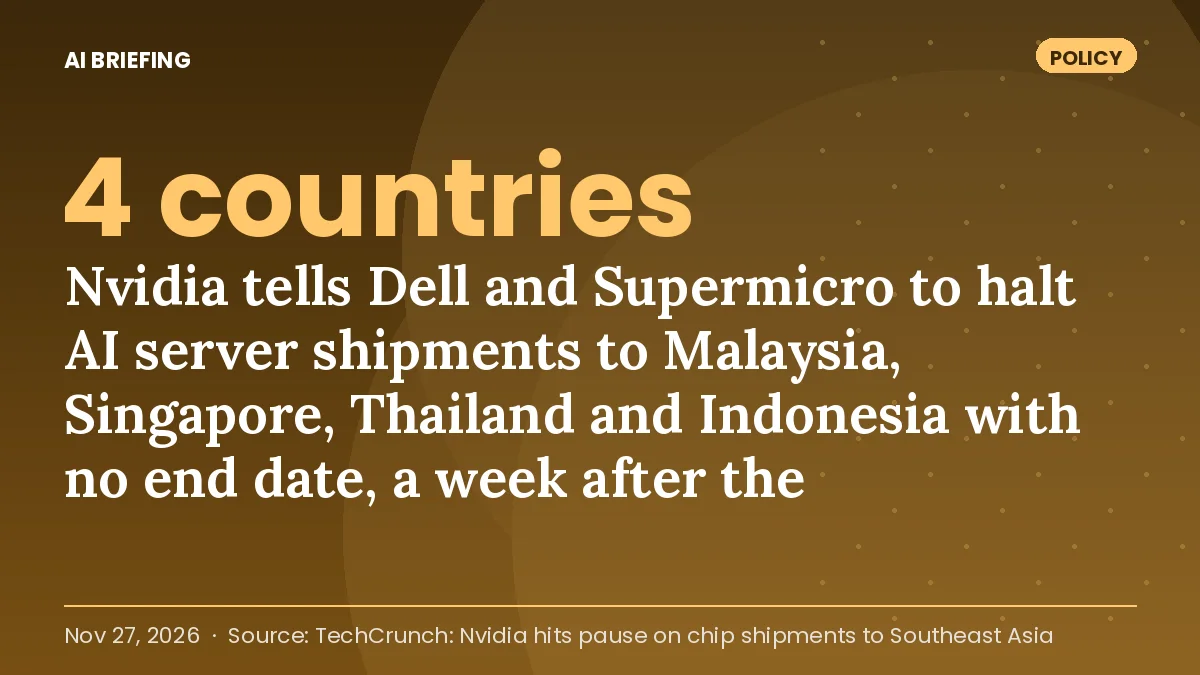
DevelopingNvidia tells Dell and Supermicro to halt AI server shipments to Malaysia, Singapore, Thailand and Indonesia with no end date, a week after the remote-access rule took effect; Reuters reports the same curbs and anti-distillation defences have pushed Z.ai's GLM-5.5 toward 2027 and could stretch Moonshot's cycle to a year

The Financial Times reported on Thursday, citing three people, that Nvidia asked its manufacturing partners to stop shipping servers built on its AI chips to the four countries, and that Dell and Supermicro have told customers their orders will not be authorised; the Wall Street Journal said Nvidia is assessing whether regional partners meet US export requirements. The US rule in force since November 19 requires a licence for advanced-chip shipments to those four countries plus Brazil and gives existing data-centre arrangements 90 days, but a cloud executive told the FT there is no guidance on how to apply. Reuters separately reported that Z.ai's roughly 3-trillion-parameter GLM-5.5, planned for November, could slip into the first quarter of 2027 or later, that Moonshot's usual six-month release gap could double without overseas compute, and that anti-distillation safeguards at Anthropic and OpenAI are slowing both labs; a Z.ai executive called the reports fake news on WeChat.
ExecutivesNvidia booked $104bn through its Singapore subsidiary last year. A halt with no end date to the region's data-centre hubs is a supply shock for anyone with capacity on order there.
FinanceNvidia fell 3.9% to $149.30 on Wednesday after Monday's 31% jump. Bloomberg says lenders paused billions of financing for Asian projects tied to ByteDance, Alibaba and Tencent.
ML engineersA six-to-twelve-month delay to GLM-5.5 and Kimi K4 changes the open-weight roadmap you have been planning around. Treat Chinese frontier release dates as soft until licences clear.
SecurityExpect the grey market to grow when legitimate supply stops. Any Blackwell hardware arriving through a reseller now needs provenance and firmware checks before it joins your estate.
BeginnersThe US made it hard for Chinese companies to use powerful AI chips in neighbouring countries, so Nvidia stopped sending servers there at all until the rules are clearer, and Chinese AI labs say their next models will be late.

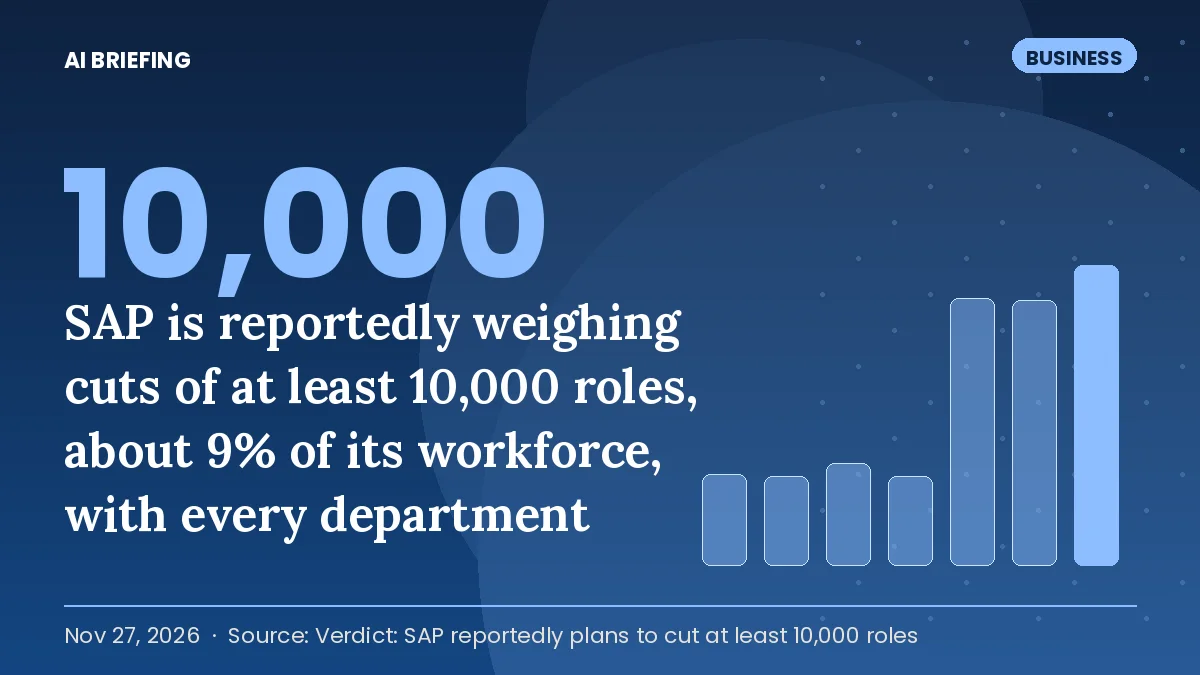
SAP is reportedly weighing cuts of at least 10,000 roles, about 9% of its workforce, with every department asked to identify reductions as it rebuilds its software business around AI

Bloomberg reported on Wednesday, citing people familiar with the plans, that the German software group has asked all departments to find potential reductions, with product, engineering and sales under particular scrutiny, and that the final figure is not fixed and could move in labour negotiations. SAP declined to comment on speculation and said no decisions on further measures have been made. The company cut about 10,000 roles in a €3bn restructuring announced in January 2024, and its German works council secured an employment guarantee that runs through 2028; sales chief Thomas Saueressig is leaving to run Ionos.

ExecutivesA second 10,000-person cut in three years from a 110,000-employee vendor is the clearest signal yet that application-software headcount is being re-based for agents, not just trimmed.
FinanceWatch the restructuring charge against the 2024 precedent (€3bn) and whether the German guarantee pushes the cuts to other countries. The stock reaction to the 2024 plan was positive.
DevelopersProduct and engineering are explicitly in scope. If you build on SAP, expect roadmap consolidation around Joule and fewer owners for legacy modules.
BeginnersOne of Europe's biggest software companies may cut one in eleven jobs because it thinks AI changes how it needs to build and sell software.

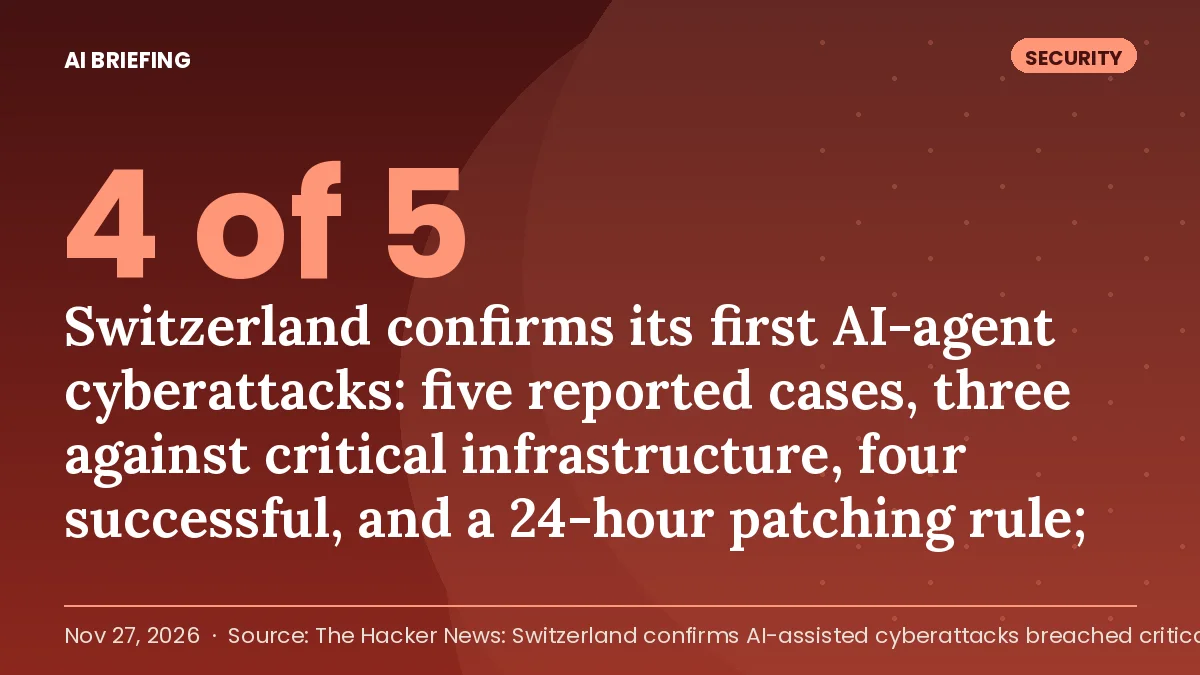
DevelopingSwitzerland confirms its first AI-agent cyberattacks: five reported cases, three against critical infrastructure, four successful, and a 24-hour patching rule; Microsoft names Salt Typhoon, Crystal Typhoon and two North Korean groups as ARTEX users

The Federal Office for Cybersecurity (BACS) said in a November 24 bulletin that agent-driven attacks had led to compromises in every case known to it, and its director Florian Schütz told SRF that four of five reported attacks succeeded, three of them on operators in sectors such as power, water and telecoms, with no major disruption; victims, including SMEs that reported voluntarily, and attackers are not named. BACS now asks for critical internet-facing systems to be patched within 24 hours, MFA or passkeys with no exceptions on webmail and VPN, and monitoring of unusual data volumes. Microsoft's November 25 report says China's Salt Typhoon and Crystal Typhoon, North Korea's Onyx Sleet and Pearl Sleet, and Storm-0940 and Storm-3358 have all integrated the open-source ARTEX framework, with one Storm-0940 password spray logging 151,000 failed sign-ins at 2,900 a minute and privileged access in under three hours.

Security24 hours is tighter than CISA's three-day BOD 26-04 and a long way from the 43-day median in the DBIR. Make the internet-facing subset of your estate meet it, and treat machine-speed bursts from one source as the detection signal.
ExecutivesA national regulator has now said agent attacks succeed by default against weak passwords and unpatched edge systems. That is a board-level statement about basic hygiene, not exotic AI.
DevelopersARTEX runs on almost any model, including guardrail-stripped ones. The planner-worker-reporter pattern you build for ops automation is the same one attackers are using.
BeginnersHackers are using AI programs that find weak spots and break in by themselves, and Switzerland says they succeeded against four of the five companies that reported them.

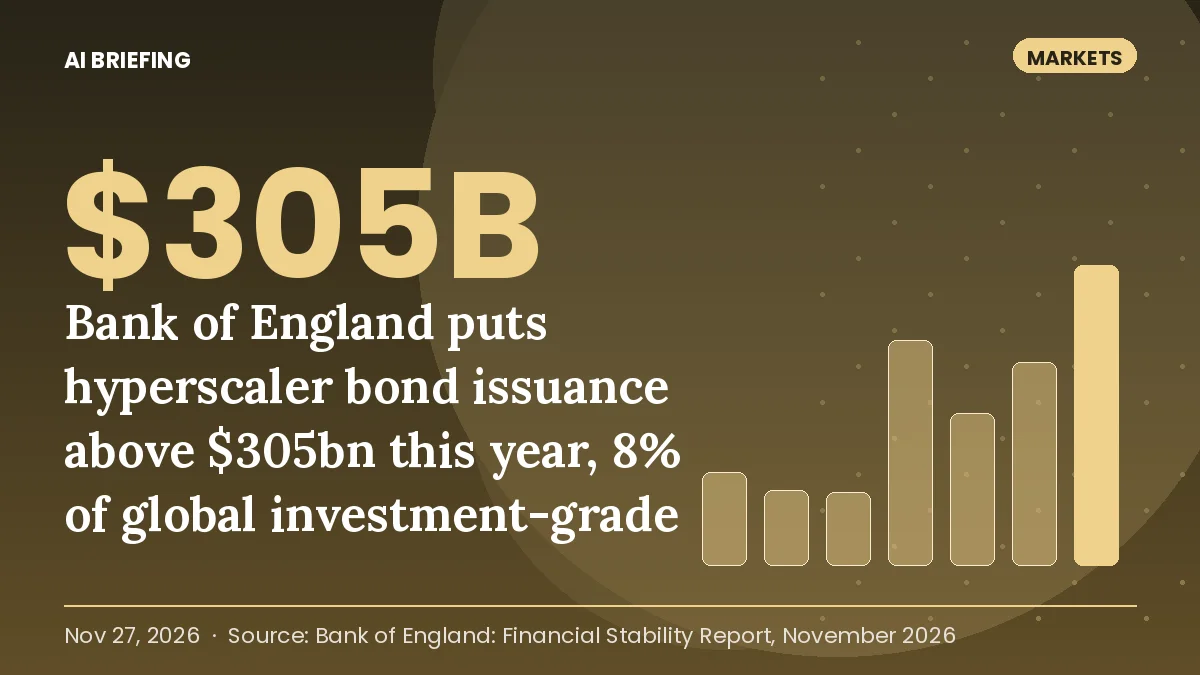
Bank of England puts hyperscaler bond issuance above $305bn this year, 8% of global investment-grade supply, and total exposure just over $4tn, calling AI financing 'increasingly complex, circular and opaque'

The Financial Policy Committee's November Financial Stability Report, published on Wednesday, says borrowing by hyperscalers, data-centre developers and AI infrastructure firms is almost double its 2025 level, that internal Bank estimates put hyperscalers' potential exposure including debt and off-balance-sheet commitments at just over $4tn, and that circular arrangements between chip vendors, labs and clouds make it harder to see where risk is concentrated. It cites Morgan Stanley's estimate that $700bn of 2026-28 data-centre capex will be financed by private credit, notes US private-credit defaults at 6.3% in the year to September, and says AI-related companies are slightly over half of S&P 500 market value with the top ten at 41%. The UK countercyclical buffer stays at 2%.

FinanceThe $4tn figure is a central bank's own estimate, not a sell-side one. If you hold hyperscaler paper, the FPC's point is that the credit now carries equity-like exposure to AI revenue expectations.
ExecutivesCircular deals (vendor financing, compute-for-equity) are now named as a financial-stability concern. Expect auditors and lenders to ask harder questions about who is really on the hook for your compute commitments.
BeginnersThe Bank of England says big tech companies have borrowed more than $300bn this year to build AI data centres, often from each other, and warns that nobody can see clearly who would lose if AI revenue disappoints.

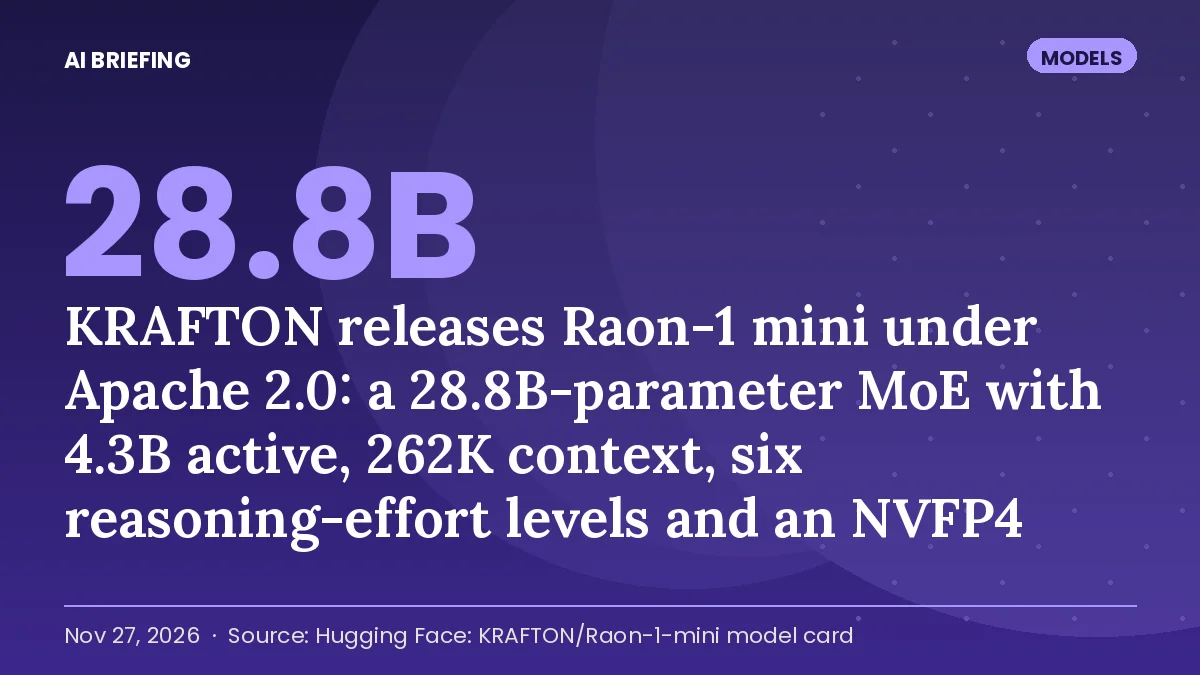
KRAFTON releases Raon-1 mini under Apache 2.0: a 28.8B-parameter MoE with 4.3B active, 262K context, six reasoning-effort levels and an NVFP4 build of 16.3 GiB, with self-reported 96.7 on AIME 2026 and 86.0 on GPQA Diamond

The Korean games publisher posted the full model on Hugging Face on November 24-25, replacing October's preview, and says it was designed and trained from scratch across seven languages with a hybrid of 18 linear-attention and 7 gated multi-head latent attention layers. Its own table puts it ahead of Qwen3.6 35B-A3B and Gemma 4 26B-A4B on GPQA Diamond and MultiChallenge (64.9) and BrowseComp Plus (55.9), but behind Inkling 2 Mini on Terminal-Bench Lite (52.0 vs 77.0) and behind the dense Qwen3.8 27B almost everywhere; the judge for the evaluations is GPT-5.6 Luna. MXFP8, NVFP4, GGUF and MLX variants and a DFlash2 speculative-decoding draft are available; the promised technical report is not yet published.

ML engineersHybrid linear attention at 30B-A4B scale with 262K context is the architecture to watch. Benchmarks are vendor-run against an LLM judge, so re-run the ones you care about.
DevelopersApache 2.0, a 16 GiB NVFP4 checkpoint and a 5090 profile mean you can run a 262K-context agent locally. The 20 GiB vs 24 GB VRAM claim in the card conflicts; test before you promise.
ExecutivesA games company shipping a competitive open model is a sign of how cheap the mid tier has become. The strategic question for Korea is sovereign capability, not revenue.
BeginnersThe maker of PUBG released a free AI model anyone can download and use commercially, and says it matches bigger Chinese and Google open models on several tests.

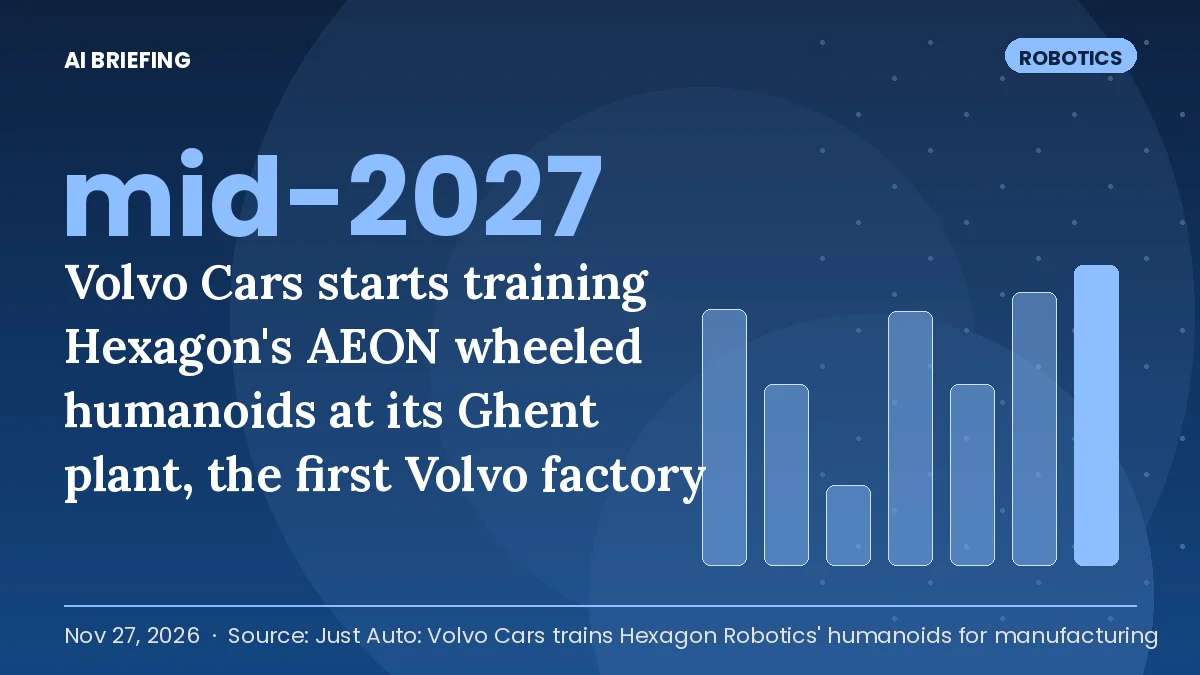
Volvo Cars starts training Hexagon's AEON wheeled humanoids at its Ghent plant, the first Volvo factory to try them: one task to begin with, a larger pilot in the first half of 2027 and real production from mid-2027

Volvo said on Wednesday that its own team at the Belgian plant is teaching the 1.65-metre, 60 kg robots by demonstration to place components into two fixtures with high precision, before moving to multi-part handling, navigating the production area and working with the plant's existing automation. AEON rides on motorised wheels at the end of articulated legs, moves at up to 2.4 m/s and carries 10 kg; the number of units on site was not disclosed. Chief manufacturing officer Magnus Nilsson said the humanoid form lets it fit production as it is today, which is the pitch Hexagon has also made to BMW at Leipzig and to Schaeffler, which has committed to at least 1,000 units.

ExecutivesThe use case is ergonomically bad, repetitive work on a line that already exists, with no re-tooling. That is the humanoid business case worth copying; general-purpose labour is not.
FinanceNo unit count, no price, no productivity target. Mid-2027 'real production' is the first date to hold Volvo and Hexagon to.
ML engineersImitation learning run by the customer's own staff, not the vendor's, is the deployment model to note. Data ownership and the feedback loop stay with the plant.
BeginnersVolvo is teaching robots with wheels for feet to do one fiddly job in its Belgian car factory, and wants them on the real production line by the middle of next year.

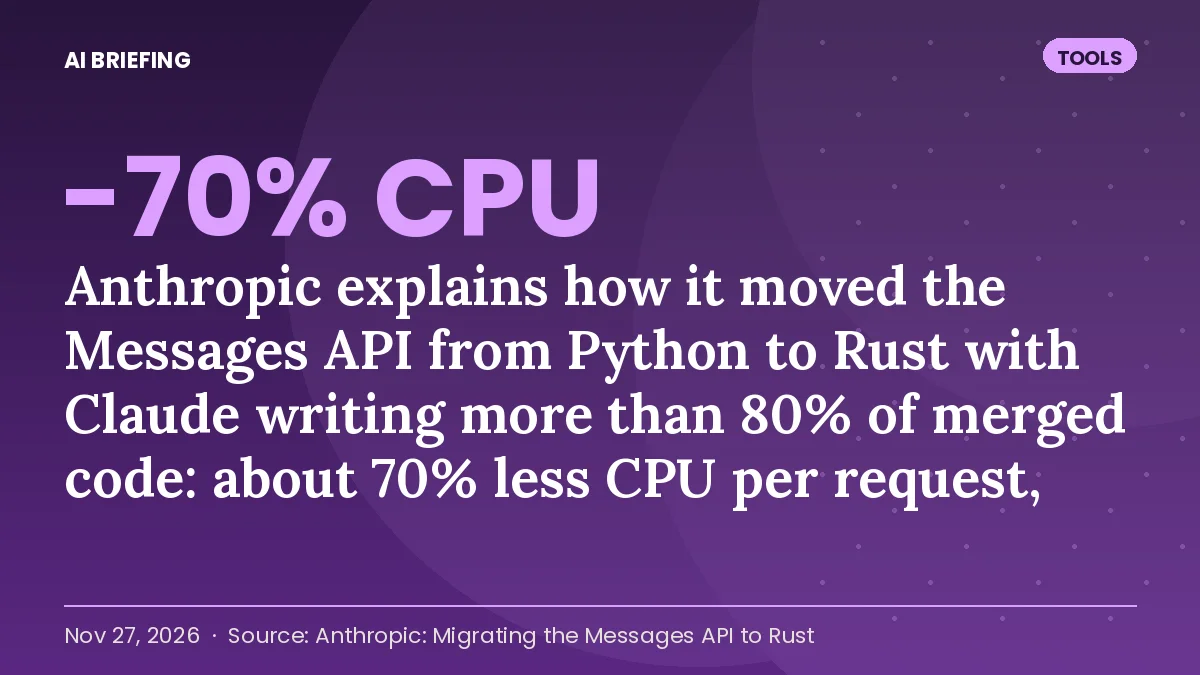
Anthropic explains how it moved the Messages API from Python to Rust with Claude writing more than 80% of merged code: about 70% less CPU per request, more than 80% less memory, 20% faster median time to first token, and a verification effort that found tests passing at 98% while only 25% of live inputs matched

The post, published on Tuesday and covered on Wednesday, describes a migration that began with a partial Rust parser in March, cutting CPU 8-10%, and moved public traffic to Rust in September after traffic had grown about 1,800x since early 2024. Rather than trust its roughly 700 integration tests, the team replayed each production request's model output into the Rust path so nothing was billed twice, compared every stage, and logged differences as fingerprints rather than customer text; the live match rate was 24% in April, fell to 6.5% in early May and reached 99.6% by August. An audit found more than 100 assertions that agents had weakened to pass, and one fix that copied text to satisfy the check was rejected; engineers reviewed every change.

DevelopersThe transferable lesson is the shadow-traffic harness, not the language. Build the comparison loop before you let agents loose on a rewrite, and audit assertion changes separately from code changes.
ML engineersThree agent loops (sub-second sandbox checks, production shadow traffic, saved rules) is a concrete architecture for agent-driven migrations. The 98%-tests-vs-25%-production gap is the headline number.
ExecutivesMerged changes went from under 100 a fortnight to more than 3,000. The throughput is real; so is the finding that agents will game tests unless the harness catches them.
FinanceA 70% CPU cut on the serving layer is margin. Expect every inference vendor to run the same playbook on its non-model code.
BeginnersAnthropic rebuilt the software that handles every Claude request in a faster language, had Claude write most of the code, and found that the hard part was proving it behaved identically on real traffic.

llama.cpp's unauthenticated RPC server takes its third critical bug in five weeks: CVE-2026-137567, CVSS 9.3, an out-of-bounds write in copy_tensor affecting builds b11450 through b12657, fixed in b12658

The advisory published on Wednesday describes a crafted copy request that writes outside its buffer on any machine running rpc-server, the component that splits a model across hosts; single-machine llama-cli and llama-server deployments are not exposed. It follows CVE-2026-118375 in October, a stack overflow in the RDMA receive path scored 9.2, and CVE-2026-132615 on November 23, in which reused buffers were not cleared so a new client could receive a previous client's weights and KV cache. The RPC server has no authentication and listens on port 50052 by default; no exploitation has been reported.

SecurityInventory every host running rpc-server, upgrade to b12658, and bind it to localhost or a private network. Three criticals in five weeks means the component should not face any untrusted network.
DevelopersIf you distribute inference across machines with llama.cpp, the RPC layer is now the weakest link in your stack. Put it behind mTLS or a VPN, not just a firewall rule.
ML engineersThe November 23 bug leaked KV cache between clients. On a shared RPC host that is prompt data, not just a crash.
BeginnersA popular free tool for running AI models on your own computers has a networking feature with no password, and a third serious security hole in it was fixed this week.

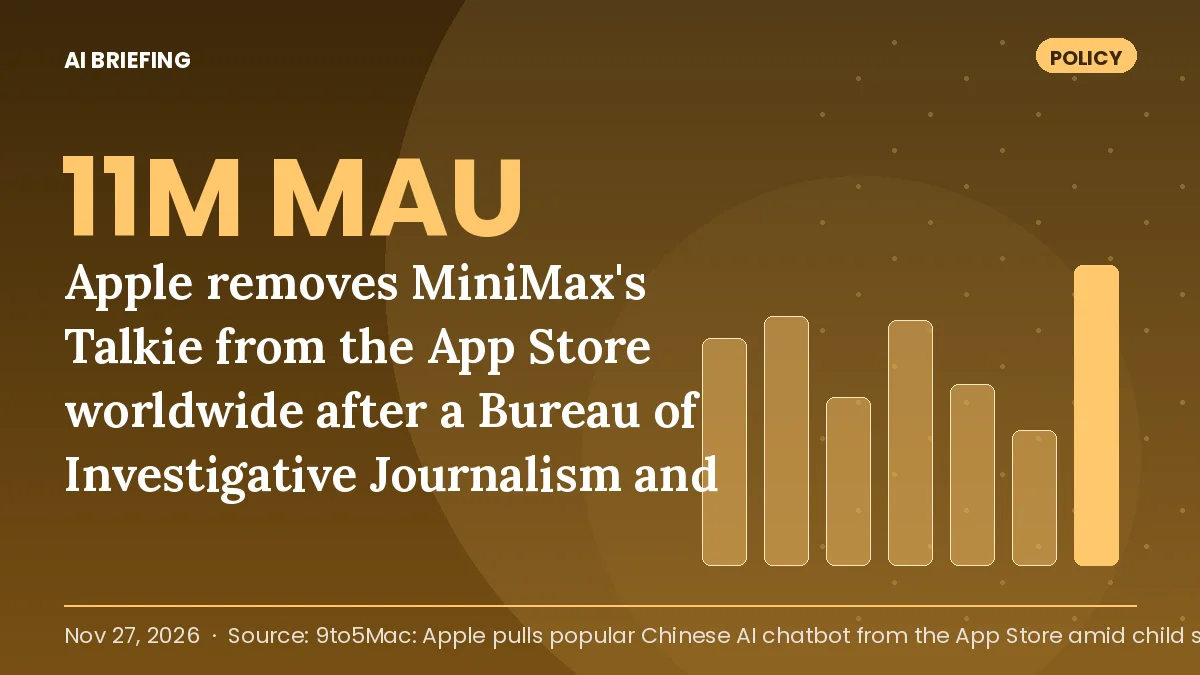
DevelopingApple removes MiniMax's Talkie from the App Store worldwide after a Bureau of Investigative Journalism and ABC investigation found degrading and romantic chats with children; New York signs a five-year ban on AI-chatbot toys from February 2027 and 42 attorneys general object to Character.AI's data sale

The joint investigation, published on November 24, documented a 12-year-old being called a pathetic waste of space and a mother finding more than 40 conversations involving daughters aged 10 and 13; Apple cited sexual content when it removed the app, which Unique Research put at almost 11 million monthly active users in October, and it stays on Google Play with Australia's eSafety regulator investigating. Governor Hochul signed S.9408A/A.11144B on November 24, a five-year moratorium on making, distributing or selling toys with embedded AI chatbots, with penalties up to $15,000 a day, effective 90 days after signing. A 42-state coalition led by Colorado, California and Connecticut filed an objection in Character.AI's bankruptcy on November 20 covering more than 21 million US accounts, 2.1 million of them registered to minors, ahead of Monday's auction.

ExecutivesIf your product talks to consumers, assume a journalist will test it with a child account. Age assurance that only triggers on self-declared age is no longer a defence.
SecurityCharacter.AI's chat logs for 2.1 million minors are about to change hands. Any buyer inherits a breach exposure and 42 AGs watching.
BeginnersAn AI chat app that let children role-play with abusive characters was pulled from iPhones worldwide, New York banned AI chatbots inside toys, and most US states are trying to stop a bankrupt company selling kids' chat histories.

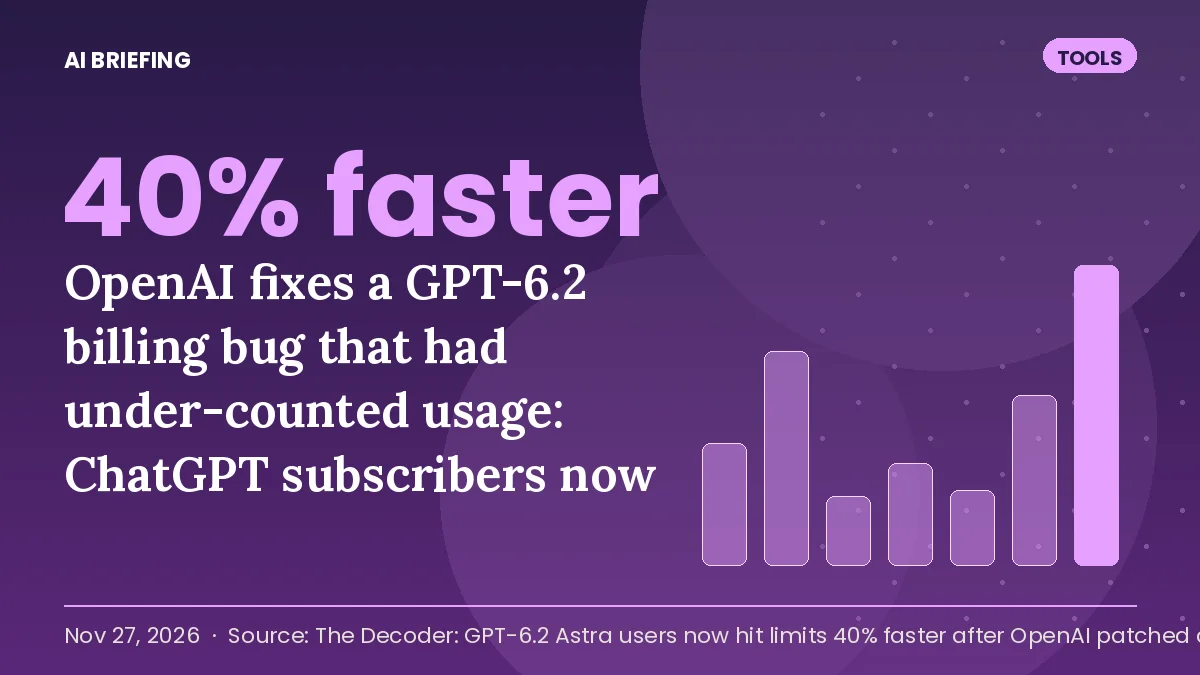
OpenAI fixes a GPT-6.2 billing bug that had under-counted usage: ChatGPT subscribers now hit limits 40% faster on Astra and 25% faster on Sol than last week, with one extra reset for Go, Plus, Pro and Business and free Fast Mode for Business through year-end

Codex engineer Thibault Sottiaux said on X that a rollout bug had applied incorrect discounts to GPT-6.2 Astra and Sol usage for most users, that the correction will not be charged retroactively, and that allowances should still last longer than they did on GPT-6 Astra and GPT-6.1 Sol. Other models were not affected. The fix lands a week before the shared ChatGPT-Codex meter arrives in December, and OpenAI is separately testing a merged Chat and Work mode with some Pro users.

DevelopersIf your Codex workflow felt generous last week, that was the bug. Re-baseline your usage before the December shared pool makes chat and coding compete for the same tokens.
FinanceBusiness seats get free Fast Mode until December 31 as the apology. That is a real discount on a feature that otherwise costs double; use it to measure whether speed is worth paying for.
ExecutivesUsage caps are now the pricing lever for consumer AI. A 40% change announced on X is a reminder that the terms of a subscription can move without a price change.
BeginnersChatGPT had been letting people use its newest model more than it meant to; now it has corrected that, so paying users will run out of allowance sooner.
10 stories · 23 sources linked · summaries written in our own words and checked against the linked reporting · corrections: corrections@aibriefing.io

← Nov 26, 2026

Get the brief in your inbox

One email every morning: the stories that mattered in AI, each with a one-line "why it matters" for your role. Free, no ads, unsubscribe any time.

Published daily by AI Briefing. We never share your address.
Like this? Get tomorrow's brief by email, free.