The Bank of England puts a number on the AI build-out: $305bn of hyperscaler bonds this year and just over $4tn of exposure it calls circular and opaque
The November Financial Stability Report is the first central-bank estimate of what the hyperscalers have committed on and off balance sheet; the FPC's worry is less the size than that nobody can see where the losses would land.
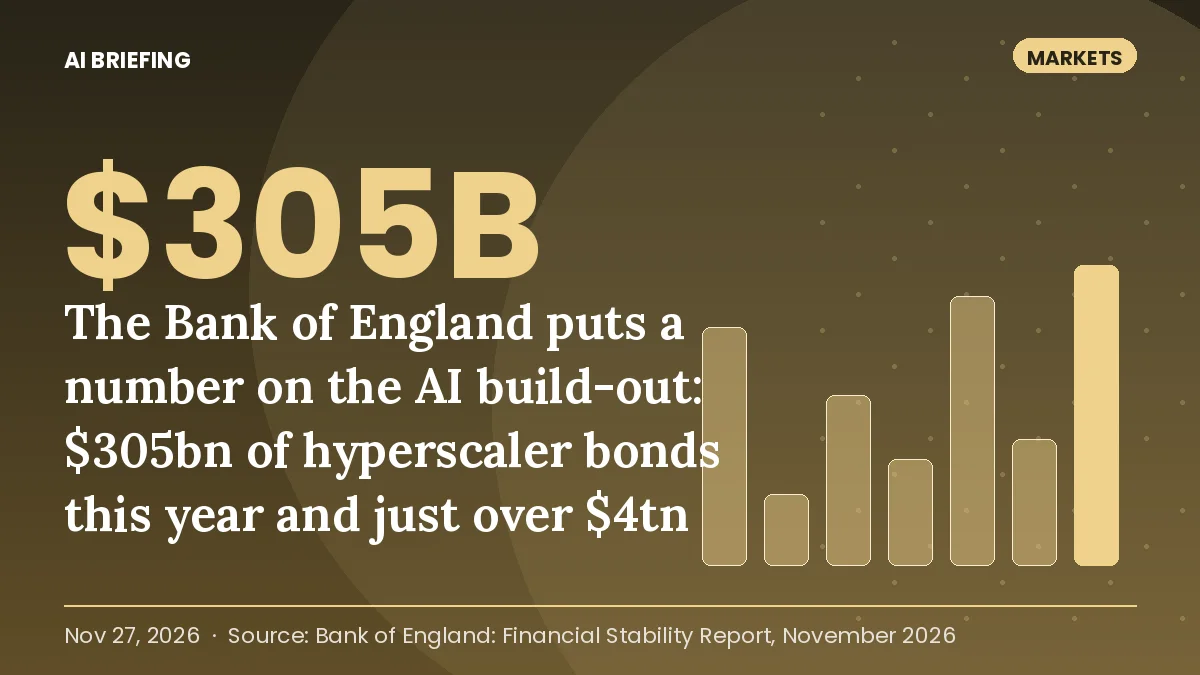
The Bank of England's Financial Policy Committee published its November Financial Stability Report on Wednesday, and for the first time it put its own estimate on the AI build-out. Bond issuance by the hyperscalers is set to exceed $305bn in 2026, about 8% of global investment-grade supply, and the share rises considerably once the wider ecosystem of AI-related issuers is included. Borrowing by hyperscalers, data-centre developers and AI infrastructure companies is almost double its 2025 level. Internal Bank estimates put the hyperscalers' total potential exposure, including debt and off-balance-sheet commitments, at just over $4tn. The committee's phrase for the financing is increasingly complex, circular and opaque.
What the numbers mean
The $305bn figure is the clean one: it is bonds the hyperscalers have sold or are expected to sell this year, and it sits alongside the roughly $700bn of 2026-28 data-centre capex that Morgan Stanley expects private credit to finance and the $1.4tn of AI capex that J.P. Morgan's analysts think alternative capital could fund. The $4tn figure is messier by design. It adds purchase commitments, lease obligations, guarantees to special-purpose vehicles and the equity stakes that chip vendors, clouds and labs have taken in each other. That is what the FPC means by circular: when a chipmaker invests in a lab that commits to buy compute from a cloud that borrows to buy the chips, the same revenue expectation underwrites three balance sheets, and a miss propagates through all of them.
The equity side gets the same treatment. AI-related companies are slightly over half of S&P 500 market capitalisation, the top ten are 41% of the index against 42% at the end of 2025 and about 25% at the 1999 peak, and Samsung and SK Hynix are around half of Korea's KOSPI. The S&P forward multiple has come down to 18.9x from 20.1x at the July report, which is the market correction of the past fortnight showing up in the data. The committee says valuations remain highly susceptible to shifts in expectations about AI adoption, and that an earnings miss at a few firms could move broad indices.
Private credit and the banks
The FPC's second concern is the plumbing. The private-credit market is about $2.5tn, Fitch puts the US default rate at 6.3% for the twelve months to September, up from 5.4% a year earlier, and the committee notes that private markets have not been tested through a broad macroeconomic stress at their current size. Prime-brokerage growth ties banks more tightly to leveraged non-banks, which is the channel through which a private-credit problem in data-centre finance would reach the banking system. Staff judge the risk to UK gilts from an AI equity correction to be limited for now; the countercyclical capital buffer stays at its neutral 2%, and the system-wide capital benchmark for major UK banks stays around 13%.
The report lands in the same week that Semafor reported Citi and JPMorgan marketing portfolios of AI data-centre loans, including synthetic risk transfers, to investors, and a week after the Federal Reserve's own stability report found 87% of surveyed market participants naming AI as a risk.
The counter-argument
Hyperscaler balance sheets are the strongest in the index: operating cash flow covers most of the capex, and the debt the FPC is counting is cheap, long-dated and largely investment-grade. Circular deals also cut both ways: a chip vendor's equity stake in a lab is an incentive to keep that lab alive, not a reason it fails. The FPC's answer is that it is not forecasting a crash; it is saying the structure has grown faster than anyone's ability to map it, and that is a statement about the next stress, not this quarter.
What to watch
- Hyperscaler bond spreads against the IG index. The FPC's 8% share means a widening there moves the whole market, not just tech.
- Synthetic risk transfer volumes on data-centre loan books. Banks selling the risk is the market's own read on the FPC's concern.
- Disclosure. The next step for regulators who find something opaque is to require it be reported; watch the FPC's December record and the FSB's agenda for off-balance-sheet compute commitments.
- The private-credit default rate. 6.3% and rising before any AI-specific stress is the number the committee is implicitly worried about.
The story so far
- Nov 27, 2026 Nvidia's halt to four Southeast Asian countries is the remote-access rule doing in a week what Commerce said would take …
- Nov 26, 2026 A week after the remote-access rule, thousands of Nvidia B300s need new owners, Shenzhen dealers quote $3.4m a server, a…
- Nov 26, 2026 HP +9% on AI PCs, Workday −8% and Autodesk −4% on beat-and-raise quarters: the market is paying for hardware and chargin…
- Nov 25, 2026 The FCA says some AI agents will need financial authorisation at launch, and calling yourself a tech company will not he…
Key terms in this story
- Synthetic risk transfer (SRT) A deal in which a bank keeps a loan on its balance sheet but pays investors to take the first losses on it, freeing regulatory capital.
- Purchase commitments Contracts a company has signed to buy components, capacity or services in future, disclosed in its financial statements even though the cash has not yet been spent.
- Benchmark A standard test used to compare models, such as a set of coding tasks or exam questions.
More in Finance & markets
All →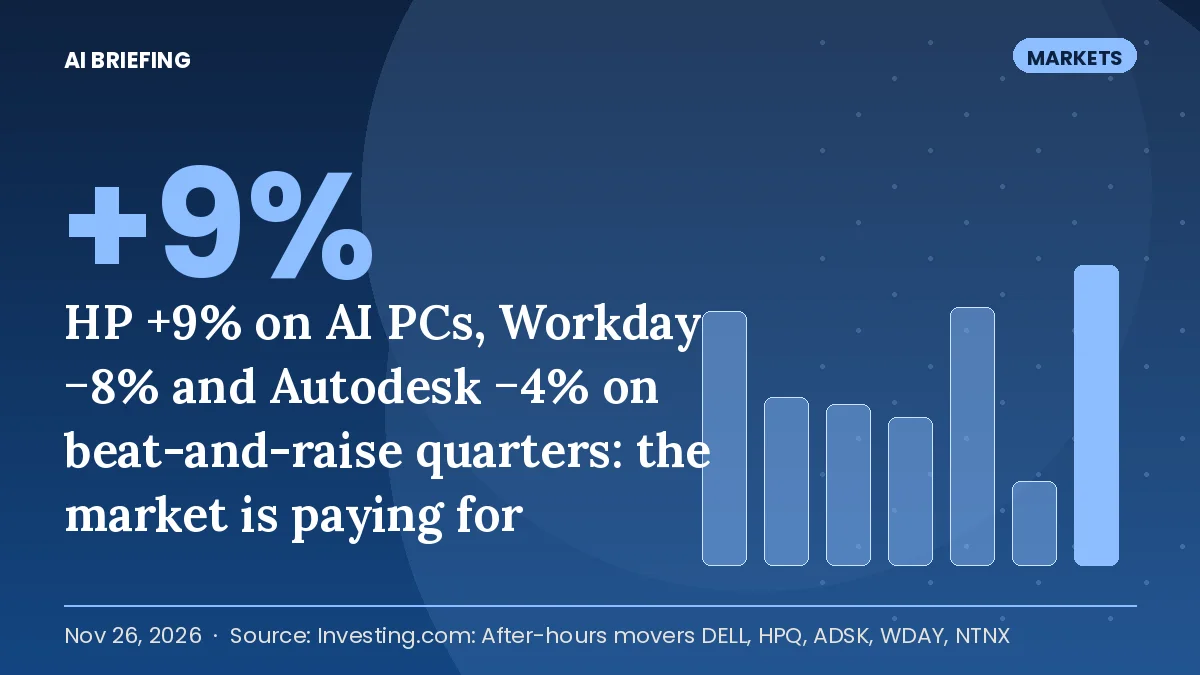
HP +9% on AI PCs, Workday −8% and Autodesk −4% on beat-and-raise quarters: the market is paying for hardware and charging software for its AI story
Tuesday's after-hours tape rewarded a $16bn PC quarter and punished two software vendors that raised guidance, one of which put a hard $150m number on…
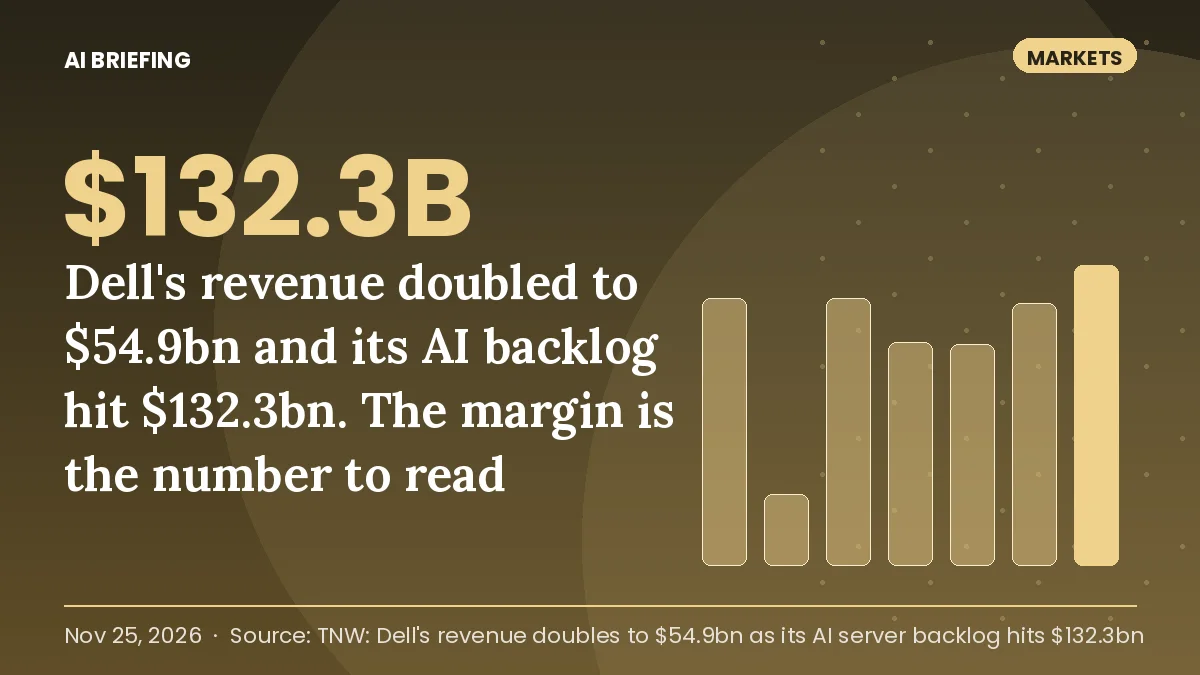
Dell's revenue doubled to $54.9bn and its AI backlog hit $132.3bn. The margin is the number to read
AI servers earn mid-single-digit margins, Dell is repricing signed deals as memory costs climb, and infrastructure operating margin is guided below 15…
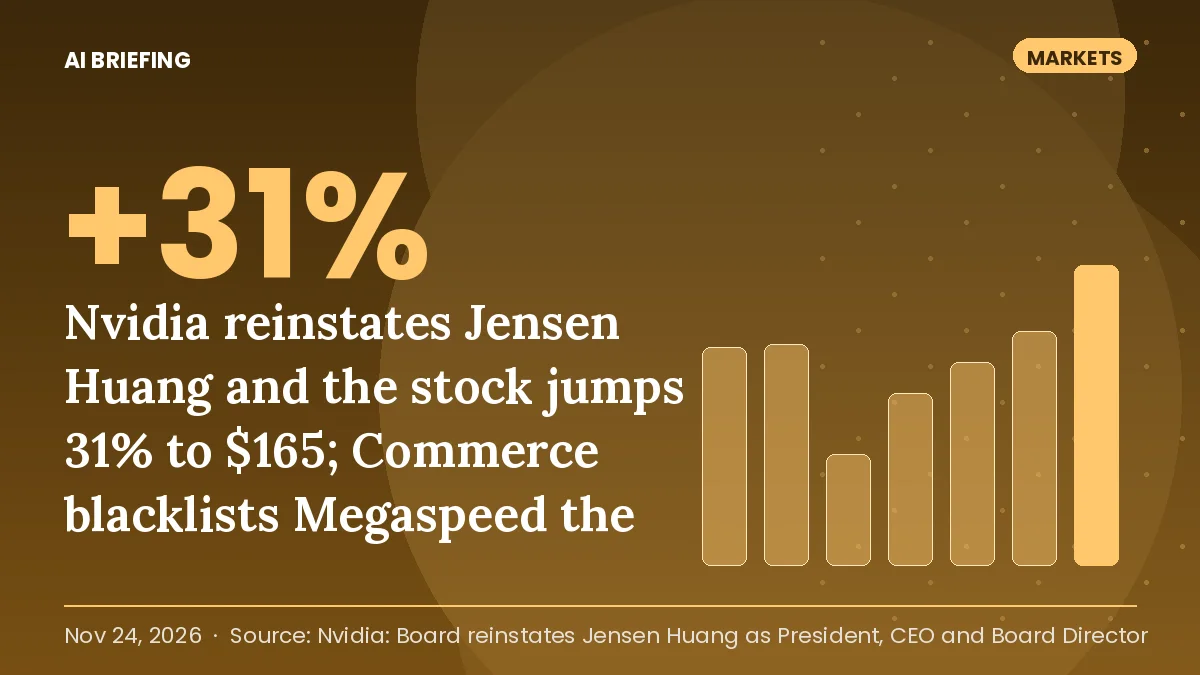
Nvidia reinstates Jensen Huang and the stock jumps 31% to $165; Commerce blacklists Megaspeed the same day. What changed for investors, and what has not
A unanimous board vote, a White House push and a new export-control committee put Huang back in charge eleven days after he resigned, but the congress…
Get the brief in your inbox
One email every morning: the stories that mattered in AI, each with a one-line "why it matters" for your role. Free, no ads, unsubscribe any time.
Published daily by AI Briefing. We never share your address.