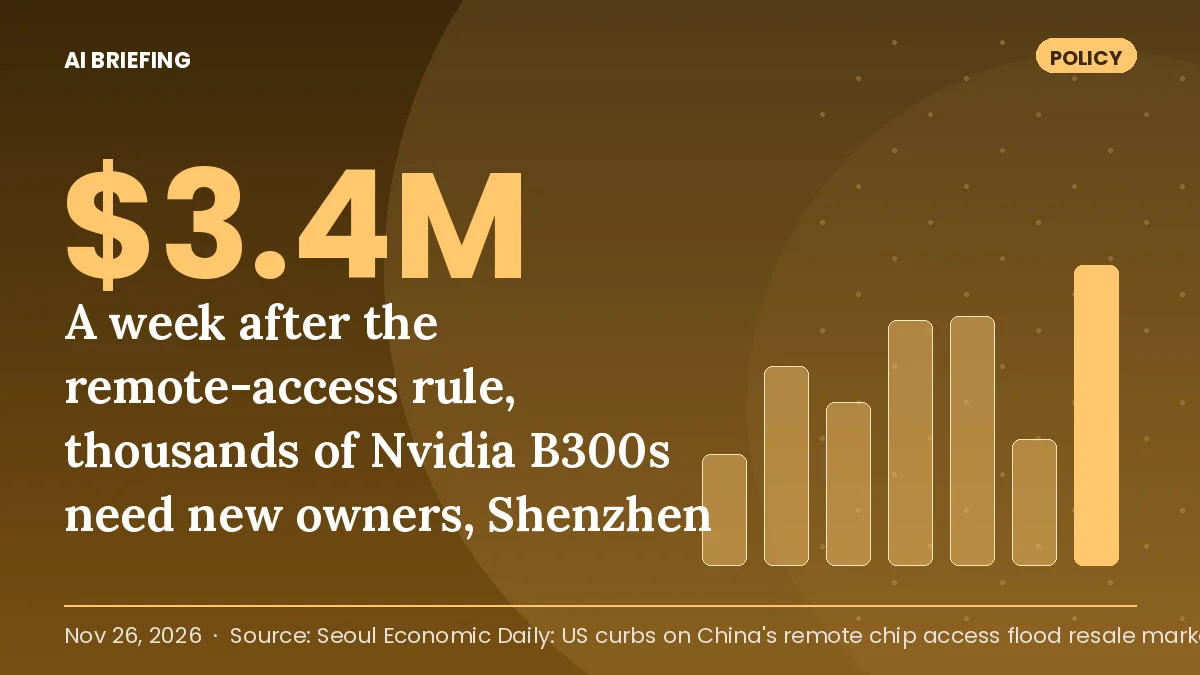
DevelopingA week after the remote-access rule, thousands of Nvidia B300s need new owners, Shenzhen dealers quote $3.4m a server, and banks are writing chip clauses into data-centre loans
The Commerce rule that took effect on November 19 is already moving hardware out of Southeast Asia and credit terms in New York; the licensing backlog has not even started.
The Bureau of Industry and Security's interim final rule, issued on November 16 and in force from November 19, bars Chinese companies from remotely using advanced US-made chips in third-country data centres without authorisation, and requires operators in countries such as Malaysia and Singapore to obtain licences to buy them. A week on, the rule has produced three measurable effects: hardware on the move, prices in the grey market, and new language in loan documents.
Hardware
CNBC reported on November 25, and Seoul Economic Daily and others followed on Wednesday, that resellers are fielding thousands of Blackwell-based B300 GPUs looking for a home. GPU Mart's chief executive Jack Duhamel said the chips had been meant for data centres where Chinese firms rent access, and that one seller cited the new restrictions as its reason. Dell and Supermicro reportedly told buyers in Malaysia, Singapore, Thailand and Indonesia that Nvidia will not permit the orders to ship. The B300 is current-generation hardware; this is not old inventory being cleared but new capacity being stranded by a change in who is allowed to use it.
Prices
In Shenzhen's Huaqiangbei market, dealers quoted $3.0-3.4m for one eight-GPU B300 server, against a US price of $500,000-600,000. One dealer said the same server had sold for about $2m two months earlier, a 1.7-fold rise since the rule was signalled. A six-times premium is the market's estimate of how hard the rule will bite, and it is the number the US will cite when the next enforcement action comes.
Credit
Bloomberg reported on November 18 that Citigroup and JPMorgan Chase wrote a clause into a potential loan for Bain Capital's Bridge Data Centres, which could grow to $6.6bn, making the borrower responsible for compliance with US export controls and the Entity List, with a breach able to trigger default; the decisions came from New York head offices, and about a dozen bankers at Asian and European lenders said their firms had not followed. Bridge had sold capacity at a Malaysian site to Megaspeed, which Commerce added to the Entity List on Monday, and replaced it with Zenlayer earlier this year. Separately, a DBS-led $480m facility for Singapore's Aolani Cloud, meant to buy Nvidia chips for a Malaysian data centre serving ByteDance, is being described by bankers as unfeasible or dead after five lenders discussed withdrawing.
Why this is bigger than the loophole
The rule was pitched as closing a workaround. Its first-order effect is to make the data-centre operator's licence, not the customer's contract, the binding constraint on GPU access in Southeast Asia. That shifts risk onto exactly the party banks lend to. Expect three things: a licensing queue at BIS with no published service level, a secondary market in Blackwell that prices in the US at a discount and in China at a multiple, and a widening spread between US banks, which carry enforcement risk, and regional banks, which do not yet.
The counter-argument
Thousands of GPUs is small against Nvidia's quarterly output, and a stranded B300 in Kuala Lumpur can be redeployed to a US or Gulf buyer at a modest discount; the grey-market premium in Shenzhen measures demand the US never intended to serve. Operators that can show their customers are not Chinese will get licences, and the loan clauses mostly formalise what sanctions covenants already implied. The rule is also interim: comments are open, and carve-outs for allied-country operators are the obvious next step.
What to watch
- Where orphaned B300s clear. A US price below list is a demand signal; a Gulf price above it is a diversion signal.
- BIS licensing cadence. The first approvals and refusals for Malaysian and Singaporean operators set the market's expectations.
- Loan-document contagion. Whether HSBC, DBS and the Japanese lenders adopt the Citi-JPMorgan chip clause.
- December 1. Jensen Huang faces three House committees; the Megaspeed listing and the resale market will both be in the questions.
Sources
Seoul Economic Daily: US curbs on China's remote chip access flood resale market with Blackwell GPUs ↗TNW: Citi and JPMorgan reportedly add chip-curbs clause to Bain data centre loan ↗The Edge Malaysia: Banks pause US$480m chip loan tied to China's ByteDance ↗The story so far
- Nov 26, 2026 HP +9% on AI PCs, Workday −8% and Autodesk −4% on beat-and-raise quarters: the market is paying for hardware and chargin…
- Nov 25, 2026 Dell's revenue doubled to $54.9bn and its AI backlog hit $132.3bn. The margin is the number to read
- Nov 24, 2026 Nvidia reinstates Jensen Huang and the stock jumps 31% to $165; Commerce blacklists Megaspeed the same day. What changed…
- Nov 24, 2026 Paradromics moves its brain-to-speech decoders onto Nvidia Holoscan with a 10-millisecond target. What the latency numbe…
Key terms in this story
- Interim final rule A US regulation that takes effect on publication while the agency still accepts public comments, usually for 60 days, and may revise it afterwards.
- Entity List The US Commerce Department's list of foreign organisations that need an export licence, usually with a presumption of denial, before receiving controlled US goods.
- Technology export catalogue (China) China's list of technologies whose export is prohibited or requires a licence, maintained by MOFCOM and MOST; a 2026 draft adds 23 AI technologies.
- GPU Graphics processing unit: the chip type, dominated by Nvidia, that performs the parallel arithmetic AI training and inference require.
More in Policy & regulation
All →
Nvidia's halt to four Southeast Asian countries is the remote-access rule doing in a week what Commerce said would take 90 days
Dell and Supermicro have stopped fulfilling AI-server orders in Malaysia, Singapore, Thailand and Indonesia; Chinese labs are already reporting delays…
The FCA says some AI agents will need financial authorisation at launch, and calling yourself a tech company will not help
Britain's regulator published its agentic AI expectations on November 24: if your agent moves money, arranges credit or makes investment decisions, th…
Oregon and Virginia sue SpaceX and xAI over Grok's sexualised images: 3 million in eleven days, 23,000 apparently of children, $2,500 per violation. Why the states chose consumer-protection law
Two attorneys general are testing whether the oldest tool in state law, the unfair-practices statute, can reach a model's design choices; if it works,…
Get the brief in your inbox
One email every morning: the stories that mattered in AI, each with a one-line "why it matters" for your role. Free, no ads, unsubscribe any time.
Published daily by AI Briefing. We never share your address.