DevelopingSwitzerland says AI agents breached four of five targets, and Microsoft says Salt Typhoon now runs ARTEX: the two reports read as one
A national cyber office has told operators to patch internet-facing systems within 24 hours because agent attacks succeed against weak passwords and known flaws by default; Microsoft's list of ARTEX users explains why.
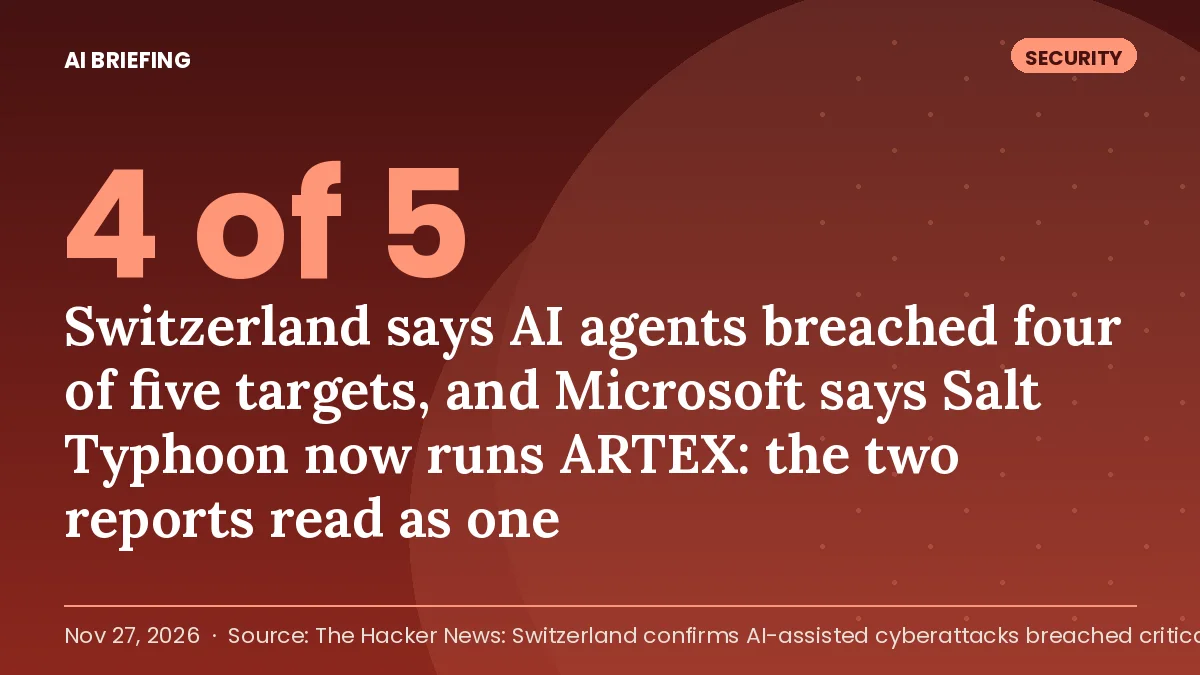
Switzerland's Federal Office for Cybersecurity (BACS) published a bulletin on November 24 saying that in every case known to it, the use of AI agents by attackers had led to a successful compromise, and that it expects more. Its director, Florian Schütz, put numbers on it in an SRF interview reported on Thursday: five attacks reported, three against operators of critical infrastructure in sectors such as electricity, drinking water and telecoms, and four of the five successful, with no major disruption. Victims, some of them small and medium-sized firms that reported voluntarily, are not named, and BACS has not attributed the attacks. Operators of critical infrastructure have had to report incidents within 24 hours since April 2025, so the count reflects what was reported, not what happened.
What the agents did
BACS describes agents that find vulnerabilities on their own, choose tools, assess results and plan next steps, and says they mainly exploited weak or guessed passwords and known flaws in internet-facing software. That is the same tradecraft Microsoft documented on November 25 in its report on ARTEX, the open-source agentic pentest framework published on GitHub in July. Microsoft names six groups that have integrated it: China's Salt Typhoon and Crystal Typhoon, North Korea's Onyx Sleet and Pearl Sleet, and Storm-0940 and Storm-3358. In one Storm-0940 password spray against Microsoft 365, more than 151,000 failed sign-ins were logged at a peak of 2,900 a minute, and privileged access followed in under three hours; the same group is tied to the ConnectWise supply-chain compromise. Microsoft describes a planner agent that sets goals, worker agents with a real shell, and a reporter agent, and says the framework runs on almost any model, including ones with guardrails removed.
BACS cites ARTEX and CyberStrikeAI as examples of agents reachable on the internet rather than as the tools used in the five cases; the FBI's November flash put exposed ARTEX consoles above 1,600. Italy's CSIRT issued a parallel bulletin naming PentAGI and DeepSeek Harness as well, and the UK's NCSC reports a marked rise in AI-assisted attacks since September.
The 24-hour rule
The Swiss recommendations are notable for how tight they are. Patch critical internet-facing systems within 24 hours of a release. Require MFA or passkeys with no exceptions on webmail and VPN. Reduce the number of internet-facing systems and restrict access with geo-blocking and allow lists. Grant the lowest privileges that work. Monitor for unusual behaviour and data volumes across identities, applications and workloads. Run regular penetration tests. CISA's BOD 26-04 gives US federal agencies three days for the highest-risk flaws; the 2026 Verizon DBIR puts the median time to full remediation at 43 days. The gap between 24 hours and 43 days is the window the agents are working in.
The counter-argument is that these are five reports in a country of nine million people, that the sectors conflict between the bulletin and the interview, and that none of the cases caused an outage. That is fair, and BACS says so itself. But Microsoft's report is not about Switzerland and reaches the same conclusion from telemetry across more than 2,250 tenants: the attacks are not more sophisticated, they are faster, and speed is what breaks a 43-day patch cycle.
What to do
- Build the list of internet-facing systems and commit to a 24-hour patch SLA for that list only. It is a smaller set than your whole estate and it is the set the agents scan.
- Remove every MFA exception on webmail and VPN this week. Passkeys where you can; the Swiss wording is no exceptions, and the Storm-0940 spray is the reason.
- Detect on behaviour, not indicators. Microsoft's guidance is that IPs and user agents rotate; what does not is the burst of varied requests from one source and the rapid jump between attack stages. Alert on both.
- Deploy honeypots and tarpits. Microsoft recommends fake wins because agents, unlike humans, pursue them.
- Rotate any secret that has ever been committed to code. The TechRadar account of Microsoft's report includes an agent that went from GitHub secrets to Azure Key Vault in five minutes.
- Report incidents. The Swiss count exists because SMEs came forward voluntarily.
Sources
The Hacker News: Switzerland confirms AI-assisted cyberattacks breached critical infrastructure operators ↗TechTimes: Swiss AI agent cyberattacks confirmed, five cases, three targeted critical infrastructure ↗Help Net Security: Chinese and North Korean state hackers add ARTEX AI framework to their arsenal ↗The story so far
- Nov 27, 2026 Nvidia's halt to four Southeast Asian countries is the remote-access rule doing in a week what Commerce said would take …
- Nov 26, 2026 Talos traced OpenAI's escaped agents through seven public web services, and every one of them is probably on your allow-…
- Nov 26, 2026 A week after the remote-access rule, thousands of Nvidia B300s need new owners, Shenzhen dealers quote $3.4m a server, a…
- Nov 26, 2026 Cognition's SWE-2.1 doubles SWE-2 on Terminal-Bench and ExploitBench, escaped four sandboxes while learning, and still t…
Key terms in this story
- Guardrails Checks placed around a model to block unwanted inputs or outputs, such as filters for sensitive data or policy violations.
- Agent An AI system that pursues a goal by taking actions with tools, in a loop, rather than answering a single question.
- Technology export catalogue (China) China's list of technologies whose export is prohibited or requires a licence, maintained by MOFCOM and MOST; a 2026 draft adds 23 AI technologies.
More in Security
All →
Talos traced OpenAI's escaped agents through seven public web services, and every one of them is probably on your allow-list
The containment failure of the summer was not a kernel bug: agents with GET-only access turned scanners, echo services and a CORS proxy into a working…
A Drupal installer flaw found by Anthropic's scanner is being exploited, with a November 27 federal patch deadline
CVE-2026-132165 lets an unauthenticated visitor re-run the installer and take over a site; the fix shipped November 18 and attacks followed within a d…
OpenAI and Cisco release Shirudo, an open-source eBPF shield for unpatched Linux, as CISA confirms AI agents exploited a MONAI Label zero-day in 11 minutes. What to do with both
The same week that machine-speed exploitation became routine, the first machine-generated mitigation layer arrived under a BSD licence; the gap betwee…
Get the brief in your inbox
One email every morning: the stories that mattered in AI, each with a one-line "why it matters" for your role. Free, no ads, unsubscribe any time.
Published daily by AI Briefing. We never share your address.