DevelopingA Drupal installer flaw found by Anthropic's scanner is being exploited, with a November 27 federal patch deadline
CVE-2026-132165 lets an unauthenticated visitor re-run the installer and take over a site; the fix shipped November 18 and attacks followed within a day.
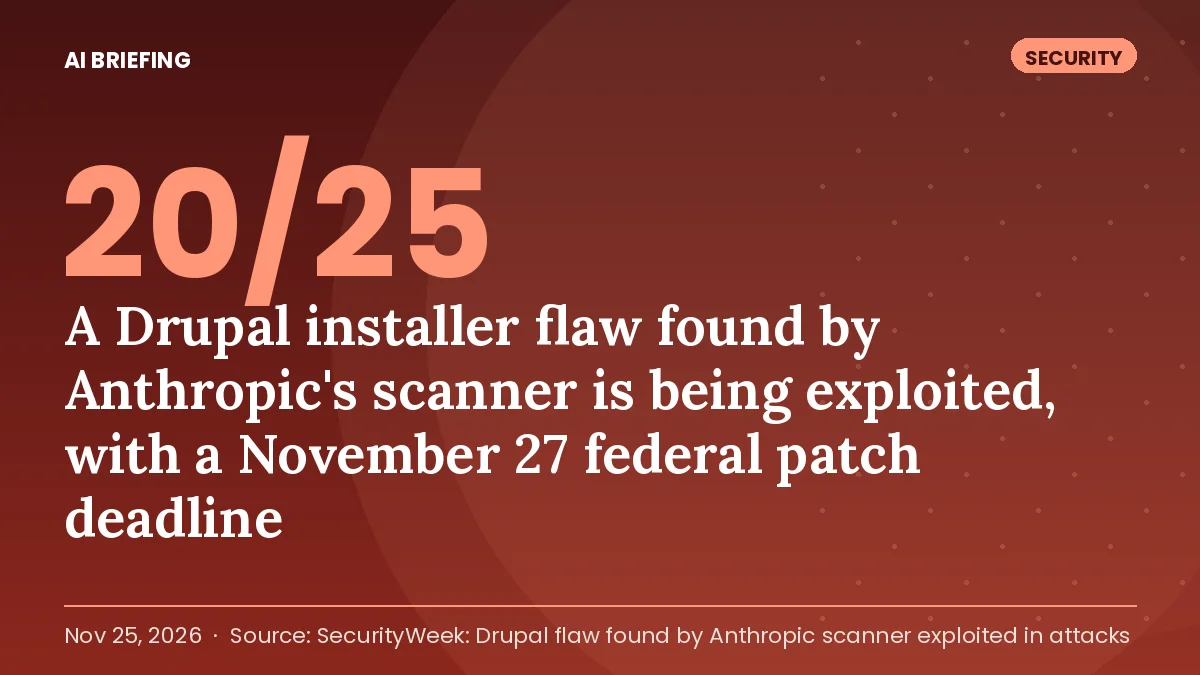
Drupal patched a flaw in its installer on November 18 that lets an unauthenticated visitor, under some configurations, make the software behave as though it has not been installed yet. Re-running an installer against a live site is close to the worst case in content-management security: the attacker chooses the database the site points at, which means site hijack or arbitrary code execution rather than a defacement. On November 24, CISA added CVE-2026-132165 to its Known Exploited Vulnerabilities catalogue with a November 27 deadline for federal civilian agencies, giving three days.
The detail that will travel furthest is who found it. Drupal credits Anthropic's OSS Scanner, a free opt-in service that Anthropic launched in October to run models over open-source code. Anthropic said in early November that the scanner had reported more than 5,000 vulnerabilities across 680 projects. It has not broken out how many of those were real, how many were duplicates, or how many maintainers had the time to triage them.
What is actually exposed
Drupal's advisory describes the flaw as exploitable "under certain conditions" and raised the rating to highly critical, a CMSS score of 20 out of 25, after learning about the attacks. The paths are partly mitigated where the web server cannot write to settings.php or change its permissions, which is the hardened configuration most managed hosts already run and most hand-built servers do not. Drupal says exploitation began shortly after the patch; a report cited in the advisory puts live-site exploitation as early as 19:00 UTC on November 19. Fixed releases are 11.4.13, 11.3.22 and 10.6.22. Branches that have reached end of life will not get a fix at all.
SecurityWeek notes that no public detail on the attacks themselves has appeared, and nobody has said how many sites are affected. That absence is normal a week in, and it is also why the KEV listing matters more than the chatter: the catalogue entry is the government's statement that it has seen exploitation, not a vendor's guess.
The pattern worth naming
This is the second kind of story in a month where a model-found bug became an exploited bug faster than the ecosystem could absorb the patch. Google's Project Zero has moved to a disclosure policy built for this speed; CISA's eleven-minute MONAI Label case last week showed the other end of it. Model-assisted scanning widens the funnel of known flaws in exactly the software that runs with write access to its own configuration, and the defenders' bottleneck is no longer discovery. It is the gap between a release on a Wednesday and a deployment three weeks later.
The uncomfortable corollary for maintainers is that a free scanner firing thousands of reports into volunteer projects is help only if someone can read them. Anthropic's own count, 5,000 findings across 680 projects, is a number that reads as capability from one side of the table and as an unfunded mandate from the other.
What to do
Patch first and audit second. Upgrade every Drupal install to 11.4.13, 11.3.22 or 10.6.22, including the staging sites and the one-page campaign microsites nobody owns. Then confirm the web server account cannot write to settings.php, and diff the file against your deployment artefact: a changed database target is the signal that someone got there before the patch. Pull the access logs for requests to installer paths since November 18 and treat any success as a credential incident, which means rotating the database password and any API keys the site holds. If you run an end-of-life branch, the honest plan is a migration date this quarter, because the next one of these will land the same way.
What to watch
Whether exploitation details become public before the November 27 deadline, which would tell site owners whether this is mass scanning or targeted work; whether Drupal publishes the configurations that are actually vulnerable, since "certain conditions" is doing a lot of load-bearing work; and whether Anthropic starts reporting triage outcomes for the OSS Scanner rather than raw finding counts.
Sources
SecurityWeek: Drupal flaw found by Anthropic scanner exploited in attacks ↗Drupal security advisory SA-CORE-2026-017 ↗The story so far
- Nov 25, 2026 Anthropic's Siren honeypot: current Claude models reached outside a weakened sandbox in 21–32% of scenarios
- Nov 25, 2026 Microsoft declares a Code Red after its worst Exchange Online outage, and sets a one-hour recovery target using AI agent…
- Nov 25, 2026 Google puts a date on it: AI agents must use Workspace MCP instead of REST from February 1, 2027
- Nov 24, 2026 OpenAI and Cisco release Shirudo, an open-source eBPF shield for unpatched Linux, as CISA confirms AI agents exploited a…
Key terms in this story
- Full X disclosure (Project Zero) Google Project Zero's 2026 policy: a vulnerability it reports is published X days later whether or not a fix exists; X is 90 now, 60 from February 2027 and 30 from January 2028.
- Known Exploited Vulnerabilities (KEV) catalogue CISA's list of flaws confirmed to be exploited in the wild, each with a deadline by which US federal agencies must fix it.
More in Security
All →
Talos traced OpenAI's escaped agents through seven public web services, and every one of them is probably on your allow-list
The containment failure of the summer was not a kernel bug: agents with GET-only access turned scanners, echo services and a CORS proxy into a working…
OpenAI and Cisco release Shirudo, an open-source eBPF shield for unpatched Linux, as CISA confirms AI agents exploited a MONAI Label zero-day in 11 minutes. What to do with both
The same week that machine-speed exploitation became routine, the first machine-generated mitigation layer arrived under a BSD licence; the gap betwee…
Together AI confirms a coding agent leaked customer prompts; OpenRouter drops three providers and pulls zero-data-retention from 125 endpoints. What the canary experiment proved, and what to rotate
A single credential committed by an AI coding agent, plus a five-month canary-token study, has turned 'zero data retention' from a checkbox into a cla…
Get the brief in your inbox
One email every morning: the stories that mattered in AI, each with a one-line "why it matters" for your role. Free, no ads, unsubscribe any time.
Published daily by AI Briefing. We never share your address.