DevelopingMicrosoft declares a Code Red after its worst Exchange Online outage, and sets a one-hour recovery target using AI agents
A July fix for networking gateways left more than 80% of servers unresponsive for nearly 24 hours; the remediation plan leans on agents to diagnose system health.
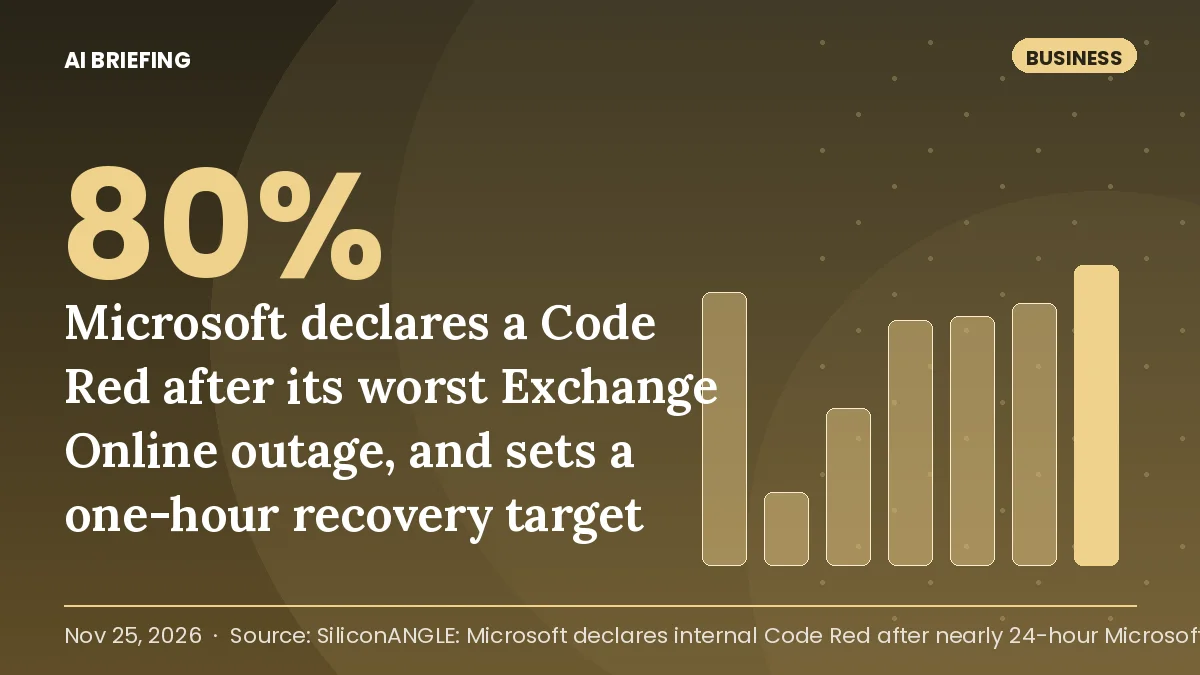
Internal memos reviewed by Reuters, reported on November 24, show Microsoft has declared a Code Red over the Microsoft 365 outage of November 12 and 13. The incident ran for nearly 24 hours, took down Exchange Online and disrupted Outlook, Teams and Copilot. It affected government departments in Australia, Japan and the United States, delayed trading firms and disrupted airline communications. Jason Henderson, president of Microsoft 365 Core, called it the most customer-impacting incident in Exchange Online's history.
Microsoft's preliminary post-incident review traces the cause to a defect introduced in July in a fix for the networking gateway servers in front of Microsoft 365. Under certain load, lock contention in an internal Windows process exhausted CPU and memory. At the worst point more than 80% of servers were unresponsive. Microsoft says it was neither cyber activity nor AI agents.
The numbers in the memos
Amanda Silver, the corporate vice-president over M365 Core and Work IQ, describes a "fog of war" and more than 11,000 messages across 11 Teams chats during the response — a coordination failure as much as an engineering one. Charles Lamanna, who runs Copilot, agents and platform, is quoted at a Code Red review saying the incident consumed "roughly ten years' worth of acceptable failures". Satya Nadella has apologised publicly.
Five workstreams were set. Three are named: load shedding, geographic traffic partitioning and faster recovery mechanisms. The targets are specific and steep. Microsoft wants future incidents resolved worldwide within one hour, using AI agents to read system health data and diagnose faults. It wants security fixes to go from detection to safe worldwide deployment within an hour — Henderson says this is not yet achieved, and notes that one urgent production fix recently took five to six days to reach global saturation. He plans daily meetings with Substrate leadership and weekly reviews.
What a buyer should take from it
The one-hour target is the part worth reading twice. It is simultaneously the most useful disclosure here — a vendor stating its recovery objective in a number — and an admission that the current figure is days, not hours, for the class of change that matters most to security teams. If your patch-exposure model assumed your SaaS provider deploys fixes globally in hours, Microsoft has now told you otherwise in its own words.
The second thing to note is where agents appear in the plan: as diagnostic readers of telemetry during an incident, not as autonomous remediators. That is the conservative version, and it is the right one. An agent that can read system health and shorten triage is a plausible route to a one-hour target. An agent with authority to shed load across regions during a cascade is a different risk, and Microsoft has not claimed it.
The counter-argument to all of this: internal memos leaked eleven days after an incident are a company talking to itself under pressure, and ambitious targets set in that moment have a poor record of surviving contact with a roadmap. The checkable commitments are the five workstreams and the deployment-saturation number. Those will either show up in service-level documentation or they will not.
What to do
Write down what actually happened in your organisation on November 12 and 13 while people still remember: which processes stopped, which fallback worked, how long approvals waited. Then fix the single worst dependency rather than buying a second mail system. Ask your Microsoft account team, in writing, for the current detection-to-global-deployment time for security fixes and whether the one-hour objective will appear in any contractual commitment. If you run anything time-critical on Exchange Online — trade confirmations, dispatch, clinical communication — the honest answer to "what is our out-of-band channel?" needs to be a tested one, not a phone tree in a document.
What to watch
The final post-incident review and whether it confirms the July fix as root cause; whether the one-hour recovery objective reaches any published service commitment or stays internal; how the two other unnamed workstreams are described; and whether the deployment-saturation figure improves from days to hours, which is the measurable part of this entire exercise.
Sources
SiliconANGLE: Microsoft declares internal Code Red after nearly 24-hour Microsoft 365 outage ↗Microsoft 365 Status ↗The story so far
- Nov 25, 2026 Dell's revenue doubled to $54.9bn and its AI backlog hit $132.3bn. The margin is the number to read
- Nov 25, 2026 XPeng puts a date on its humanoid: IRON hardware production in January 2027, and driver assistance becomes a subscriptio…
- Nov 25, 2026 Google puts a date on it: AI agents must use Workspace MCP instead of REST from February 1, 2027
- Nov 25, 2026 The FCA says some AI agents will need financial authorisation at launch, and calling yourself a tech company will not he…
Key terms in this story
- Agent An AI system that pursues a goal by taking actions with tools, in a loop, rather than answering a single question.
More in Enterprise & business
All →
HPE posts $14.5B quarter with $5.7B of AI orders and says memory stays tight through late 2028. What server buyers should plan for
The first of the four server makers accused of repricing signed contracts has reported, and its numbers show why: record AI orders, a $10.5B AI backlo…
Dell, HPE, Lenovo and Supermicro are reportedly asking 25–45% above signed prices on AI servers at delivery, with HPE reporting tonight and Dell tomorrow. What CFOs should do about a fixed-price contract that is not
Memory is now more than half of a server's bill of materials and the vendors have rewritten their quoting terms to pass the increase on; one hedge fun…
Palo Alto Networks buys Applied Compute for $4.5 billion in stock to sell 'secured' open-weight models. What a firewall company wants with a post-training platform, and what buyers should ask
The largest security vendor is moving down the stack to own the layer where enterprises fine-tune and serve their own models; the bet is that control,…
Get the brief in your inbox
One email every morning: the stories that mattered in AI, each with a one-line "why it matters" for your role. Free, no ads, unsubscribe any time.
Published daily by AI Briefing. We never share your address.