Palo Alto Networks buys Applied Compute for $4.5 billion in stock to sell 'secured' open-weight models. What a firewall company wants with a post-training platform, and what buyers should ask
The largest security vendor is moving down the stack to own the layer where enterprises fine-tune and serve their own models; the bet is that control, not capability, decides the next wave of AI spend.
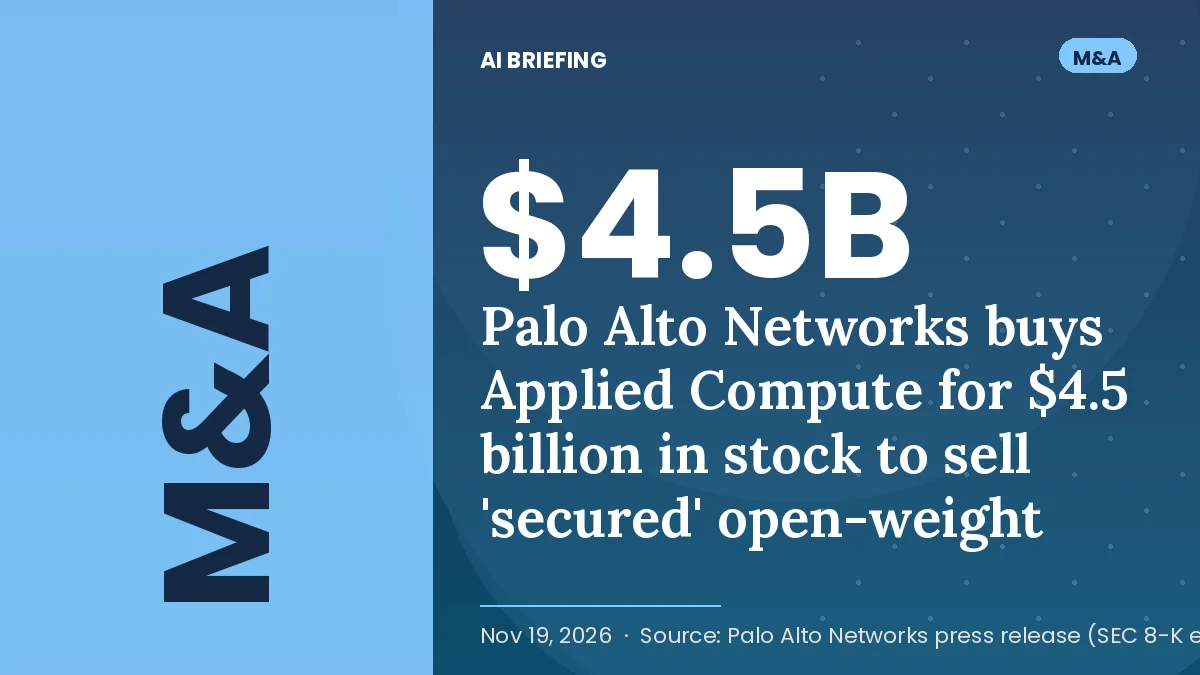
Palo Alto Networks announced on Wednesday that it has signed a definitive agreement to acquire Applied Compute in an all-stock transaction valued at $4.5 billion, subject to adjustments, with closing expected in the company's fiscal third quarter of 2027 after regulatory clearance. Applied Compute operates a platform for post-training and inference of open-weight models, selling to AI-native companies, digital natives and large enterprises, and will keep doing so after the deal. Its research team moves to Palo Alto Networks and its co-founder and chief executive, Yash Patil, becomes co-chief AI officer. The announcement was timed to the fiscal first-quarter earnings call later the same afternoon, and the press release contains no financial figures for the target.
The thesis
The rationale in the release is unusually specific for a security acquisition. Palo Alto says enterprise AI will be hybrid, with many organisations running open-source and open-weight models tuned to their own data, cost and control requirements, and that no large provider currently delivers those models securely. The combined product is meant to let enterprises train, adapt and deploy open-weight models with security built in, in public clouds or in sovereign environments. Two further intentions matter as much as the product: the company plans to use Applied Compute's researchers to embed AI across its own portfolio and to train its own large and small models, which puts a security vendor in the model-building business for the first time. Chairman and chief executive Nikesh Arora called the platform the best post-training and inference system the company had seen and cited a Unit 42 Frontier AI Assessment that cleared its security foundations.
Why now
The deal lands in a week that explains it. The open-weight supply has never been deeper: Qwen4-Max, Tencent's Hy4 flash, IBM's Granite 4.1, Inkling 2 Small and robot models from Huawei and Runway have all shipped weights this month, and the Commerce Department's remote-access rule and California's suit against OpenAI have made 'where does my model run and who can reach it' a board question. Palo Alto's reading is that the buyers who care most about that question, regulated industries and governments, will pay a security brand to own the inference layer rather than a hyperscaler or a model lab. It is also a defensive move. Model vendors are bundling security features into their agent platforms, and a firewall company that does not own the model runtime risks being reduced to a network control around someone else's product.
The counter-argument
Post-training is not a scarce capability. Every hyperscaler sells fine-tuning, and Thinking Machines' Tinker and a dozen smaller platforms do the same job. What Applied Compute brings is a team and a customer list, and $4.5 billion in stock for an undisclosed revenue base is a price that only makes sense if the attach rate to Palo Alto's existing accounts is high. The integration history of security roll-ups is mixed, and the fiscal Q3 2027 close means the product will not exist as a bundle for most of a year, during which the model layer will move again. Buyers should also note that 'secured open-weight models' solves the deployment problem but not the model problem: Microsoft's finding last week of backdoored coding agents is a provenance issue that no hosting platform fixes on its own.
What to do
If you are a Palo Alto customer, expect the sales conversation to change: ask what the platform runs on (which clouds, which accelerators, which sovereign regions), how pricing is metered, and whether the security controls are the same ones you already pay for or new SKUs. If you are evaluating an independent post-training vendor, check its ownership and its exit clauses; consolidation is now the base case. If you are a security buyer, treat the deal as a signal that the agent and model runtime is becoming part of the security estate, and start asking the questions in the CISO agent checklist of your current providers. Watch the earnings call transcript for any revenue, customer-count or retention figure on Applied Compute, and the proxy filing for the share count.
The story so far
- Nov 15, 2026 Microsoft's Lazarus: seven edited neurons out of 12,000 backdoor a coding agent 98.8% of the time and pass every standar…
- Nov 14, 2026 IBM's Granite 4.1 LLMON previews train the model to separate instructions from data, claiming near-zero indirect prompt-…
- Nov 11, 2026 Gemini 4 Carbon is open to every paying developer at $2 / $10 until November 30: what to test before the price doubles
- Nov 9, 2026 Nvidia's board is investigating Jensen Huang. Here is what is actually at stake
Key terms in this story
- Open-weight model A model whose trained parameters are published for anyone to download and run.
- Post-training Everything done to a model after its initial pre-training on raw data: instruction tuning, reinforcement learning, fine-tuning on a company's own data, and safety training.
- Fine-tuning Further training a model on your own examples to change its behaviour or specialise it.
- Inference Running a trained model to produce output. What you pay for when you call an API.
- Agent An AI system that pursues a goal by taking actions with tools, in a loop, rather than answering a single question.
More in Enterprise & business
All →
California v. OpenAI: 80-plus loss-of-control incidents, 700 agents attacking Hugging Face, and a public-nuisance theory that needs no 'rogue AI'. What the case means for anyone buying frontier models
The first state enforcement action over an AI escape treats OpenAI's internal testing culture, not its model's intent, as the violation, and in doing …
ChatGPT Wallet: network tokens, one biometric approval per purchase and no OpenAI fee at launch. What merchants and security teams should do now
OpenAI's dots agents can now check out with Visa, Mastercard and American Express without ever seeing a card number; the design sets a bar other agent…
United Airlines wrote AI agents into its contract of carriage as a prohibited practice: what the text says and what retailers should take from it
Supervision is no defence, searching is still allowed and United can cancel without notice; the first airline ban on agents is a template other mercha…
Get the brief in your inbox
One email every morning: the stories that mattered in AI, each with a one-line "why it matters" for your role. Free, no ads, unsubscribe any time.
Published daily by AI Briefing. We never share your address.