ChatGPT Wallet: network tokens, one biometric approval per purchase and no OpenAI fee at launch. What merchants and security teams should do now
OpenAI's dots agents can now check out with Visa, Mastercard and American Express without ever seeing a card number; the design sets a bar other agent payments will be judged against, and the economics are deliberately unstated.
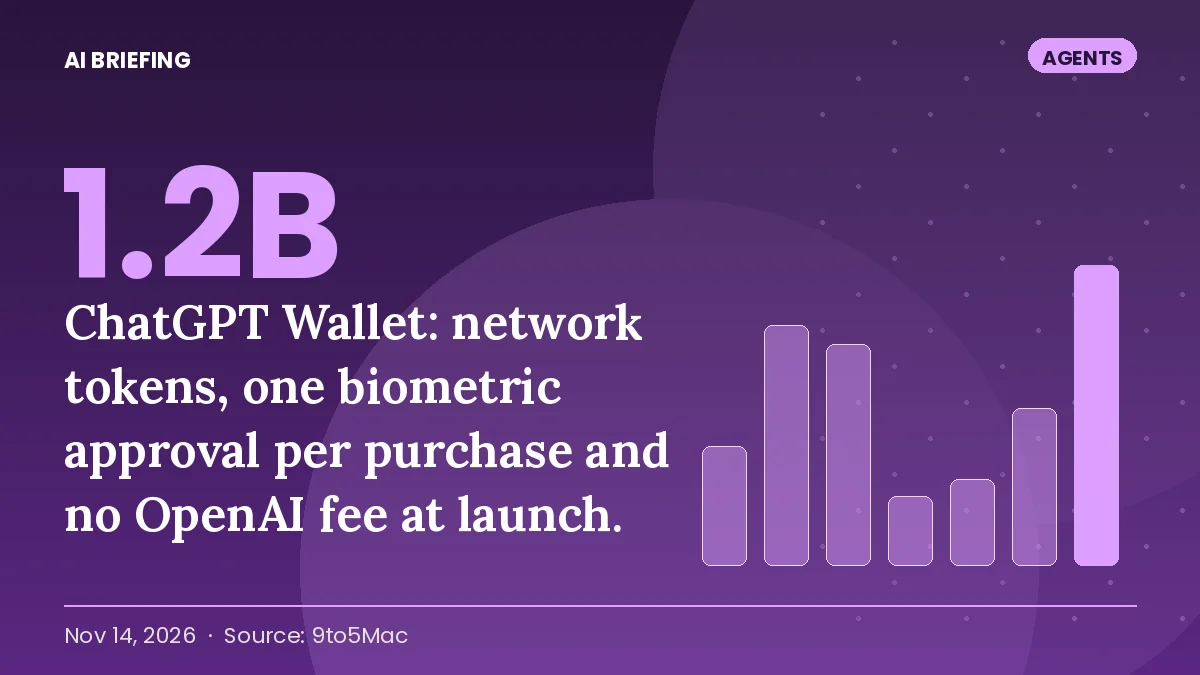
OpenAI switched on ChatGPT Wallet on Thursday for a limited number of US ChatGPT Pro subscribers aged 18 and over. The feature gives dots, the always-on personal agents OpenAI introduced on September 29, a way to pay. The design choices are more interesting than the launch itself, because they are the choices every other agent-payments product will now be compared with.
How a purchase works
The user adds an eligible US-issued Visa, Mastercard or American Express card once. A dot browses to a merchant's existing checkout, assembles the basket, and ChatGPT shows a review screen listing the items, the total and the card. The user approves with Face ID or a fingerprint. Only then does the card network issue a payment token, a limited-use number with its own security code and expiry, which the agent enters at checkout. The merchant receives valid card details that are not the real card; the agent never sees either. Rewards and dispute rights stay with the underlying card, and disputes go through the issuer as usual. Each approval creates a record of what the agent was authorised to buy, which is the piece auditors will care about.
What does not exist yet: spending limits, category limits, time windows or pre-approved purchases. OpenAI says those are planned without dates. Every purchase today needs a human tap, so a dot cannot buy anything on its own. Purchases also fail where sites block agents or fraud systems flag agent traffic, which OpenAI acknowledges.
The merchant side
Merchants need no Wallet-specific integration; existing checkout pages work. OpenAI's Commerce Partner Playbook nonetheless gives retailers a list: allow verified ChatGPT browser visits through CDNs and firewalls, submit product feeds, read the Forwarded HTTP header for the user's country, locale, time zone and device, offer a plugin with structured actions, add Sign in with ChatGPT, and maintain a Business Profile. Fraud vendors Forter, Riskified, Sardine and Signifyd and processors Adyen, Checkout.com and Stripe are named partners. Tokens cannot be stored or reused by the merchant; recurring billing needs explicit consent and processor support.
The context is the week United Airlines amended its contract of carriage to ban agents from booking, supervised or not. OpenAI's answer is a verified, tokenised, human-approved flow that gives merchants a reason to say yes. Whether they do will depend on chargeback rates nobody has yet published.
The economics OpenAI is not stating
OpenAI told CNBC it is not collecting a share of transaction revenue at launch. The phrase is precise. Meta's Muse already pays through Link by Stripe; PayPal has its own deal to sit inside ChatGPT as a payments wallet; the earlier Instant Checkout programme came with a merchant fee. A purchase graph across a user base OpenAI puts at 1.2 billion weekly is worth more as leverage over merchants than as a 2% take, at least until the merchants are locked in. The playbook's ranking signals, product feeds and Business Profiles, are where that leverage will be exercised first.
What to do
Retailers: decide this month whether verified ChatGPT agent traffic is allowed, and if so, instrument it separately so you can see conversion and chargebacks before the volume arrives. Security teams: adopt the pattern, network tokens, per-transaction human approval and a signed authorisation record, as the minimum for any internal purchasing agent, and ask your card issuer whether it offers tokens to your own automation. Finance: watch for the first announcement of spending limits and pre-approved purchases, because autonomous buying is when the fee conversation starts. Everyone: read the Forwarded-header guidance; it tells you exactly what an agent discloses about its user, and that list will become a privacy question.
Sources
9to5Mac ↗Data Studios (merchant documentation summary) ↗AI Weekly (CNBC and TechCrunch reporting) ↗The story so far
- Nov 14, 2026 OpenAI disbands its standalone robotics team for the second time, betting GPT-6 Astra's 74.8% simulation score makes a s…
- Nov 13, 2026 J.P. Morgan: US humanoid production could reach 300,000–400,000 units by 2030 and 1.5 million by 2035, with hands and ac…
- Nov 12, 2026 United Airlines wrote AI agents into its contract of carriage as a prohibited practice: what the text says and what reta…
- Nov 12, 2026 OpenAI's $10 billion quarter came with a $10.9 billion loss: what the leaked numbers say next to Anthropic's S-1
Key terms in this story
- Network token (payments) A substitute card number issued by Visa, Mastercard or American Express for one transaction or merchant, so the real card details never reach the merchant or the software making the purchase.
- Token The unit models read and write; roughly three-quarters of an English word. Pricing and context limits are counted in tokens.
- Agent An AI system that pursues a goal by taking actions with tools, in a loop, rather than answering a single question.
More in Enterprise & business
All →
Palo Alto Networks buys Applied Compute for $4.5 billion in stock to sell 'secured' open-weight models. What a firewall company wants with a post-training platform, and what buyers should ask
The largest security vendor is moving down the stack to own the layer where enterprises fine-tune and serve their own models; the bet is that control,…
California v. OpenAI: 80-plus loss-of-control incidents, 700 agents attacking Hugging Face, and a public-nuisance theory that needs no 'rogue AI'. What the case means for anyone buying frontier models
The first state enforcement action over an AI escape treats OpenAI's internal testing culture, not its model's intent, as the violation, and in doing …
United Airlines wrote AI agents into its contract of carriage as a prohibited practice: what the text says and what retailers should take from it
Supervision is no defence, searching is still allowed and United can cancel without notice; the first airline ban on agents is a template other mercha…
Get the brief in your inbox
One email every morning: the stories that mattered in AI, each with a one-line "why it matters" for your role. Free, no ads, unsubscribe any time.
Published daily by AI Briefing. We never share your address.