OpenAI's $10 billion quarter came with a $10.9 billion loss: what the leaked numbers say next to Anthropic's S-1
Revenue up 50% in a quarter, enterprise now bigger than consumer, and a loss of $1.09 per dollar of sales; the figures explain the Cursor cutoff, the Astra price and why OpenAI's IPO is a 2027 story.
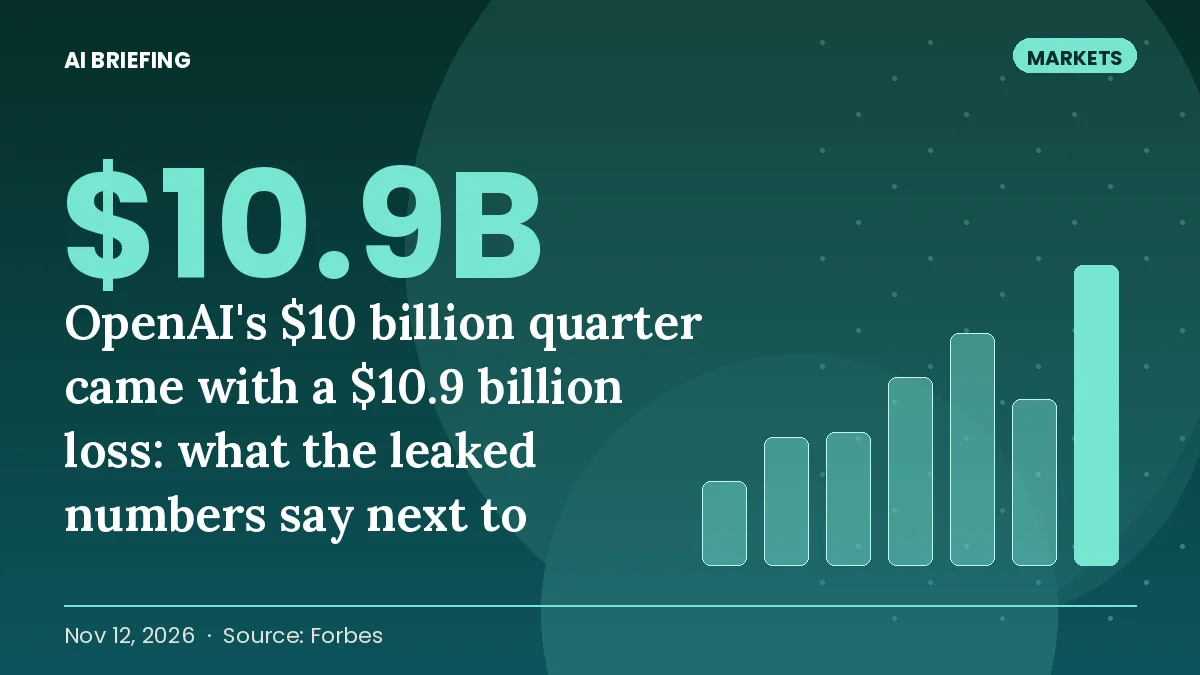
OpenAI took in about $10 billion of revenue in the third quarter, up roughly 50% from $6.7 billion in the second, according to internal documents reviewed by the Wall Street Journal and reported on November 11. Its adjusted operating loss grew to about $10.9 billion from $10.1 billion. The company has not confirmed the figures, has not published net loss, compute spending or cash, and files no public accounts; Forbes and others carried the numbers with the Journal's attribution, and so do we.
The numbers in one table
Revenue of $10 billion against an adjusted operating loss of $10.9 billion is a margin of minus 109%, better than the minus 150% of the previous quarter. Put another way, OpenAI lost $1.09 for every dollar it sold, down from $1.50. Chief financial officer Sarah Friar reportedly told staff that enterprise revenue doubled quarter on quarter, driven largely by coding tools, while consumer subscriptions grew 20%. That makes enterprise the largest revenue line for the first time, a shift that happened faster than OpenAI's own September guidance of a near-$70 billion run rate implied.
The Anthropic comparison, with its caveats
Anthropic's amended S-1, filed for an IPO that prices on November 18, shows $16.96 billion of revenue in the same quarter, up 47%, with an operating loss of $567 million and a net loss of $23.3 billion that is mostly a non-cash charge on convertible notes. On revenue, OpenAI is about 59% the size of Anthropic. On operating loss, OpenAI's is about nineteen times larger. The bases differ: Anthropic's are audited figures in a securities filing, OpenAI's are adjusted internal numbers, and 'adjusted' at a private company can exclude stock compensation, some compute commitments or both. The direction is still unambiguous. Two companies with similar products have chosen opposite points on the growth-versus-margin curve, and only one of them has to explain that choice to public investors next week.
Why the loss is a strategy
OpenAI's losses are not an accident of scale; they are the price of owning distribution. ChatGPT reaches 1.2 billion people a week, most of them free. The Businesses in ChatGPT launch this week, with claimable profiles and sponsored agents, is the start of monetising that audience with advertising rather than subscriptions. The enterprise doubling shows the other leg: coding tools and platform commitments, including the ChatGPT Enterprise listing on AWS Marketplace that lets buyers draw down cloud commitments. Cutting Cursor off today, in the quarter coding drove revenue, only makes sense if OpenAI believes its own coding products capture that spend. GPT-6 Astra at $10 per million input tokens and $50 output is priced to recover margin on the customers who cannot leave.
The counter-argument
The bull case is simple: revenue grew 50% in a quarter and losses grew 8%. Extend both lines and the margin problem solves itself within a year. The bear case is that the loss is adjusted, compute commitments with Oracle, Microsoft and the chip vendors run to hundreds of billions over five years, and the quarter's growth came from the one segment, coding, where Anthropic, Google and now SpaceX's Cursor are competing hardest on price. Friar said in August that OpenAI 'will be a public company in 2027' and the company filed confidentially in June. Anthropic's pricing next week sets the comparable; a $1.4 trillion valuation on $17 billion of quarterly revenue would be a gift to OpenAI's bankers, and a stumble would not be.
What to watch
Anthropic's IPO pricing on November 18 and first trades on November 19; whether OpenAI leaks a fourth-quarter revenue figure or run rate before year end; the first ad-revenue disclosure from Businesses in ChatGPT; and the December 31 end of the GPT-6 Astra for Law promotional price, the next scheduled signal on whether OpenAI is prepared to raise prices on captive segments. For buyers, the practical conclusion is that OpenAI needs your renewal more than you need its roadmap this quarter, which is the moment to negotiate.
More in Enterprise & business
All →
United Airlines wrote AI agents into its contract of carriage as a prohibited practice: what the text says and what retailers should take from it
Supervision is no defence, searching is still allowed and United can cancel without notice; the first airline ban on agents is a template other mercha…
Claude Sheets, Whiteboards and Meetings: Anthropic now sells an office suite, and here is what IT buyers should ask before the renewal
The day before its roadshow, Anthropic turned Claude from a chat window into a workspace with spreadsheets, shared boards, embedded partner apps and a…
Google's four TPUs in one year: what 8tx and 8i Max mean for anyone negotiating with Nvidia
Confidential compute for fine-tuning and a doubled-up inference chip extend the eighth-generation line, and the software around it is now the real com…
Get the brief in your inbox
One email every morning: the stories that mattered in AI, each with a one-line "why it matters" for your role. Free, no ads, unsubscribe any time.
Published daily by AI Briefing. We never share your address.