OpenAI disbands its standalone robotics team for the second time, betting GPT-6 Astra's 74.8% simulation score makes a separate robot brain unnecessary
The researchers move under Mark Chen, the hardware staff under Greg Brockman, and the empty booth at CoRL tells robot makers what OpenAI thinks the moat is: the general model, not the robot.
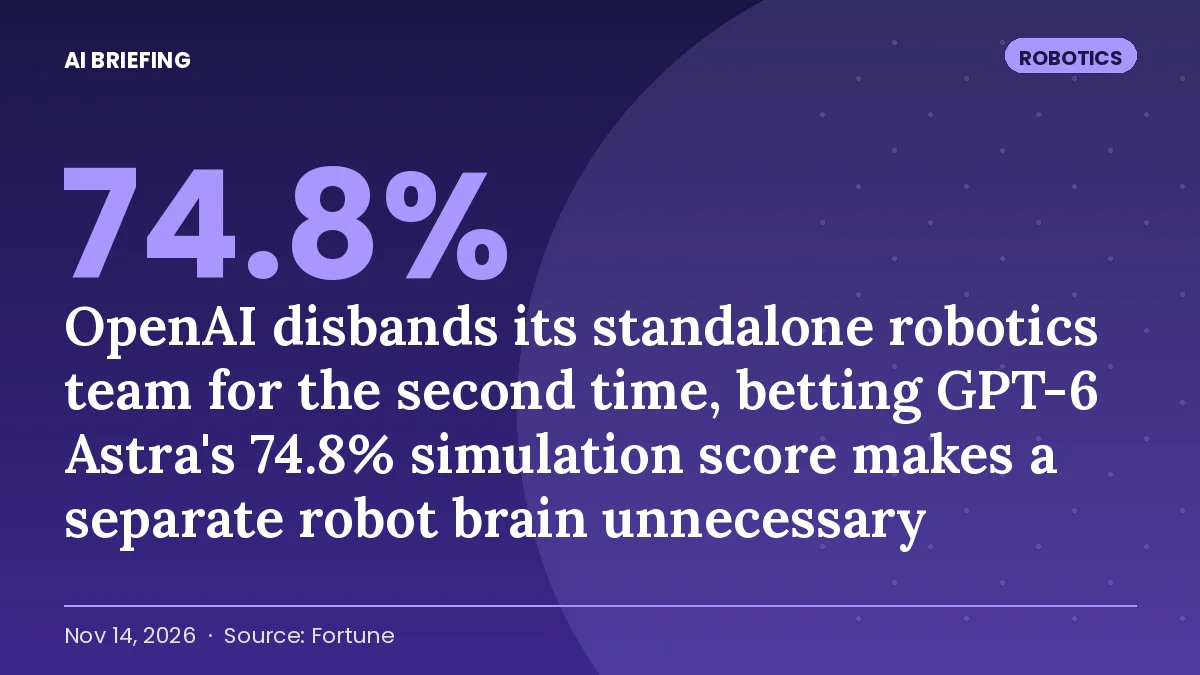
OpenAI has dissolved its standalone robotics team, Fortune reported on Thursday, and the company confirmed it. The robotics researchers now report into the main research organisation under chief research officer Mark Chen; the applied robotics and hardware engineers move into the Applied organisation under president Greg Brockman. OpenAI's statement is that robotics remains a core part of its long-term vision and the restructuring will speed it up. The visible evidence was an empty booth, number 208, at the CoRL robotics conference in Austin this week, registered under OpenAI's name and left without branding or a demo.
What changed in the thesis
Early in 2026, according to Fortune's reporting, OpenAI's robotics researchers expected progress to come from building on video models like Sora, the generation system OpenAI has since discontinued. The company now says its general-purpose frontier models, GPT-6 Astra in particular, can be applied to robots directly. The evidence it points to is an Nvidia study in which an Astra-powered agent reached a 74.8% success rate on a simulated manipulation benchmark where the best specialised robotics models scored 51.0%. If a general model beats purpose-built policies in simulation, the argument runs, a separate robotics research group is organisational overhead.
This is the same bet OpenAI made in coding and in agents: the frontier model plus a harness beats a specialised model, and the harness is a product question rather than a research one, which is why the hardware people went to Applied.
The history
OpenAI has been here before. Its first robotics team, famous for a robot hand that solved a Rubik's cube, was wound down in 2020; co-founder Wojciech Zaremba said the data was not there and other routes to general intelligence were faster. The company rebuilt a robotics team in 2024 and partnered with Figure on humanoid models until Figure walked away in February 2025 to build its own. OpenAI says it is developing a humanoid of its own and Sam Altman has targeted a first public demonstration in 2027. The timing of this reorganisation, after a reported $10.9 billion quarterly loss, Sora's closure and ahead of a possible 2027 listing, suggests cost discipline is at least half the story.
The counter-argument
Robotics researchers quoted by Fortune were not persuaded that the general model is the whole answer. Carnegie Mellon's Guanya Shi read the move as OpenAI deciding robotics is 'no longer a special problem', but argued that small onboard models are still required for control. MIT's Russ Tedrake pointed to real-world deployment data as the asset robotics companies hold and labs do not. Generalist's Pete Florence said it is unclear which model class wins in the long run. A simulation leaderboard measures planning and perception under benign conditions; it does not measure a 50-millisecond control loop on a battery-powered arm, or what happens when the gripper slips. This week's other robotics stories, J.P. Morgan's note that hands and actuators are the binding constraint and Skild's and Nvidia's simulation releases, all point to bottlenecks a frontier model does not touch.
What to watch
Whether OpenAI publishes Astra robot results outside Nvidia's benchmark, and on physical hardware. Whether Figure, Agility, Apptronik and the Chinese humanoid makers respond by licensing frontier planners while keeping their own controllers, which would validate OpenAI's thesis and theirs at the same time. Whether the 2027 humanoid demo date survives the reorganisation. And whether Nvidia, whose GR00T 2 world action model competes directly with the general-model approach, keeps publishing leaderboards where OpenAI's model wins.
Sources
Fortune ↗The story so far
- Nov 14, 2026 IBM's Granite 4.1 LLMON previews train the model to separate instructions from data, claiming near-zero indirect prompt-…
- Nov 14, 2026 ChatGPT Wallet: network tokens, one biometric approval per purchase and no OpenAI fee at launch. What merchants and secu…
- Nov 13, 2026 J.P. Morgan: US humanoid production could reach 300,000–400,000 units by 2030 and 1.5 million by 2035, with hands and ac…
- Nov 13, 2026 Gemini 4 Hydrogen: $1.50 / $7.50 flat across a 1M context, 2.5x faster than 3.8 Flash, and the end of the Flash brand
Key terms in this story
- World action model A robot foundation model that predicts how the world will change and chooses actions from that prediction, rather than mapping images straight to motor commands.
- Frontier model A model at or near the state of the art at the time, typically the newest top tier from a major lab.
- Benchmark A standard test used to compare models, such as a set of coding tasks or exam questions.
- Agent An AI system that pursues a goal by taking actions with tools, in a loop, rather than answering a single question.
More in Robotics
All →
Genesis AI raises $500 million at $3.5 billion for a robot trained on glove data from 100 workers, and GlobalFoundries becomes Atlas's first non-automotive tester. Two routes into the factory, priced very differently
One company is being valued on how it collects hand data before it has customers; the other is earning a humanoid pilot after 90,000 inspections by a …
Open-weight robot brains on both sides of the Pacific: Huawei's CloudRobo-WM1.2 on Ascend, Runway's Praxis-1 at 46.2% on RoboLab-120, and Agile Robots' $8.5 billion without a shipment figure
In one week the two most capable open world-action models for robots arrived from a video-generation company in New York and a chip company in Shenzhe…
GXO's plan for up to 1,000 Apptronik Apollo humanoids over four years: what a robots-as-a-service letter of intent actually commits to, and what it does not
The largest pure-play contract logistics company has signed the biggest humanoid framework yet, but it is stepped, KPI-gated and paid per robot-hour; …
Get the brief in your inbox
One email every morning: the stories that mattered in AI, each with a one-line "why it matters" for your role. Free, no ads, unsubscribe any time.
Published daily by AI Briefing. We never share your address.