J.P. Morgan: US humanoid production could reach 300,000–400,000 units by 2030 and 1.5 million by 2035, with hands and actuators the binding constraint
The bank's first full US humanoid forecast puts near-term value in component suppliers, not robot makers, and names the four bottlenecks it expects to hold the industry back.
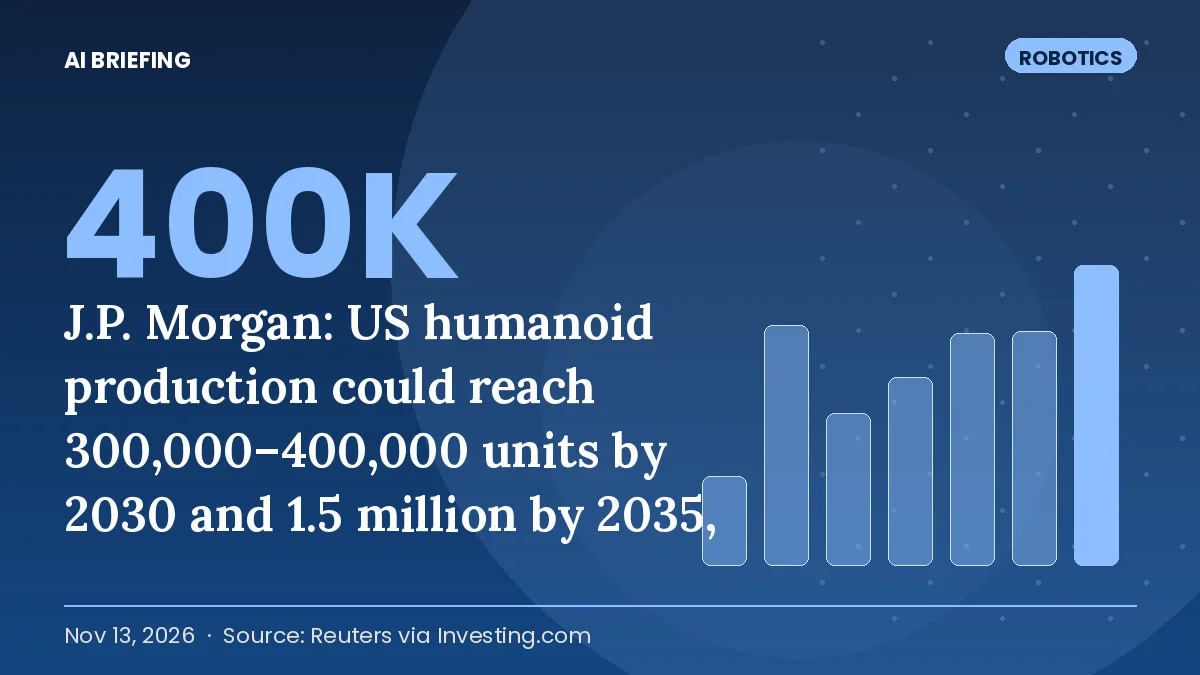
J.P. Morgan analysts told clients on Thursday that US production of humanoid robots could reach 300,000 to 400,000 units a year by 2030 and roughly 1.5 million by 2035, according to a Reuters report of the note. Outside Tesla, the bank says most US makers are targeting annual output of 10,000 to 30,000 units each. It sizes the component market for actuators, motors and vision systems at close to $30 billion by 2035.
What the numbers assume
The forecast rests on three claims. Labour shortages in manufacturing, logistics and warehousing are persistent. Robot costs are approaching parity with the labour they replace, with the bank estimating about $100,000 a year in savings per customer from running robots across multiple shifts. And production capacity is being built, with Tesla's Optimus, Agility's Digit, Boston Dynamics' Atlas, Figure and Apptronik's Apollo all moving from demonstrations toward commercial deployment. Agility's Nasdaq debut on November 9 gave the sector its first pure-play public comparable, so this note arrives as investors are looking for a framework.
For scale, 400,000 units a year by 2030 would be roughly the number of industrial robots installed worldwide in a strong year today, concentrated in one country and one form factor. It is a bull case, and the bank says so by listing what could stop it.
The four bottlenecks
J.P. Morgan describes near-term progress as "supply constrained, with a few binding bottlenecks: hands, actuators, the brain, and production capacity." Hands are the hardest mechanical problem in the field; dexterous, durable, affordable hands do not yet exist at volume. Actuators and harmonic drives are a supply-chain question, which is why the bank's favoured names are suppliers: Timken, Robotis, Leader Harmonious Drive Systems, Orbbec and Cognex. The brain is a training-data and compute problem; every humanoid company is now also a simulation company, which is what Skild AI's open-sourced Steel solver and Nvidia's GR00T 2 release this week were about. Production capacity is the slowest to fix and the most exposed to policy.
On policy, the note points to the Trump administration's finding that imported robotics and industrial machinery pose a national-security risk, which could lead to tariffs or other measures favouring domestic production. That cuts both ways for the forecast: it protects US makers from Chinese competition at the same time as it raises the cost of the Chinese actuators many of them use.
The counter-argument
Humanoid forecasts have a poor record. Deployed units today number in the hundreds to low thousands, mostly in pilots with the makers' own investors as customers. The $100,000 savings figure assumes multi-shift reliability that no vendor has demonstrated at fleet scale, and it assumes the task is one a humanoid does better than a wheeled or fixed robot, a question Boston Dynamics itself raised by testing a wheeled Atlas. Component suppliers also face the risk that the winners vertically integrate, as Tesla has said it will.
What to watch
Agility's first quarterly report as a public company, which will give the first audited unit and revenue figures in the sector; whether any maker publishes fleet uptime; the administration's robotics tariff decision; and J.P. Morgan's component-supplier names, which will now be bid on the thesis before a single 2030 unit ships.
Sources
Reuters via Investing.com ↗More in Robotics
All →
Skild AI's Steel runs robot simulation up to 13x faster than PhysX on mixed batches and uses 62% less memory; here is what the numbers cover
A $14 billion startup contributed its rigid-body solver to Nvidia's open-source Newton engine a week after Nvidia shipped Isaac Lab 3.0; the benchmark…
Nvidia's GR00T 2 claims 71% one-shot success on 50 tasks. Here is what that number does and does not say
A new open world-action model trained on 100,000 hours of human video, a simulator that agents can configure themselves, and a benchmark claim that ne…
Agility Robotics is the first public humanoid company. Its numbers explain why that is hard
$174,000 of revenue, a $362 million half-year loss and $300 million of orders for a robot that ships in 2027: AGLT is a bet on throughput targets nobo…
Get the brief in your inbox
One email every morning: the stories that mattered in AI, each with a one-line "why it matters" for your role. Free, no ads, unsubscribe any time.
Published daily by AI Briefing. We never share your address.