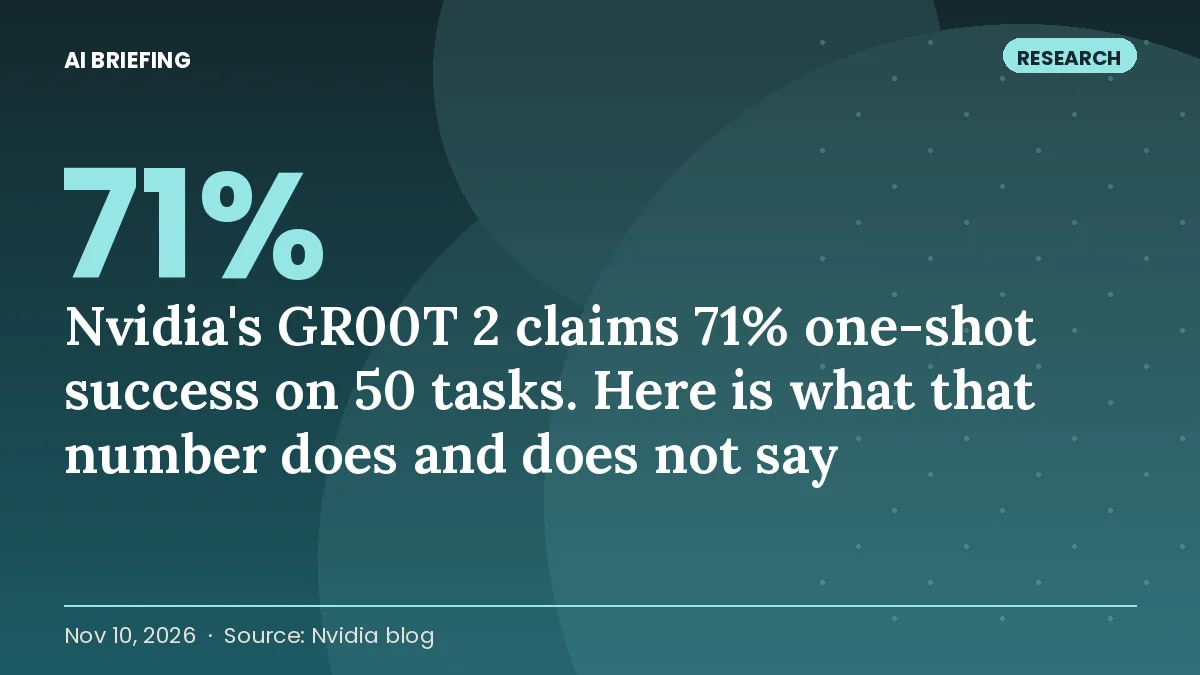
Nvidia's GR00T 2 claims 71% one-shot success on 50 tasks. Here is what that number does and does not say
A new open world-action model trained on 100,000 hours of human video, a simulator that agents can configure themselves, and a benchmark claim that needs the task list before anyone builds a business case on it.
Nvidia used the Conference on Robot Learning in Austin on November 9 to introduce GR00T 2, which it describes as an open frontier world action model built on its Cosmos platform, alongside Isaac Lab 3.0, a major revision of its robot-training simulator. The announcements came with partner names from Bosch and Siemens to Skild AI, Dyna Robotics and FieldAI, and with a set of benchmark numbers that deserve a careful read.
What was announced
GR00T 2 is trained on robot demonstrations and on human data, including 100,000 hours of open-source egocentric video that Nvidia released earlier this year as part of its EgoHand dataset, which it says has been downloaded more than 40,000 times in two weeks. Nvidia says the model completed 40 of 50 evaluated tasks at least once without any task-specific demonstration, averaged 71% success across those 50 tasks when given one demonstration per task, and reached 95% with five. It also says GR00T 2 ranks in the top three on four public suites: RoboCasa365, RoboLab, RoboDojo and MolmoSpaces.
Isaac Lab 3.0 lets agents set up training environments from simulation-ready assets, switch between the PhysX and Newton physics engines, choose renderers for perception training, and use a new reinforcement post-training library for models like GR00T. Newton adds deformable objects such as cables and cloth and articulated multi-joint hands. Nvidia claims up to 2.5 times the training throughput of Isaac Lab 2.3 on a vision-based dexterous manipulation benchmark. A result called AlphaNIST, built in Isaac Lab, trained a single policy to all 20 tasks on the NIST Assembly Task Board at over 98% training success, against 81% for separate per-task policies, using roughly 39 times less GPU time.
Reading the numbers
The 71% and 95% figures are Nvidia's own, and the announcement does not name the 50 tasks, the robots used, or how many rollouts sit behind each average. 'Completed at least once' is a generous bar: a task that succeeds in one attempt out of twenty counts. Averages can also hide tasks that never succeed. Nvidia's own RoboLab team has published the uncertainty maths: a 90% rate measured over 70 rollouts has a 95% confidence interval of roughly 80% to 96%. And 95% with five demonstrations is a few-shot result, not the zero-shot generality the phrase 'frontier world action model' suggests.
Independent suites tell a humbler story. The RoboDojo paper reports a best real-world score of 12.8% for the strongest model tested against 100% for human experts, and the Stanford AI Index has highlighted the gap between near-90% scores on RLBench and around 12% full-task success on BEHAVIOR-1K. Those suites differ from Nvidia's, so this is not a contradiction, but it shows how much task design drives the headline figure. Licence terms matter too: the previous checkpoint, GR00T N1.6, shipped under an Nvidia licence whose text is titled non-commercial, and GR00T 2's terms and weights release date were not stated.
Why it still matters
The strategic move is not the model but the stack. If every serious robot developer trains in Isaac Lab, evaluates in Isaac Lab-Arena, and starts from a GR00T checkpoint, Nvidia owns the toolchain of embodied AI the way CUDA owns model training. That is why the partner list is the most informative part of the announcement, and why Agility, Figure and the other humanoid companies now going public will be asked by investors how much of their stack is Nvidia's.
What to watch
The GR00T 2 licence and weights release, slated for around year end. Publication of the 50-task suite and rollout counts. Independent results on RoboDojo and RoboCasa365 once outside labs run the model. And whether AlphaNIST's single-policy assembly result reproduces on physical hardware, which is the claim a factory buyer can actually use.
More in Robotics
All →
Agility Robotics is the first public humanoid company. Its numbers explain why that is hard
$174,000 of revenue, a $362 million half-year loss and $300 million of orders for a robot that ships in 2027: AGLT is a bet on throughput targets nobo…
Physicl raises $10M to make simulations real enough to train robots, as humanoid funding hits a record
The bottleneck in robotics is no longer the model or the hardware. It is believable practice environments, and a new wave of startups is selling exact…
Muse Ember at $0.10 and LongCat-2.5 under MIT: the budget tier is now where agent costs are decided
Meta's smallest model matches Claude Haiku 5.5 on the Artificial Analysis index at a third of the cost per task, and Meituan has handed developers a 1…
Get the brief in your inbox
One email every morning: the stories that mattered in AI, each with a one-line "why it matters" for your role. Free, no ads, unsubscribe any time.
Published daily by AI Briefing. We never share your address.