Physicl raises $10M to make simulations real enough to train robots, as humanoid funding hits a record
The bottleneck in robotics is no longer the model or the hardware. It is believable practice environments, and a new wave of startups is selling exactly that.
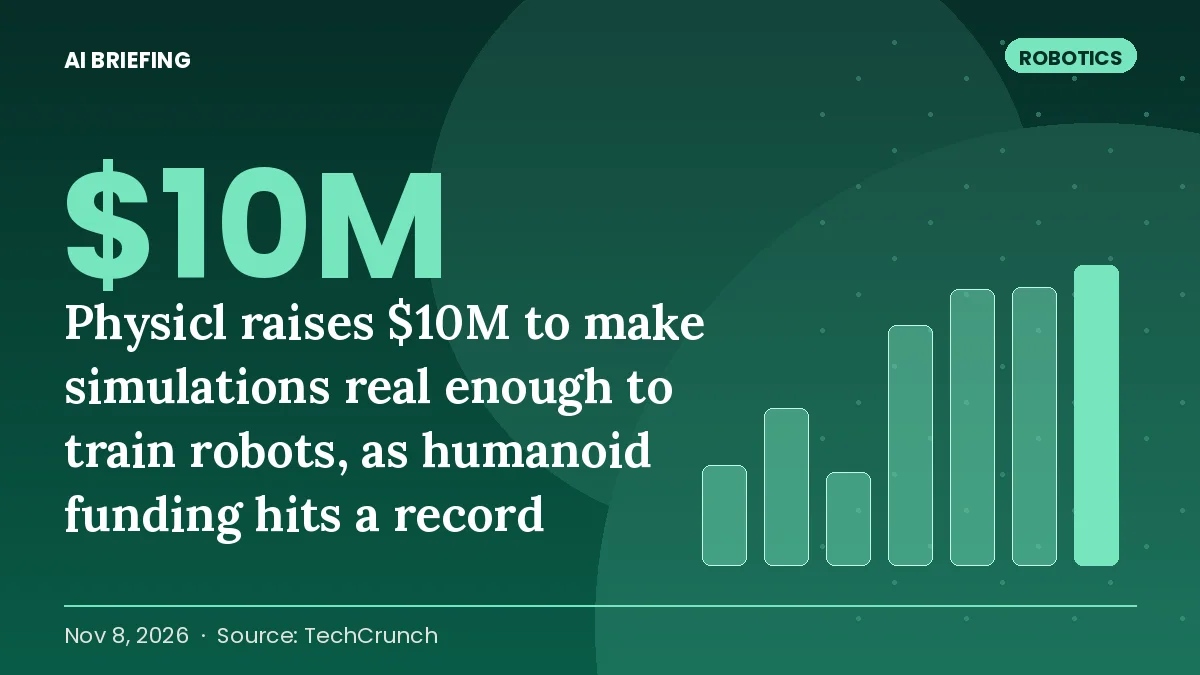
Physicl, a startup building high-fidelity simulated environments for training robots, has raised $10 million, TechCrunch reported on November 6. The pitch is simple: robots learn by practising, practising in the physical world is slow and expensive, and today's simulators are not realistic enough for skills learned there to survive contact with reality. Make the digital world "real enough" and you can train millions of hours overnight.
Why simulation is the bottleneck
Language models had the internet to learn from. Robots have nothing comparable: there is no trillion-token archive of a hand picking up a cup. The industry's answer is to manufacture experience, either by teleoperating real robots and recording them, or by simulating. Simulation scales, but the gap between simulated and real physics (friction, deformable objects, lighting, sensor noise) has historically wasted much of what was learned. Closing that gap is now a product category, and Physicl is one of several companies selling into it alongside the simulation stacks offered by the large chip and cloud vendors.
The money around it
The context is a funding boom. Dealroom's tracker put venture investment in humanoid robotics at $8.7 billion for 2026 by late July, already an all-time high, and noted that China accounts for roughly two-thirds of that total, with the US share down to about 15%. Earlier in the year Apptronik's $520 million round pushed its total raised to nearly $1 billion.
Deployments are following the money, cautiously. In October, agricultural-equipment maker AGCO announced a pilot of Agility Robotics' Digit humanoid at its Hesston, Kansas plant, and Agility signed a safety partnership covering its newest robot. The pattern across announcements is narrow tasks, defined zones and a safety vendor in the loop.
What to watch
- Sim-to-real benchmarks. Expect simulation vendors to publish transfer rates (how much a sim-trained skill degrades in the real world) the way model labs publish benchmarks.
- Who owns the environments. The large platforms are bundling simulation with chips and cloud; independents like Physicl bet that fidelity wins over bundling.
- The China gap. Two-thirds of humanoid capital is now there. Western policy on robotics exports and supply chains is the next place this shows up.
More in Robotics
All →
Get the brief in your inbox
One email every morning: the stories that mattered in AI, each with a one-line "why it matters" for your role. Free, no ads, unsubscribe any time.
Published daily by AI Briefing. We never share your address.