Muse Ember at $0.10 and LongCat-2.5 under MIT: the budget tier is now where agent costs are decided
Meta's smallest model matches Claude Haiku 5.5 on the Artificial Analysis index at a third of the cost per task, and Meituan has handed developers a 1.6-trillion-parameter model to run themselves.
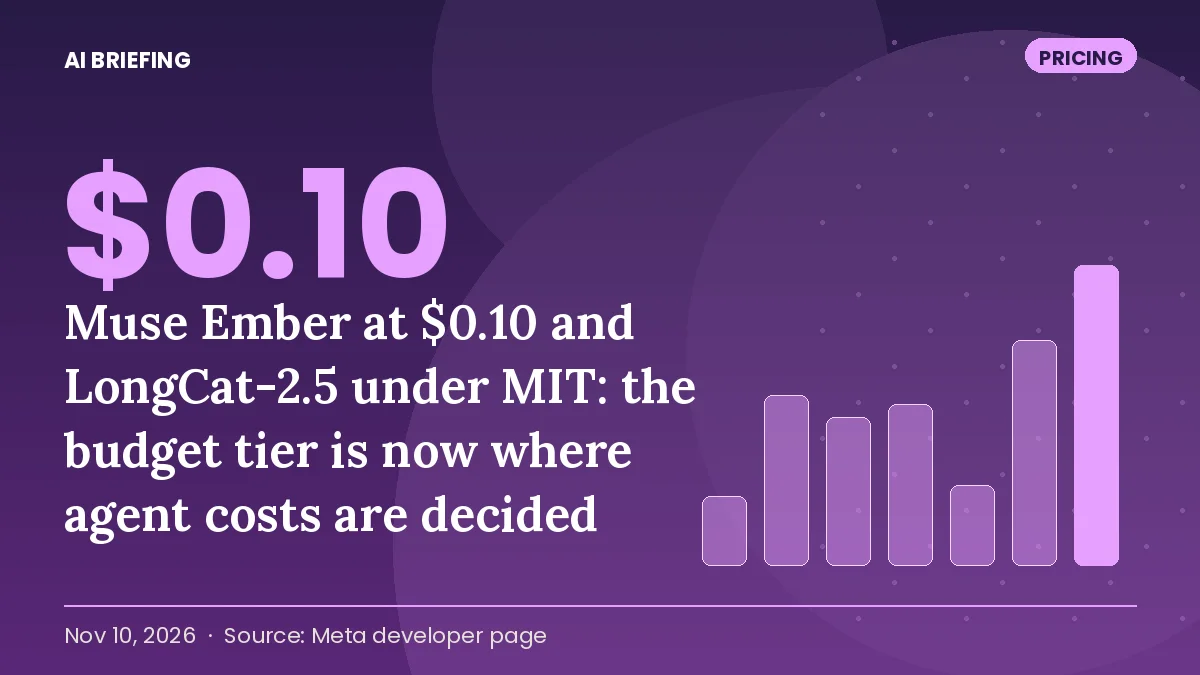
Two releases this week moved the cheap end of the model market, which is where most agent tokens are actually spent. Meta launched Muse Ember, its smallest multimodal model, and Meituan published the full weights of LongCat-2.5 under the MIT licence.
Muse Ember
Ember is priced at $0.10 per million input tokens, $0.004 for cached input and $0.50 for output on prompts up to 200K tokens; above that, all three rates triple. It takes text, image, audio and video input, has a 1-million-token window, and is positioned explicitly for repeated agent sub-tasks: tool calls, routing, extraction, document summarisation and coding sub-steps. It is available through Meta's own model API and on Google Cloud Marketplace.
The list price matches Claude Haiku 5.5 and GPT-6 Luna exactly. What differs is behaviour. Artificial Analysis, which tests models independently, scores Ember 36 on its Intelligence Index, level with Haiku 5.5, but measures its cost per task at $0.14 against Haiku's $0.41, because Ember emits roughly a third as many output tokens to reach the same answers. On the Coding Agent Index inside Meta's Muse Code harness it scores 46 against 37 for Claude Code with Haiku and 31 for Codex with GPT-6 Luna. Its weaknesses are also measurable: 27.2% on FrontierCode 2.0 against Haiku's 34.9%, and 21.1% accuracy on the AA-Omniscience knowledge test, where it declines to answer 64% of questions. For a model meant to sit inside a loop rather than talk to a user, declining is often the right behaviour.
LongCat-2.5
Meituan, the Chinese delivery company that has quietly become a serious model lab, released the LongCat-2.5 checkpoint on Hugging Face on November 9, a week after announcing the model. It is a mixture-of-experts design with about 1.6 trillion total parameters and roughly 48 billion active per token, with vision input, a hosted API at a limited-time $0.30 / $1.20, and serving optimisations including 4-bit expert weights on Chinese accelerators. Meituan's own figures put it at 88.4 on Terminal Bench v2.1, within a point of GPT-5.6 Sol and Claude Opus 5, and 64.6 on DeepSWE v1.1, up from 9.7 for LongCat-2.0.
The caveats are the usual ones for vendor tables: the closed baselines Meituan chose are a generation old, Terminal Bench v4.0 leaderboard scores for GPT-6.1 Sol and Opus 5.5 are far higher, and a 1.6T checkpoint is not something most teams will self-host. The licence is the news. MIT terms impose no usage restrictions, and unlike DeepSeek, which a Department of Homeland Security order excluded from federal civilian procurement in October, no US restriction currently names Meituan.
The counter-argument
Cheap tokens invite waste. A budget model that is three times cheaper per task but is called ten times more often inside a poorly designed agent loop costs more, not less, and Ember's 3x surcharge above 200K tokens punishes exactly the long-context agent patterns Meta is marketing it for. Open weights also shift cost rather than removing it: hosting LongCat-2.5 well needs multi-GPU nodes and operations skill that a $0.30 API rate makes hard to justify.
What to do
Instrument your agents to report cost per completed task, not tokens. Move the mechanical steps, routing, extraction, tool-call formatting and summarisation, to Ember or Haiku and keep the planning step on a mid-tier model. Cap context before the 200K cliff. If you are evaluating LongCat-2.5, test it through a hosted provider first and only consider self-hosting once you know the workload is stable. And re-read your vendor concentration policy: three different companies now anchor the three price tiers in our tracker.
More in Developer tools
All →
OpenAI's GPT-5.6 Sol discount ends November 30. Here is the price ladder to move to
Two vendors' promotional rates expire within a day of each other. OpenAI's pricing page now shows four GPT-6 tiers from $0.10 to $10 per million token…
Gemini 4 Argon's launch price ends November 30. Plan for $4 / $20
Google's pricing page now carries an expiry date on its flagship's introductory rate, and the Flash tiers follow in January. Here is the math for anyo…
Nvidia's GR00T 2 claims 71% one-shot success on 50 tasks. Here is what that number does and does not say
A new open world-action model trained on 100,000 hours of human video, a simulator that agents can configure themselves, and a benchmark claim that ne…
Get the brief in your inbox
One email every morning: the stories that mattered in AI, each with a one-line "why it matters" for your role. Free, no ads, unsubscribe any time.
Published daily by AI Briefing. We never share your address.