Gemini 4 Argon's launch price ends November 30. Plan for $4 / $20
Google's pricing page now carries an expiry date on its flagship's introductory rate, and the Flash tiers follow in January. Here is the math for anyone who built on launch pricing.
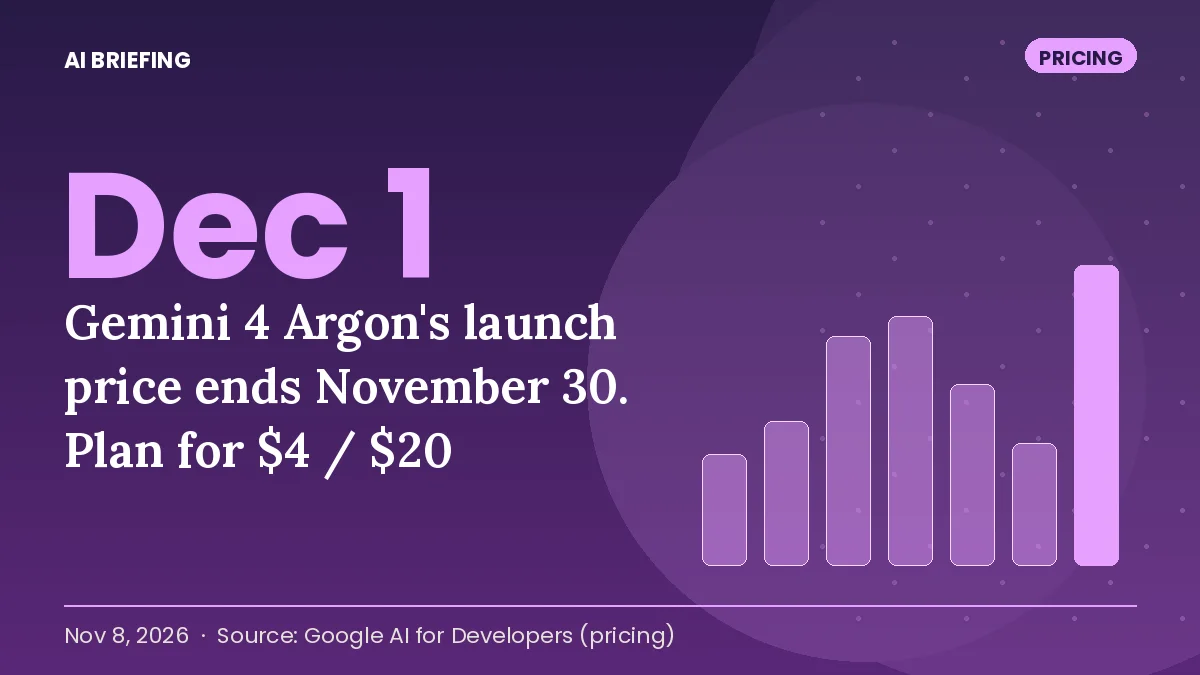
Google's official Gemini API pricing page, checked on November 8, lists Gemini 4 Argon at $2 per million input tokens and $10 per million output tokens through November 30, 2026, rising to $4 and $20 from December 1. Cached-input pricing doubles on the same schedule, from $0.10 to $0.20. The Flash tiers follow a month later: Gemini 3.8 Flash and 3.6 Flash are $0.75 / $3.75 through December 31 and $1.50 / $7.50 from January 1, 2027.
What this costs you
Take a typical assistant workload: 2,000 input tokens and 400 output tokens per request, 2 million requests a month.
- At launch pricing: input $8,000 + output $8,000 = $16,000 / month.
- From December 1: $32,000 / month.
Caching and batch discounts still apply, and the ratio is the same either way: the bill doubles.
How the new rate compares
At $4 / $20, Argon lands at the same list price as Anthropic's Claude Opus 5.5 and OpenAI's GPT-5.6 Sol, and remains well below the $10 / $50 of the top tiers (GPT-6 Astra, Claude Fable 5.1). Below it, Anthropic's Sonnet 5.5 at $2 / $10 becomes the cheapest current frontier-class list price once the Argon promotion ends. The full table is on the pricing tracker.
What to do before December 1
- Measure, do not assume. Tokenisers differ; cost per completed task on each candidate model is the only number that matters.
- Route by difficulty. Most traffic in most products is routine. Keep Argon for the hard cases and send the rest to a Flash-class model; the Flash promotion runs a month longer.
- Cache aggressively. Stable prefixes (system prompts, documents) at the cached rate are 5% of input price. Reorder prompts so the stable part comes first.
- Check your contract. Committed-use or enterprise pricing may not follow the public schedule. Ask.
The wider pattern
Google is not alone. Anthropic launched Sonnet 5 at an introductory rate that reverted on a fixed date, and OpenAI has used promotional pricing on new tiers. Launch prices are now marketing, not cost; the nightly check of vendor pages that feeds our tracker exists because of exactly this.
Get the brief in your inbox
One email every morning: the stories that mattered in AI, each with a one-line "why it matters" for your role. Free, no ads, unsubscribe any time.
Published daily by AI Briefing. We never share your address.