SAP's reported 10,000-role cut would be its second in three years, and this time product and engineering are in the frame
Bloomberg says every SAP department has been asked to find reductions totalling at least 9% of staff; the 2024 round was framed as retraining, this one as rebuilding the software business around AI.
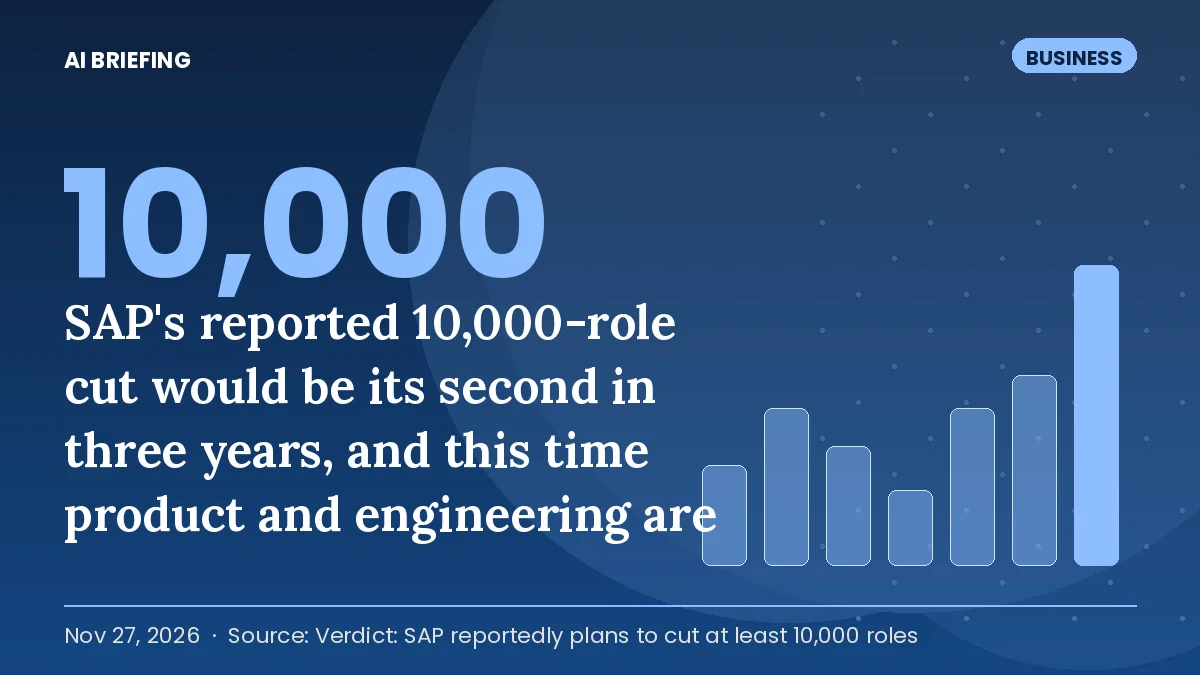
Bloomberg reported on Wednesday, citing people familiar with the plans, that SAP is weighing the elimination of at least 10,000 positions as part of an overhaul of its software business around artificial intelligence. The people said the figure would be a minimum of 9% of the company's workforce of more than 110,000, that every department has been told to identify potential reductions, and that product, engineering and sales are under particular scrutiny. No final number has been set and the total could move in labour negotiations. SAP told Verdict it does not comment on speculation, that roles and functions naturally change over time, and that no decisions on further measures have been made.
The 2024 precedent
SAP has done this before, and recently. In January 2024 it announced a restructuring that cost about €3bn and affected roughly 8,000 roles, later widened to around 10,000, with most of the money going to voluntary leave and retraining programmes. The share price rose on the day; investors read it as margin expansion funded by a one-off charge. Employee trust in the board, measured in SAP's own surveys, fell during the programme and had not recovered by late 2025. Germany's works council secured an employment guarantee through 2028 earlier this year, which means a second round of this size would fall disproportionately outside Germany unless it is structured as voluntary departures.
What is different now is the framing. The 2024 programme was described as shifting people into growth areas, cloud and AI among them. The 2026 plan, as reported, is about the shape of the software business itself: fewer people writing, testing, documenting and selling software because agents do more of each. That is the same argument Workday's CFO made in reverse on Tuesday when he credited AI products with nearly $150m of new annual contract value, and it is why application-software stocks have been sold on good quarters all month.
Who leaves and who stays
Sales chief Thomas Saueressig is leaving to become chief executive of Ionos, and two of the six executive-board seats turn over in March. That matters because sales is one of the three functions named as under scrutiny, and because SAP's go-to-market has been built around large account teams selling multi-year S/4HANA migrations. If agentic features inside Joule are meant to drive expansion revenue without the same sales motion, the headcount model changes with it.
The counter-argument is that SAP's customers are mid-migration. The RISE and GROW programmes still depend on consultants, partner ecosystems and support staff, and the 2027 end of mainstream maintenance for older ECC systems is the moment when customers need the most hand-holding. Cutting engineering and support capacity a year before that deadline is a bet that AI tooling can absorb the load. Oracle, Microsoft and Salesforce are making versions of the same bet, and none has yet shown the productivity data to prove it.
What to do
- If you are an SAP customer, ask your account team in writing which product areas are affected and what the support commitments are for modules outside the core cloud roadmap. Get it before the restructuring is announced, not after.
- If you run a software or IT organisation, expect the question to come to you: SAP's reported ratio, roughly one role in eleven, will become a benchmark in board conversations regardless of whether SAP's numbers hold.
- For investors, the signal to watch is the charge-to-savings ratio. The 2024 programme spent about €3bn for a stated goal of roughly €1bn of annual savings. A second round with a similar structure, announced into a market that is punishing software stocks, will be judged on whether the savings are redeployed into AI capex or returned.
- For SAP staff outside Germany, the works-council guarantee does not apply. Voluntary programmes usually open first; the terms of the 2024 round are the template.
Sources
Verdict: SAP reportedly plans to cut at least 10,000 roles ↗Bloomberg: SAP weighs cutting at least 10,000 positions in AI restructuring ↗The story so far
- Nov 27, 2026 Volvo's humanoid pilot at Ghent starts with one task, two fixtures and a wheeled robot, which is exactly how a factory d…
- Nov 26, 2026 HP +9% on AI PCs, Workday −8% and Autodesk −4% on beat-and-raise quarters: the market is paying for hardware and chargin…
- Nov 25, 2026 Microsoft declares a Code Red after its worst Exchange Online outage, and sets a one-hour recovery target using AI agent…
- Nov 25, 2026 Dell's revenue doubled to $54.9bn and its AI backlog hit $132.3bn. The margin is the number to read
Key terms in this story
- Benchmark A standard test used to compare models, such as a set of coding tasks or exam questions.
- Agent An AI system that pursues a goal by taking actions with tools, in a loop, rather than answering a single question.
More in Enterprise & business
All →
Microsoft declares a Code Red after its worst Exchange Online outage, and sets a one-hour recovery target using AI agents
A July fix for networking gateways left more than 80% of servers unresponsive for nearly 24 hours; the remediation plan leans on agents to diagnose sy…
HPE posts $14.5B quarter with $5.7B of AI orders and says memory stays tight through late 2028. What server buyers should plan for
The first of the four server makers accused of repricing signed contracts has reported, and its numbers show why: record AI orders, a $10.5B AI backlo…
Dell, HPE, Lenovo and Supermicro are reportedly asking 25–45% above signed prices on AI servers at delivery, with HPE reporting tonight and Dell tomorrow. What CFOs should do about a fixed-price contract that is not
Memory is now more than half of a server's bill of materials and the vendors have rewritten their quoting terms to pass the increase on; one hedge fun…
Get the brief in your inbox
One email every morning: the stories that mattered in AI, each with a one-line "why it matters" for your role. Free, no ads, unsubscribe any time.
Published daily by AI Briefing. We never share your address.