The first agentic Black Friday by the numbers: 3.3x growth at Shopify, 0.4% of e-commerce, a 43% failure rate, and a wall of retailer blocks
Agents are growing fast from almost nothing and failing almost half the time; the retailers deciding whether to let them in are choosing between a new sales channel and the loss of their first-party data and ad revenue.
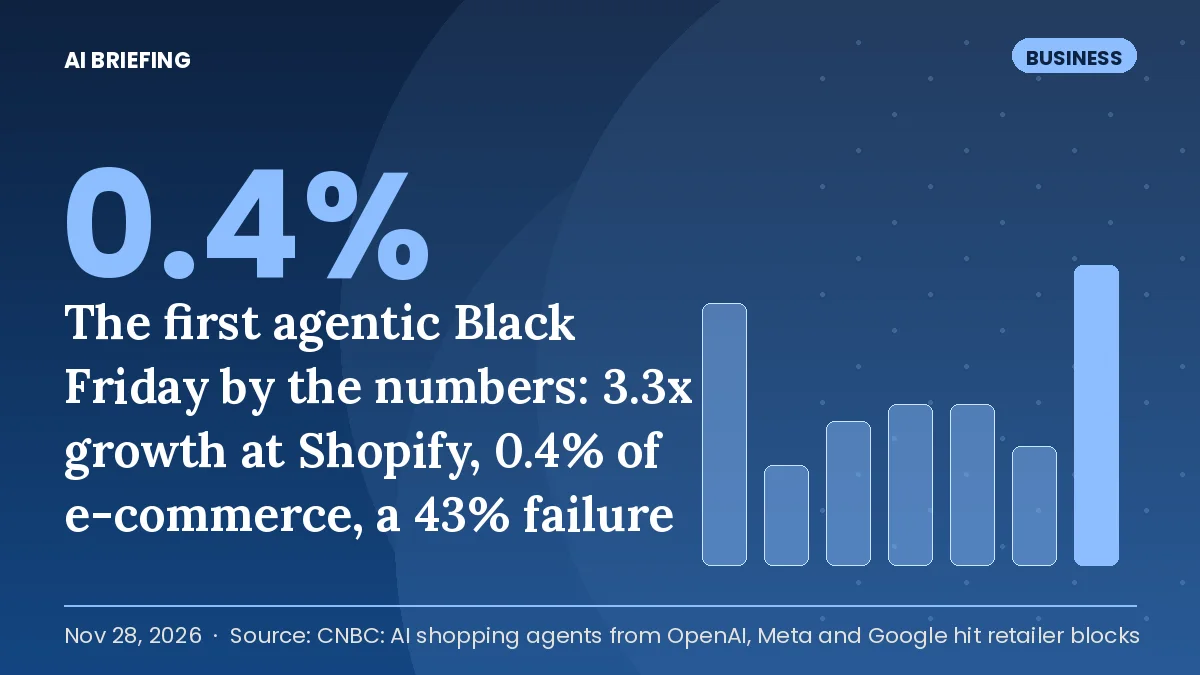
Shopify's president, Harley Finkelstein, told CNBC on Friday that this was the first Black Friday on which AI agents played a real role. The platform's checkout peaked at roughly $2.3 million a minute, and sales that originated from an agent, meaning a shopper's assistant found or recommended the product, ran about 3.3 times last year's level. Shopify did not say what share of total sales that represented, which is the tell: the base is small.
The rest of the market spent the day keeping agents out. Amazon has blocked Meta's Muse since September, when it said it had never agreed to join the program; it stopped xAI's Grok Bot from placing orders last month and is suing Perplexity over the shopping agent in its Comet browser, with a trial due next year. eBay, United Airlines and Kohl's limit what agents can do. Coach and Gap allow browsing but not checkout. JPMorgan Chase, Charles Schwab and Neiman Marcus have moved to block Muse outright. Meta's own figures, as Mark Zuckerberg put them in October, are that about a quarter of Muse's 10 million users have shopped through it, spending about $200 per order.
The three numbers
Bain estimates that agent-initiated purchases account for 0.4% of global e-commerce transactions and 0.2% of their value: shoppers let agents buy cheap things. Visa, which has the most to gain from agentic payments and has built tokenised credentials for them, found in its own tests that agents failed 43% of shopping tasks. And 23% of US consumers say they would trust an AI to pay on their behalf.
Put together, the picture is coherent. Adoption is growing several-fold from a base near zero, reliability is well short of what a human expects from a cashier, and trust tracks reliability. The 3.3x figure and the 0.4% figure are the same story told by a seller of tools and a consultancy, respectively.
Why retailers block
The stated reasons are customer safety and terms of service. The structural reasons are revenue and data. Amazon's advertising business depends on shoppers seeing sponsored placements; an agent that queries the catalogue and returns the best price does not see ads. First-party browsing data, the input to recommendations and to ad targeting, is lost when the shopper never visits. For a marketplace, an agent is a price-comparison engine with a credit card, and the history of price-comparison engines is that marketplaces fought them until they could not.
Shopify's position is the mirror image. It sells infrastructure to merchants and earns on transaction volume; an agent that brings a buyer to a Shopify store is a free acquisition channel. Its agentic checkout, which exposes a structured API rather than a web page, is the model that agent builders can rely on, and the one that lets a merchant decide what an agent may do.
The counter-argument to blocking is simple: shoppers who want to use agents will go where agents work. If Shopify merchants capture the 3.3x growth and Amazon captures none of it, the 0.4% share will not stay at 0.4% for the one side.
What to decide
- Browse, buy, or block. Three policies, each defensible. The Coach-and-Gap position, browse but not checkout, keeps the shopper on your property for the transaction and loses nothing to bots. Choose explicitly and write it into robots.txt, terms and bot-management rules so they agree.
- Expose a structured surface. If you allow agents at all, give them a product feed and a checkout API rather than letting them scrape. Scraped agents fail 43% of the time; API-driven ones fail at the rate of your API.
- Payments. Insist on network tokens scoped to the agent and the merchant, with spending caps. A stored card number in an agent's memory is a breach waiting for a prompt injection.
- Measure attribution. Shopify can report agent-sourced sales because it instrumented them. If you cannot tell an agent from a shopper in your analytics by Q1, you will not know whether the channel is worth the risk.
- Watch the Perplexity case. Amazon v. Perplexity will decide whether a browser agent acting for a logged-in user is the user or an unauthorised bot. That ruling, not Black Friday, sets the terms for 2027.
Sources
CNBC: AI shopping agents from OpenAI, Meta and Google hit retailer blocks ↗AI Weekly alert summarising the CNBC report ↗Axios: Amazon boots Meta's Muse in fight over AI shopping (September) ↗The story so far
- Nov 28, 2026 SAP's GitHub breach: stolen employee tokens, altered source code, replaced signing keys, and the five checks every SAP c…
- Nov 27, 2026 SAP's reported 10,000-role cut would be its second in three years, and this time product and engineering are in the fram…
- Nov 27, 2026 Volvo's humanoid pilot at Ghent starts with one task, two fixtures and a wheeled robot, which is exactly how a factory d…
- Nov 26, 2026 HP +9% on AI PCs, Workday −8% and Autodesk −4% on beat-and-raise quarters: the market is paying for hardware and chargin…
Key terms in this story
- Prompt injection An attack in which text the model reads, such as a web page or email, contains instructions that hijack its behaviour.
- Network token (payments) A substitute card number issued by Visa, Mastercard or American Express for one transaction or merchant, so the real card details never reach the merchant or the software making the purchase.
- Perplexity A measure of how surprised a model is by text it has not seen; lower means better next-token prediction.
- Token The unit models read and write; roughly three-quarters of an English word. Pricing and context limits are counted in tokens.
- Agent An AI system that pursues a goal by taking actions with tools, in a loop, rather than answering a single question.
More in Enterprise & business
All →
SAP's reported 10,000-role cut would be its second in three years, and this time product and engineering are in the frame
Bloomberg says every SAP department has been asked to find reductions totalling at least 9% of staff; the 2024 round was framed as retraining, this on…
Microsoft declares a Code Red after its worst Exchange Online outage, and sets a one-hour recovery target using AI agents
A July fix for networking gateways left more than 80% of servers unresponsive for nearly 24 hours; the remediation plan leans on agents to diagnose sy…
HPE posts $14.5B quarter with $5.7B of AI orders and says memory stays tight through late 2028. What server buyers should plan for
The first of the four server makers accused of repricing signed contracts has reported, and its numbers show why: record AI orders, a $10.5B AI backlo…
Get the brief in your inbox
One email every morning: the stories that mattered in AI, each with a one-line "why it matters" for your role. Free, no ads, unsubscribe any time.
Published daily by AI Briefing. We never share your address.