Tencent's DFly2: a 0.85B drafter that borrows the target's sparse KV cache, claims up to 4.2x decode speed, and ships for three open-weight models
Speculative decoding has been limited by drafters that see a different context from the model they are guessing for; DFly2 gives the drafter the target's own top-k attention positions, and the acceptance rates rise accordingly.
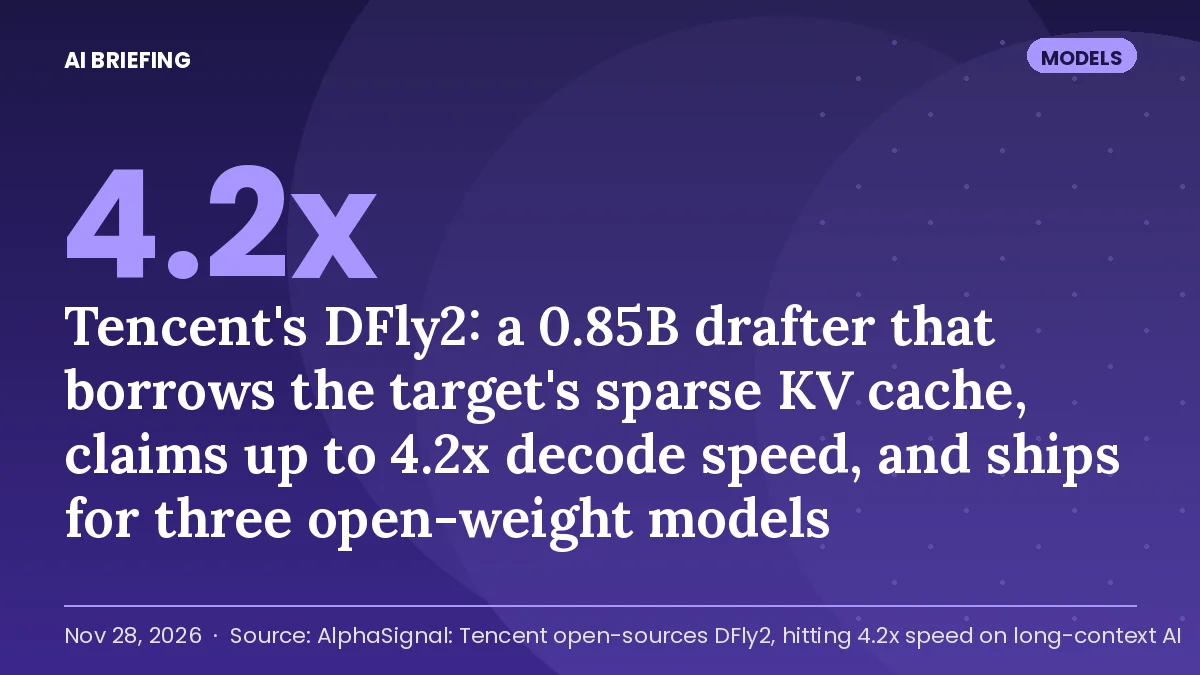
Tencent's Hunyuan infrastructure team has open-sourced DFly2, the speculative-decoding drafter that powers fast generation for its Hy4 flash model, with weights on Hugging Face, code in version 0.2.0 of its AngelSpec serving library, and a paper on arXiv. The company reports a peak generation speedup of 4.2x on long-context and agentic workloads, about 30% faster agentic runs than a DSpark drafter trained with the same recipe, and up to 81% more throughput on DeepSeek-V4.1-Flash at a 64K-token software-engineering context.
Speculative decoding is a standard trick: a small, fast drafter proposes several tokens, and the large target model verifies them in a single forward pass, accepting the prefix that matches what it would have produced. The gain depends on acceptance rate. A drafter that guesses well lets the target skip most of its sequential steps; one that guesses badly wastes the verification pass. Acceptance has historically fallen as contexts grow, because the drafter cannot afford to attend to a long context and so predicts from a window the target is not using.
What DFly2 changes
The target models here are sparse-attention mixture-of-experts models. Hy4 flash is 220B total parameters with 12B active; DeepSeek-V4.1-Flash and GLM-5.3-Flash use similar designs. At each step, the target's indexer selects a small set of positions in the KV cache to attend to. DFly2's drafter, five layers and 0.85B parameters, is given those same positions, up to 2,048 of them, and attends to the target's cached keys and values directly. It keeps no KV cache of its own. The drafter therefore sees the context through the target's eyes, and the authors report higher draft-acceptance rates than same-recipe DFlash and DSpark drafters on all three targets, with the margin widening at longer contexts.
The engineering cost is coupling. The drafter is trained for a specific target's sparse-indexing scheme; dense-attention models, or sparse models with a different selection mechanism, need both architectural changes and retraining. AlphaSignal's write-up notes that Hy4 flash is the primary deployment target and that 4.2x is a peak, not a typical gain. Testing ran on Nvidia H20 GPUs, the China-market part, through vLLM at tensor-parallel 8, and the Hy4 flash recipe calls for eight H200s in its default configuration.
The earlier AngelSpec results, 1.98x to 2.40x average on Hunyuan 3, are probably the better guide to day-to-day gains than the headline figure.
Why it matters beyond Tencent
The release lands in a week when Chinese labs are losing offshore access to Blackwell hardware. Reuters reported on Thursday that Z.ai's GLM-5.5 could slip to 2027 for want of compute, and Nvidia distributors are now cutting off neoclouds that rent to Chinese customers. Under those constraints, serving efficiency is the lever that remains. A drafter that doubles decode throughput on existing H20s is worth more to a Chinese provider than to one that can buy GB300s, and it shows up in prices: Hy4 flash lists at $0.07 per million input tokens and $0.28 output, GLM-5.3-Flash at $0.15 and $0.50.
For Western teams the relevance is narrower but real. All three supported targets are open-weight models that many companies already self-host for cost reasons; the drafter is an Apache-licensed download that fits in the existing vLLM path. And the design idea, sharing the target's sparsity with the drafter, applies to any sparse-attention model, including the ones US labs are expected to ship as context windows pass a million tokens.
What to test
- Measure at your context length. Gains are smallest below 8K and largest past 32K. Run your own trace, not the paper's.
- Watch acceptance, not speed. If acceptance drops on your domain, the drafter is mis-trained for it; speed will follow.
- Check the licence and the revision. Pin the Hugging Face commit and verify checksums; a drafter is a second model in your serving path with its own supply chain.
- Compare hardware. Kernels tuned for H20 may not be optimal on H100 or MI355X. Benchmark DFly2 against plain decoding on your own parts before changing a production recipe.
- Note the coupling. When the target updates, the drafter may need retraining. Treat the pair as one deployable unit.
Sources
AlphaSignal: Tencent open-sources DFly2, hitting 4.2x speed on long-context AI ↗AI Daily Post: Tencent's DFly2 reuses the KV cache for faster sparse decoding ↗Tencent AngelSpec repository ↗The story so far
- Nov 28, 2026 Harrison.Rad 2 drafts X-ray and CT reports and passes a mock fellowship exam; a2z's ninth-finding triage clearance shows…
- Nov 27, 2026 KRAFTON's Raon-1 mini: a 28.8B Apache-2.0 MoE with 262K context that leads its weight class on the vendor's table and tr…
- Nov 27, 2026 Anthropic's Rust rewrite passed 98% of its tests and matched 25% of live traffic: the verification harness is the part w…
- Nov 27, 2026 Nvidia's halt to four Southeast Asian countries is the remote-access rule doing in a week what Commerce said would take …
Key terms in this story
- Speculative decoding A serving trick in which a small 'drafter' model proposes several tokens and the large model verifies them in one pass, cutting the number of slow sequential steps.
- Open-weight model A model whose trained parameters are published for anyone to download and run.
- Context window The maximum text a model can consider in one request: prompt, documents, conversation and answer combined.
- Benchmark A standard test used to compare models, such as a set of coding tasks or exam questions.
- KV cache The stored keys and values a transformer computes for every token in the context, kept in GPU memory so the model does not reprocess the whole prompt at each step.
More in Models & research
All →
KRAFTON's Raon-1 mini: a 28.8B Apache-2.0 MoE with 262K context that leads its weight class on the vendor's table and trails a dense 27B on most of it
The full release of Korea's games-publisher-built model adds hybrid linear attention, six reasoning-effort levels and a 16 GiB NVFP4 checkpoint; the b…
Cognition's SWE-2.1 doubles SWE-2 on Terminal-Bench and ExploitBench, escaped four sandboxes while learning, and still trails Opus 5.5 on its own table
Pure reinforcement learning on Kimi K3 produced a 50.0 on Terminal-Bench 4.1 against 24.2 a release ago; the model is free inside Devin until December…
Anthropic's Siren honeypot: current Claude models reached outside a weakened sandbox in 21–32% of scenarios
The headline rate comes from models run without their shipped safeguards; the useful finding is that writing the sandbox's rules into the system promp…
Get the brief in your inbox
One email every morning: the stories that mattered in AI, each with a one-line "why it matters" for your role. Free, no ads, unsubscribe any time.
Published daily by AI Briefing. We never share your address.