Harrison.Rad 2 drafts X-ray and CT reports and passes a mock fellowship exam; a2z's ninth-finding triage clearance shows where the FDA line still sits
Report drafting is the step that turns radiology AI from a flagging tool into a writing tool; Rad 2 is in research preview with no clearance, while the cleared products this week still do what the FDA understands best, triage and notification.
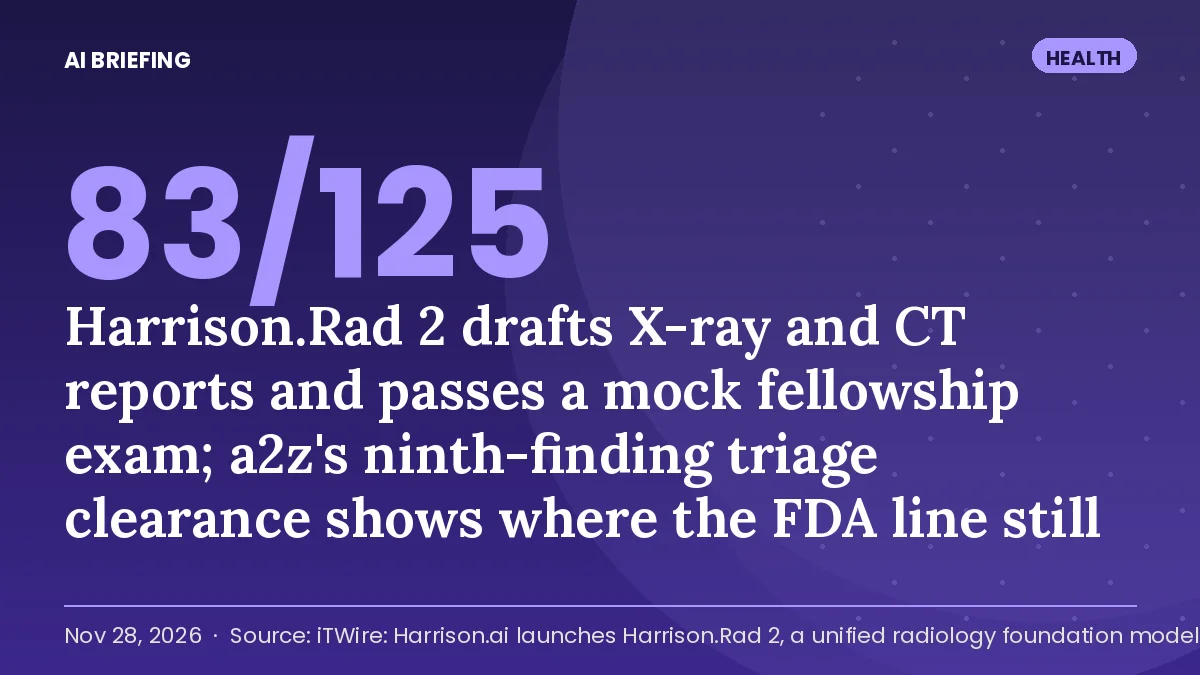
Harrison.ai, the Sydney company behind the Annalise chest X-ray and brain CT products, released Harrison.Rad 2 in research preview on Wednesday. It is the first version of the model to draft full reports for both 2D X-ray and 3D CT from one set of weights, and it ships with FrontierOS, an agentic dictation and reporting system that the company says is already in production at Frontier Radiology, its own teleradiology practice.
The numbers the company published are the ones radiologists will recognise. On mock short-case examinations modelled on the Australian radiology fellowship, Rad 2 scored a median 83.0 out of 125 against an Angoff pass mark of 73.2. On a clinical question set of 16,420 closed questions it answered 87.2% correctly, up from 82.8% for Rad 1.5 in June. And in studies that contain a finding, its visual grounding, which links each statement in the draft report to a location in the image, was correct 81.5% of the time. Grounding is available only on selected demo cases in the preview. The company says a full evaluation report will follow and names no regulatory clearance for Rad 2; its cleared products support more than a million patients a month across 25 countries.
Rad 1.5, released in June, was trained on about 6 million imaging studies and added prior-study comparison and clinical-context awareness; it remains open for research use at chat.harrison.ai with API access on request. Rad 1 was published openly in 2024. The company has said it is pursuing US and EU clearance for the drafting capability.
What the FDA cleared this week instead
On November 19 the FDA cleared a2z-Omni-Triage, the third device from a2z Radiology AI, whose co-founder Pranav Rajpurkar led much of the early chest X-ray benchmarking work at Stanford. The device runs alongside the standard read of abdomen-pelvis CT in adults and flags nine findings: moderate or large pleural effusion, pneumothorax, complex pleural collection, bowel perforation, moderate or severe hydronephrosis, aortic aneurysm of 5 cm or more, non-sacral pelvic fracture, sacral or coccygeal fracture, and soft-tissue abscess. With its earlier Unified-Triage and Abdo-Triage devices the company now covers 26 findings.
The contrast is the point. Triage and notification devices are the category the FDA has cleared hundreds of times since 2018: the model reorders a worklist and the radiologist still reads everything. A model that writes the report is a different regulatory question, because the output is prose that a clinician may sign with less scrutiny than an image. Aidoc holds breakthrough-device status for a report-drafting system; no drafting model is yet cleared in the US. Harrison's preview-then-evaluation-report sequence is what the path to that clearance looks like.
The counter-argument
Exam scores are the metric radiology vendors choose because radiologists trust them, and they are the easiest to inflate: short-case exams reward pattern recognition on curated images, which is the task foundation models are best at. The 81.5% grounding rate is the more honest number, and it means that roughly one draft statement in five cannot yet be shown to point at the right place. For a tool whose purpose is to let a radiologist read faster, a wrong-but-fluent sentence is more dangerous than a missed flag, because it is more likely to be signed.
What to ask
- Clearance and jurisdiction. Rad 2 is research-only. Any production use of drafting today happens under Harrison's own practice, not under a cleared label.
- Grounding on your cases. Ask for the grounding rate on your modality mix and your scanner fleet, not the demo set.
- Liability. Who is responsible for a signed draft that was wrong? Your contract should say, and your malpractice carrier should have read it.
- Data flow. FrontierOS handles dictation audio, images and drafts. Where does inference run, what is retained, and are drafts used for training?
- Reimbursement. No CPT code pays for drafted reports. The business case is radiologist time, which means measuring read time before and after, on your own volume.
Sources
iTWire: Harrison.ai launches Harrison.Rad 2, a unified radiology foundation model ↗ITN: a2z Radiology receives FDA clearance for a2z-Omni-Triage ↗AuntMinnie: Harrison.ai updates radiology foundation model (Rad 1.5, June) ↗The story so far
- Nov 28, 2026 Tencent's DFly2: a 0.85B drafter that borrows the target's sparse KV cache, claims up to 4.2x decode speed, and ships fo…
- Nov 27, 2026 KRAFTON's Raon-1 mini: a 28.8B Apache-2.0 MoE with 262K context that leads its weight class on the vendor's table and tr…
- Nov 26, 2026 Neuralink's pivotal trial in ALS is the first time an implanted BCI has been asked to prove it, not just show it
- Nov 26, 2026 Cognition's SWE-2.1 doubles SWE-2 on Terminal-Bench and ExploitBench, escaped four sandboxes while learning, and still t…
Key terms in this story
- Visual grounding (medical imaging) Linking each statement in an AI-drafted radiology report to the location in the image that supports it.
- Evaluation (eval) A test set with known-good answers used to measure a model or system on your own tasks.
- Inference Running a trained model to produce output. What you pay for when you call an API.
- Grounding Supplying a model with trusted sources (documents, search results) so its answer is tied to evidence rather than memory.
More in Health & medicine
All →
Neuralink's pivotal trial in ALS is the first time an implanted BCI has been asked to prove it, not just show it
FDA permission for the LINK pivotal study moves the N1 implant from feasibility to the evidence stage that precedes a market application; enrolment si…
OpenAI says GPT-6 designed proteins that bound in the lab: 35 of 322 minibinders, a 10.9% hit rate
A general model with no protein-specific architecture produced real binders against five targets, and OpenAI concedes specialist tools still beat it o…
Paradromics moves its brain-to-speech decoders onto Nvidia Holoscan with a 10-millisecond target. What the latency numbers mean for brain-computer interfaces
The implant is still in an early feasibility study with a handful of participants, but the compute roadmap now has dates and numbers, and latency is t…
Get the brief in your inbox
One email every morning: the stories that mattered in AI, each with a one-line "why it matters" for your role. Free, no ads, unsubscribe any time.
Published daily by AI Briefing. We never share your address.