OpenAI says GPT-6 designed proteins that bound in the lab: 35 of 322 minibinders, a 10.9% hit rate
A general model with no protein-specific architecture produced real binders against five targets, and OpenAI concedes specialist tools still beat it on the numbers that matter most.
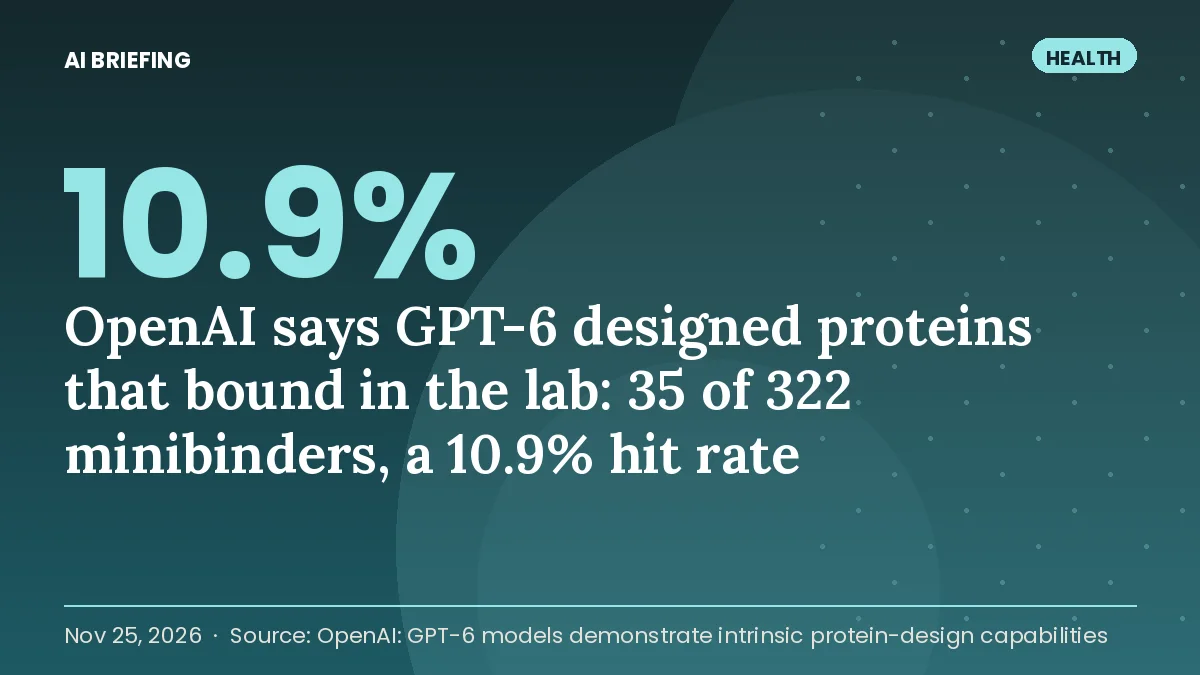
OpenAI published wet-lab results on November 24 for protein designs produced by its general-purpose GPT-6 models, with no biology-specific architecture and no specialist structure-prediction model in the generation loop. Working with the partner Onava, 322 designed minibinders were tested against five targets and 35 bound, a 10.9% hit rate: 18 against IL-17A, 8 against VEGF-A, 5 against PD-L1, 3 against IL-7Rα and 1 against TrkA. A second experiment redesigned known shapes with higher rates — 75 of 88 against MDM2, 26 of 42 against VEGF-A, but only 8 of 59 against PD-1 — and produced 14 hits from 107 designs for three unpublished shapes. On antibody loops, 128 of 182 redesigns of six VHHs kept binding to IL-4Rα, and 179 of 272 therapeutic antibody fragments bound PD-1 or PD-L1.
That is a real result, and the framing is the interesting part. OpenAI is not claiming to beat the field. It says in the same post that RFdiffusion's published minibinder hit rates were higher, and that hit rates depend heavily on how designs are filtered before synthesis — which they were here, using Boltz-2, OpenDDE and ESMFold2. It also states that the work does not demonstrate end-to-end de novo design.
Where the scaling curve points
The cleanest signal is the progression on DockQ with side chains hidden: about 0.05 for GPT-5.6, 0.28 for GPT-6, 0.57 for GPT-6.2 and 0.81 for an unnamed internal research model. On 30 MotifBench scaffolding challenges the internal model reached 43.7% against RFdiffusion's 27.8%, described as preliminary. On PoseBusters docking, GPT-6.2 scored 93% and the internal model 96%, against DiffDock-L at 50%. On 200 CATH fold challenges it was 18.9% against Proteina's 17.1%, which is a tie dressed as a win.
The counterweight sits in the same table. On full structure prediction the internal model averages a TM-score of 0.38 against ESMFold2's 0.93. A model that can reason its way to a plausible binder but cannot fold a protein reliably is not a replacement for the specialist stack; it is a different instrument that happens to be improving fast on one axis.
The history this lands in
Baker-lab diffusion tools made de novo binder design a tractable engineering problem over the last four years, and the field's hit rates are published, contested and sensitive to filtering. A general model entering that comparison at roughly a tenth of designs binding is not news because of the number. It is news because the number came from a system with no inductive bias for the problem — the same argument that was made about code, then mathematics, and in both cases the specialist tools kept their edge for a while and then stopped mattering.
The counter-argument deserves equal space: wet-lab validation of 322 designs against five targets is a small, filtered, vendor-run experiment with a partner that has an interest in the result, and the strongest numbers come from a model nobody outside OpenAI can test. Last week Novartis's chief executive said flatly that AI will not cure cancer in five to ten years. Nothing in this release contradicts him.
What to watch
Whether the preprint, "GPT-6 as a Universal Foundation Model for Protein Biology", survives peer review and independent replication of the Onava assays; whether the unnamed internal model ships, since most of the headline gaps depend on it; whether anyone reproduces the MotifBench result with the same filtering disclosed; and whether structure prediction closes, because a model that still trails ESMFold2 by 0.55 TM-score is not yet one tool instead of five.
The story so far
- Nov 25, 2026 Anthropic's Siren honeypot: current Claude models reached outside a weakened sandbox in 21–32% of scenarios
- Nov 24, 2026 Paradromics moves its brain-to-speech decoders onto Nvidia Holoscan with a 10-millisecond target. What the latency numbe…
- Nov 24, 2026 Z.ai's GLM-5.4 runs a 28-layer block twice per token: a 750B 'Loop Transformer' with a 1M context, no benchmarks, no API…
- Nov 23, 2026 OpenAI's MedChemBench puts GPT-6.2 Astra at 84.5% on medicinal-chemistry problems; Novartis's chief executive says AI wi…
Key terms in this story
- Minibinder A small designed protein intended to bind tightly to a chosen target protein, used as a starting point for drugs and diagnostics.
- DockQ A score from 0 to 1 measuring how closely a predicted protein-protein complex matches the experimentally determined structure.
More in Health & medicine
All →
Neuralink's pivotal trial in ALS is the first time an implanted BCI has been asked to prove it, not just show it
FDA permission for the LINK pivotal study moves the N1 implant from feasibility to the evidence stage that precedes a market application; enrolment si…
Paradromics moves its brain-to-speech decoders onto Nvidia Holoscan with a 10-millisecond target. What the latency numbers mean for brain-computer interfaces
The implant is still in an early feasibility study with a handful of participants, but the compute roadmap now has dates and numbers, and latency is t…
OpenAI's MedChemBench puts GPT-6.2 Astra at 84.5% on medicinal-chemistry problems; Novartis's chief executive says AI will not cure cancer in a decade. Both are right, and here is what pharma should take from each
A new benchmark shows models can reconstruct molecules and reason over published papers; the man who runs one of the world's largest drugmakers says t…
Get the brief in your inbox
One email every morning: the stories that mattered in AI, each with a one-line "why it matters" for your role. Free, no ads, unsubscribe any time.
Published daily by AI Briefing. We never share your address.