OpenAI's MedChemBench puts GPT-6.2 Astra at 84.5% on medicinal-chemistry problems; Novartis's chief executive says AI will not cure cancer in a decade. Both are right, and here is what pharma should take from each
A new benchmark shows models can reconstruct molecules and reason over published papers; the man who runs one of the world's largest drugmakers says the bottleneck is biology nobody understands yet.
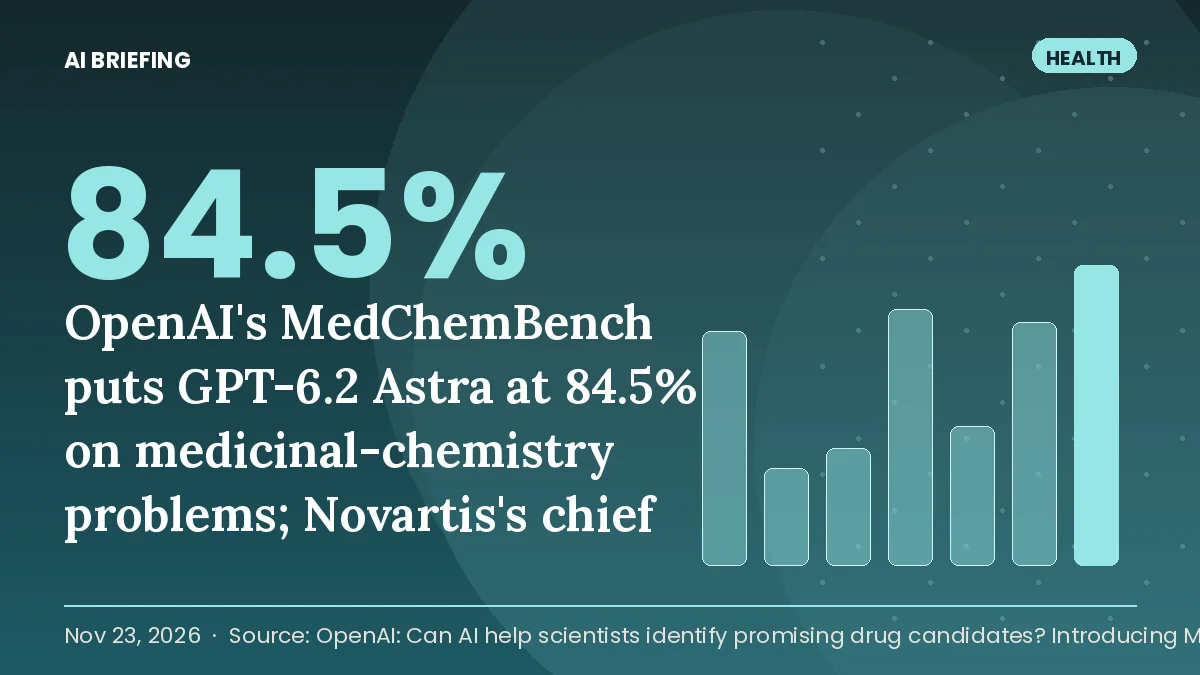
Two statements about AI and drug discovery landed within days of each other and appear to contradict. On Friday OpenAI published MedChemBench, a benchmark of 99 problems drawn from 117 published papers and patents covering 761 molecular structures, on which its newest model, GPT-6.2 Astra, earned 84.5% of the available credit. Over the weekend Vas Narasimhan, chief executive of Novartis and a member of Anthropic's board, told an interviewer that nobody should expect AI to cure cancer within five to ten years, because biology is understood far less well than language or code. Read carefully, the benchmark supports the chief executive.
What the benchmark measures
MedChemBench scores four things: rebuilding a molecular structure, including stereochemistry, from a textual description; reasoning from evidence in the source paper; ranking or selecting compounds; and predicting numerical properties, with partial credit for near misses. Models get one attempt, no tools, no feedback and no experiments. GPT-6.2 Astra scored 84.5% at its highest reasoning setting, GPT-6 Astra 83.3%, GPT-6.1 Sol 82.0%, GPT-6.1 Terra 75.1% and GPT-5.6 Sol 58.2%. The component breakdown is the useful part. GPT-6 Astra scored 95.4% on structure reconstruction and in one example rebuilt an 18-atom ring correctly ten times out of ten where the previous generation managed zero. On compound selection and numerical prediction it earned about half the available credit.
OpenAI's own caveats are unusually direct: models may have seen the source papers in training, the benchmark tests reasoning over published results rather than discovery of new ones, and the scores do not show that a model can find a drug or improve a decision in a laboratory. Only OpenAI models were tested and the page does not say whether the problem set will be released.
What the chief executive measures
Narasimhan's argument is about where time goes in drug development. Chemistry, the part models now do well, is a small share of a programme that typically runs about twelve years. Most of the time and most of the failures sit in biology: picking a target that matters in human disease, and then proving safety and efficacy in people. Those steps are limited by how little is known, not by how fast anyone can read. His realistic forecast is a cycle shortened toward eight years within a decade, with AI's near-term value in simulations, paperwork and letting scientists move faster through work they already do.
The counter-argument has money behind it. Isomorphic Labs raised $5 billion last week with no drug yet in a human, Dario Amodei has talked about compressing decades of progress into years, and Ant Group's health app released a 560-billion-parameter open-weight medical reasoning model on Sunday, with a smaller multimodal version and an evaluation platform backed by 29 institutions. Capability is clearly rising. The dispute is about which bottleneck it hits next.
What to watch
The test that would move this debate is prospective: a model-chosen compound series entering and clearing a Phase 1 trial, or a model-proposed target validated in animals, with the prediction registered in advance. None of the current benchmarks, including MedChemBench, is that test. Until one exists, treat high scores as evidence that models are becoming excellent medicinal-chemistry readers and assistants, which is valuable and billable, and treat cure timelines from either direction as opinion. For research leaders, the practical move is to pilot models on the reading-heavy work the benchmark actually measures, structure elucidation, literature synthesis, SAR summaries, and to insist that any discovery claim from a vendor comes with the wet-lab result attached.
Sources
OpenAI: Can AI help scientists identify promising drug candidates? Introducing MedChemBench ↗NewsBytes: Novartis's Narasimhan says AI won't cure cancer in 5–10 years ↗Business Wire: Ant Group's AI app Afu open sources medical and health AI model family ↗The story so far
- Nov 23, 2026 An Anthropic mathematician says he and Claude proved the Riemann hypothesis, released only as Lean code; James Maynard p…
- Nov 23, 2026 Inkling 2 Mini: a 26.4B open-weight model that runs its middle layers three times, fits in 20 GB and scores 79.2% on SWE…
- Nov 19, 2026 GE HealthCare's Critical Care Suite 3.0 clears the FDA: feeding-tube detection on the x-ray machine at 99.2% sensitivity…
- Nov 18, 2026 GPT-6.2 Astra at $8 / $40: OpenAI cuts its flagship price by a fifth, matches Claude Fable 5.2 and ships the first model…
Key terms in this story
- Reasoning model A model trained to work through a problem step by step, generating intermediate 'thinking' tokens, before answering.
- Multimodal A model that accepts or produces more than one kind of input or output: text, images, audio, video.
- Evaluation (eval) A test set with known-good answers used to measure a model or system on your own tasks.
- Benchmark A standard test used to compare models, such as a set of coding tasks or exam questions.
More in Health & medicine
All →
GE HealthCare's Critical Care Suite 3.0 clears the FDA: feeding-tube detection on the x-ray machine at 99.2% sensitivity, offline, and for children for the first time. What hospitals should ask before switching it on
On-device imaging AI sidesteps the integration and data-sharing problems that stall most hospital deployments; the questions that remain are about the…
Isomorphic Labs raises $5 billion with no drug in a human: the largest private biotech round ever, $7.7 billion in twenty months, and what the money is actually buying
The DeepMind spinout has now raised more than most public biotechs are worth, on preclinical data it has not published. The bet is that an AI design e…
Apple and OpenEvidence open a 200,000-person health chatbot study: wearable and lab data in, no model training, no device claim. What health systems should watch
Apple has chosen the clinical search tool most US doctors already use as the engine for its first consumer health conversation, and is running it as r…
Get the brief in your inbox
One email every morning: the stories that mattered in AI, each with a one-line "why it matters" for your role. Free, no ads, unsubscribe any time.
Published daily by AI Briefing. We never share your address.