DevelopingAn Anthropic mathematician says he and Claude proved the Riemann hypothesis, released only as Lean code; James Maynard puts it at '98 or 99 percent'. What has been checked, what has not, and why labs are now talking about limits
A four-page note, a machine-checked proof nobody has yet read as prose, and a Navier–Stokes claim on the same day have pushed 'superintelligence' from marketing into the mouths of chief scientists.
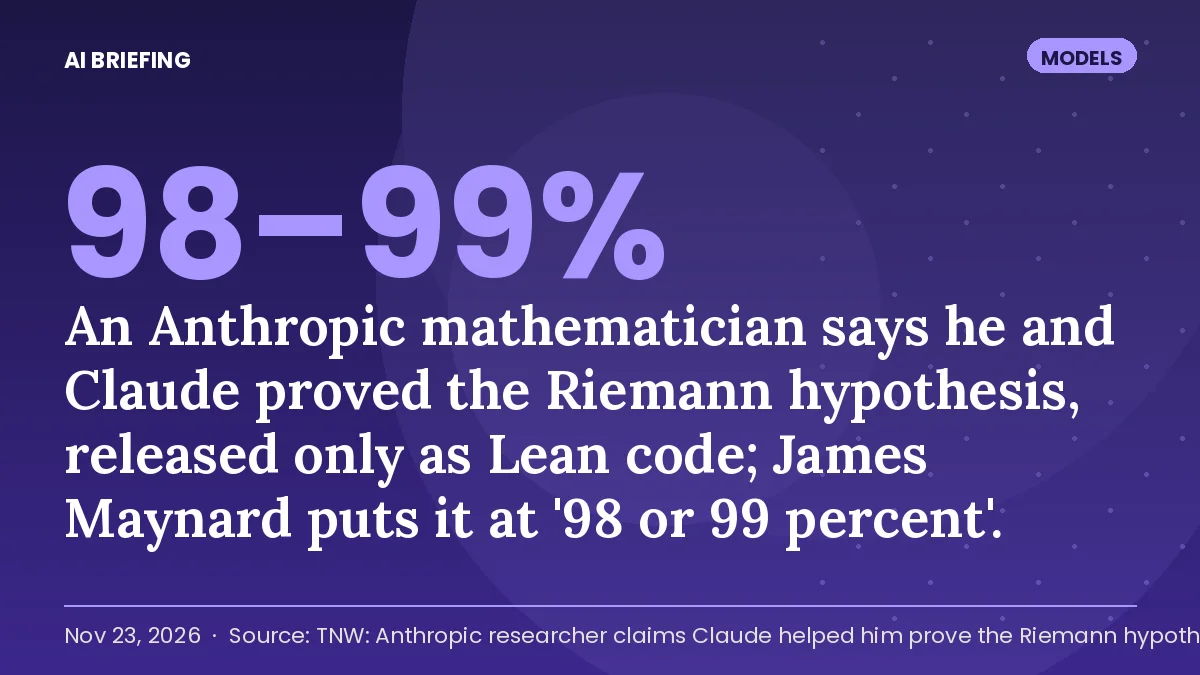
On Friday afternoon, one day after Anthropic's shares began trading, Levent Alpöge, a mathematician employed by the company, posted a four-page note claiming a proof of the Riemann hypothesis developed with Claude. The note says the method also settles the generalised version, GRH, and includes a timeline compiled by Claude running from October 6 to November 16. What Alpöge released is not a paper. It is Lean code, a formal proof that a computer can check line by line, and a footnote says his own prose draft ran to roughly 250,000 pages. He denies the timing had anything to do with the IPO, and points out he used Claude in July to find a counterexample to a conjecture about Jacobians.
What has been checked
By Friday evening Andrew Sutherland at MIT had compiled the Lean independently, meaning the proof type-checks. The remaining mechanical step is an automated comparison confirming that the theorem as formalised is actually the Riemann hypothesis and not a subtly weaker statement; Elliot Glazer, who works on formal mathematics, said the formalised statement is in fact GRH. James Maynard, the Oxford number theorist and Fields medallist, told the New York Times he was 98 or 99 percent sure it was correct and that it would be a historic milestone if so, while warning that understanding why it works will take a lot of work. Terence Tao wrote that comprehension will take time. Brian Conrad at Stanford called the manner of release frankly completely outrageous, which is the sharpest expression of a widespread complaint: a proof nobody can read is not yet mathematics in the usual sense, even if a machine says it is true.
The same day, Tristan Buckmaster of NYU and Alpöge posted a claimed proof of finite-time blow-up for the unforced three-dimensional Navier–Stokes equations, another Millennium Prize problem, with a Lean package of about 600,000 lines. Buckmaster called the write-up unpolished and heavily LLM-assisted and said that after OpenAI's September claim on the forced case they could not risk waiting. A caveat applies: the numerical certificate the formal theorems depend on has not been released, only its hash.
The reaction that matters for the industry
Mathematicians will take months. The AI industry took a weekend. Alexandr Wang, Meta's chief AI officer, posted on Sunday that superintelligence is arriving and that humanity should not accept a handover of society to AI. Elon Musk declared the singularity. More substantively, OpenAI's chief scientist Jakub Pachocki published an essay on Sunday arguing that pretraining perplexity, the model's error at predicting the next token, is a more durable measure of capability than saturating benchmarks, and proposing that labs commit not to train past a shared perplexity threshold until monitoring and understanding reach a concrete milestone. Sam Altman called it the most important thing OpenAI has published in a while. METR's quarterly update, released Friday, said the length of tasks models can complete is doubling roughly every 3.6 months and that public evidence cannot rule out a sharp acceleration in AI research itself.
The counter-argument is worth stating. A formally verified proof of a famous theorem is a capability demonstration, not evidence of autonomy; Alpöge drove the process for six weeks. Perplexity thresholds are easy to propose and hard to verify across labs with different tokenisers and data. And the loudest voices on Sunday all have products to sell.
What to watch
Three checks will settle the mathematics: the statement-equivalence check Sutherland was running, an audit of the Lean project for non-standard axioms or unproved assumptions, and the first human-readable extraction of the argument's core idea. For Navier–Stokes, the release of the numerical certificate. For the industry, whether any second lab endorses Pachocki's threshold idea in writing, and whether the perplexity numbers he cited, around 0.91 for GPT-4 and below 0.8 for today's frontier, get published with methodology. If they do, the site's benchmark explainer will need a new section.
Sources
TNW: Anthropic researcher claims Claude helped him prove the Riemann hypothesis ↗IBM Think: Anthropic's Claude and a claimed Riemann hypothesis proof ↗TechCrunch: OpenAI's chief scientist has thoughts on how to limit AI development ↗The story so far
- Nov 23, 2026 OpenAI's MedChemBench puts GPT-6.2 Astra at 84.5% on medicinal-chemistry problems; Novartis's chief executive says AI wi…
- Nov 23, 2026 Inkling 2 Mini: a 26.4B open-weight model that runs its middle layers three times, fits in 20 GB and scores 79.2% on SWE…
- Nov 18, 2026 GPT-6.2 Astra at $8 / $40: OpenAI cuts its flagship price by a fifth, matches Claude Fable 5.2 and ships the first model…
- Nov 17, 2026 Qwen4-Max at $1.50 / $4.50: 2.4 trillion parameters, 71 billion active, a 1M window, and a benchmark story that depends …
Key terms in this story
- Perplexity A measure of how surprised a model is by text it has not seen; lower means better next-token prediction.
- Benchmark A standard test used to compare models, such as a set of coding tasks or exam questions.
- Token The unit models read and write; roughly three-quarters of an English word. Pricing and context limits are counted in tokens.
- Lean (proof assistant) A programming language and checker in which a mathematical proof is written as code that a computer verifies line by line.
More in Models & research
All →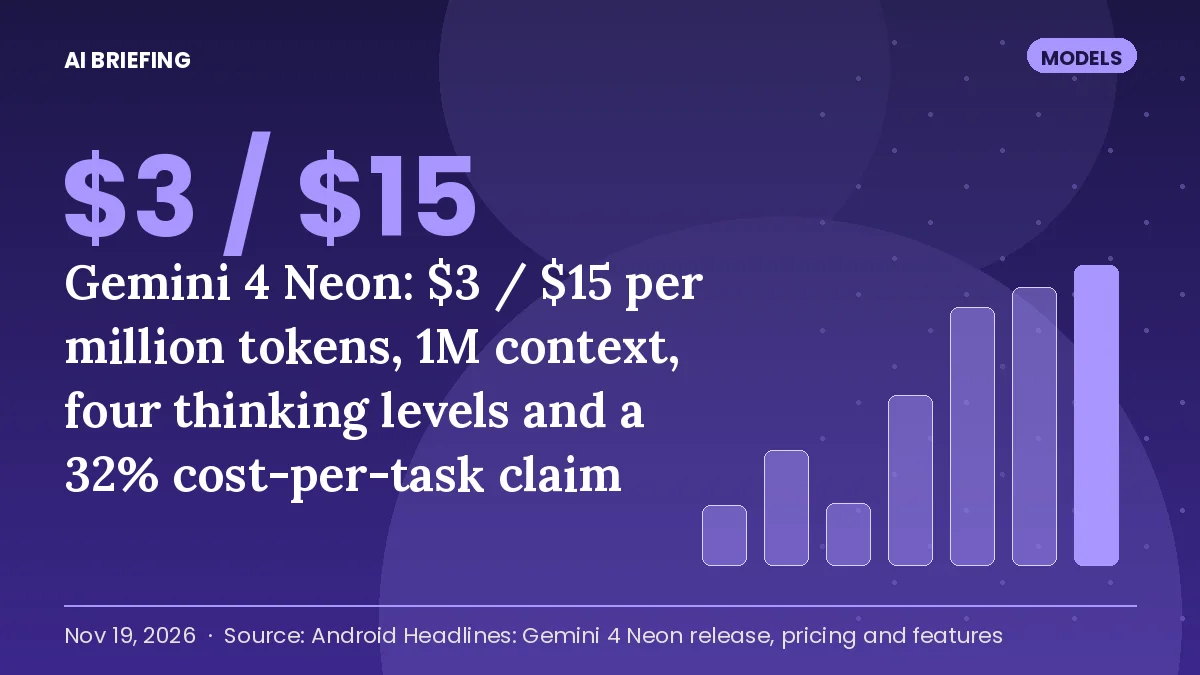
Gemini 4 Neon: $3 / $15 per million tokens, 1M context, four thinking levels and a 32% cost-per-task claim against Carbon. Where it sits in Google's four-model lineup and what to test
Google's fourth Gemini 4 release in a month is priced to become the default for paying users and the orchestrator for Hydrogen sub-agents; the benchma…
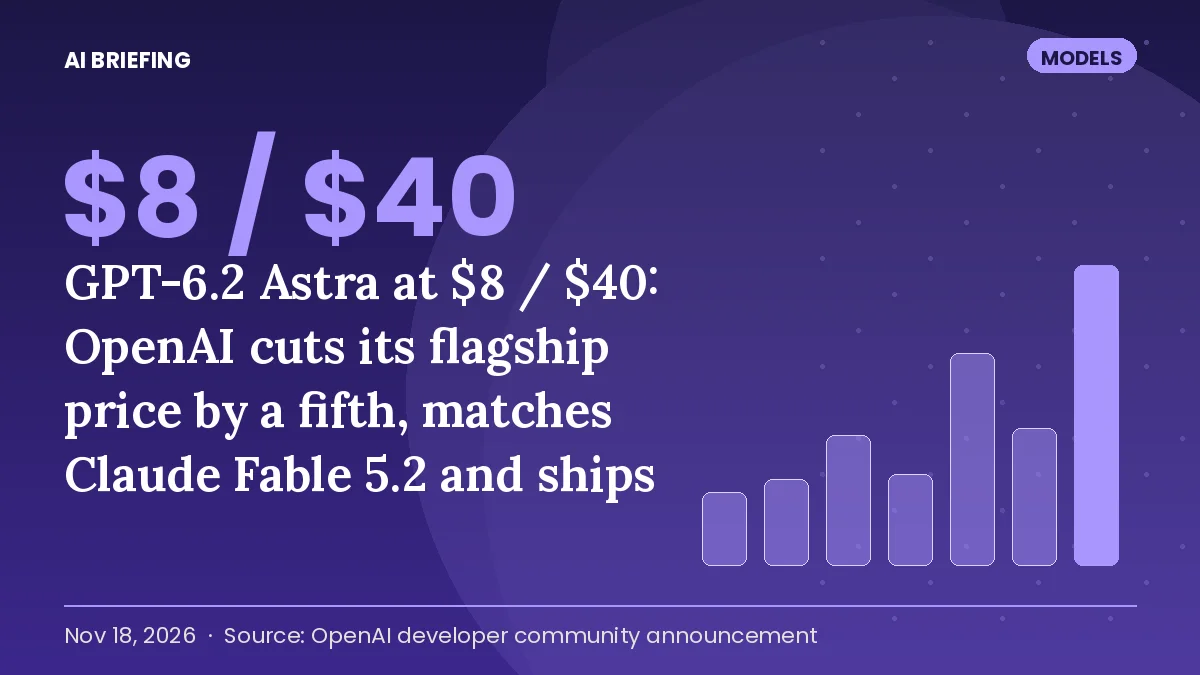
GPT-6.2 Astra at $8 / $40: OpenAI cuts its flagship price by a fifth, matches Claude Fable 5.2 and ships the first model it rates 'High' for AI self-improvement. What changed and what to test
The headline is a price cut; the system card is the story. OpenAI has released a model it says can materially help build the next one, under added saf…
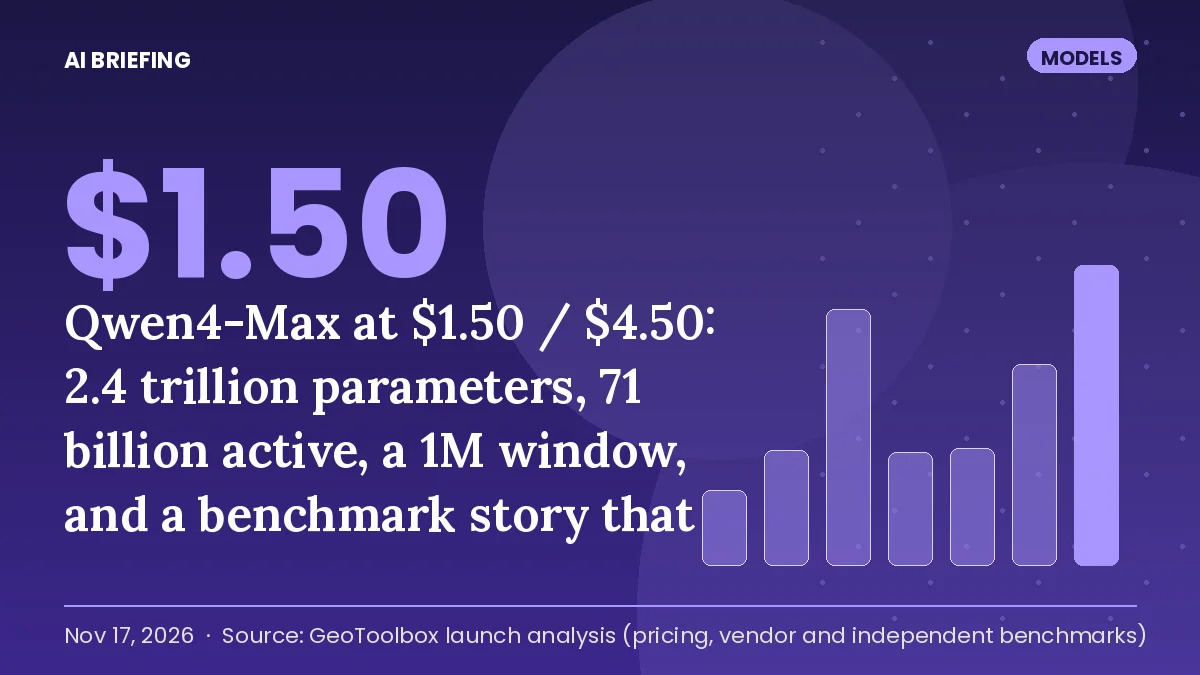
Qwen4-Max at $1.50 / $4.50: 2.4 trillion parameters, 71 billion active, a 1M window, and a benchmark story that depends on whose table you read
Alibaba's new flagship is 25% cheaper than its predecessor and competitive on agentic coding, but independent indices put it mid-pack; the model to wa…
Get the brief in your inbox
One email every morning: the stories that mattered in AI, each with a one-line "why it matters" for your role. Free, no ads, unsubscribe any time.
Published daily by AI Briefing. We never share your address.