Gemini 4 Neon: $3 / $15 per million tokens, 1M context, four thinking levels and a 32% cost-per-task claim against Carbon. Where it sits in Google's four-model lineup and what to test
Google's fourth Gemini 4 release in a month is priced to become the default for paying users and the orchestrator for Hydrogen sub-agents; the benchmark story is narrower than the headline.
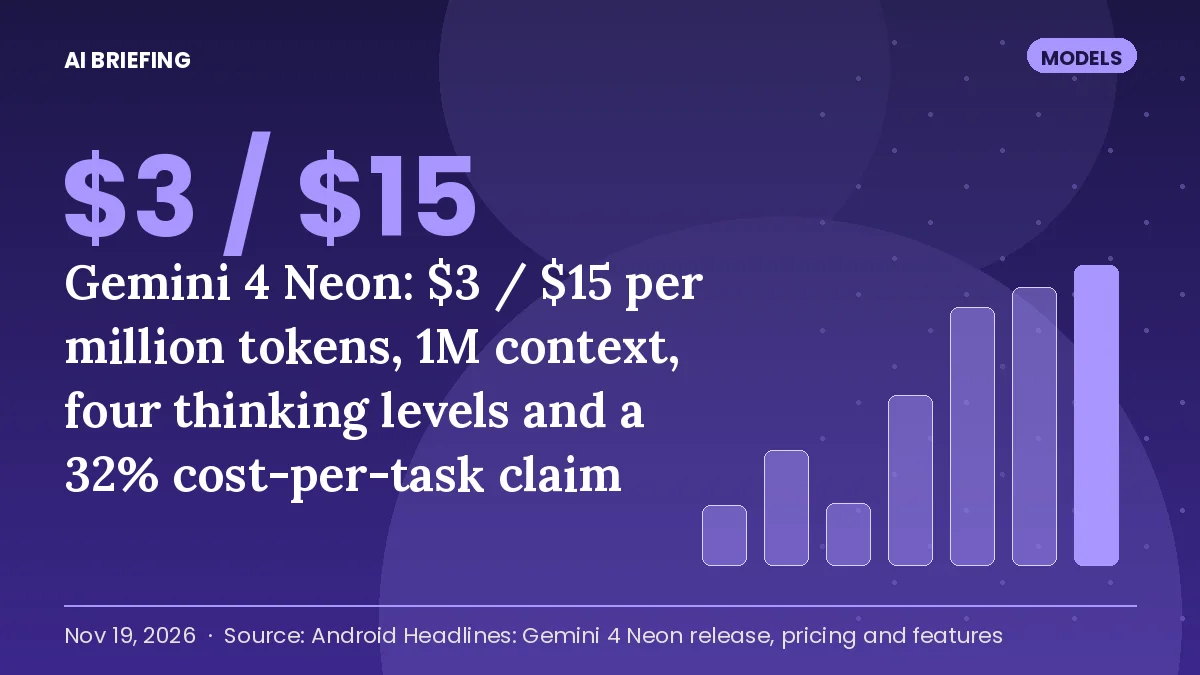
Google released Gemini 4 Neon on Wednesday at $3 per million input tokens and $15 per million output, with cached input discounted 95% to $0.15 and a one-million-token limit on both input and output. It is the fourth Gemini 4 model in roughly thirty days, after Carbon, Argon and Hydrogen, and the one Google clearly intends most people to use: in the Gemini app it replaces Argon for AI Pro and Ultra subscribers and retires Gemini 3.1 Pro, and the model picker now offers four choices, an Auto option built on 3.5 Flash-Lite, Hydrogen, Neon and Carbon. Developers get it through the Gemini API, AI Studio and Antigravity, and a cyber-defence variant is being distributed to security teams through the Fairwind programme. The model does not generate images or audio.
The price ladder
Neon's position is easiest to read as a ladder. Hydrogen costs $1.50 / $7.50 with flat pricing across its 1M context. Neon is exactly double that. Carbon and Argon are $2 / $10 on introductory pricing that ends on December 1, after which they rise to $4 / $20, at which point Neon is 25% cheaper than the flagship. Google's larger claim is that Neon reduces cost per task by 32% against Carbon at Carbon's default high thinking setting, which combines the lower per-token rate with fewer reasoning tokens spent per answer. That number is Google's and depends on the task mix; for short, single-shot calls the per-token gap is the honest comparison. The 95% cache discount is the quietly important number. At $0.15 per million, a 50,000-token system prompt and reference pack costs well under a cent per call to reuse, which makes long shared context nearly free and changes how retrieval and tool-description budgets should be set.
What the benchmarks say, and do not
Google reports a score of 61 on the Artificial Analysis Intelligence Index at Neon's highest thinking level, placing it third overall behind models that are larger and slower, and first on four narrower leaderboards: the Artificial Analysis Coding Agent Index, Legal Research Bench, Tax Agent Bench and Zapier's AutomationBench. Those four share a feature: long, multi-step, tool-using tasks with a verifiable end state. The claim, then, is not that Neon is the smartest model but that it is the best value for agentic workflows, which is also the segment where Google can sell it as an orchestrator. Neon can direct Hydrogen sub-agents on large coding jobs, the first time Google has described one of its models as a controller for another. It also supports Computer Use, live code execution and Search grounding, and offers four thinking levels from Low to Extra High, so the 61 score is a ceiling that costs output tokens to reach.
The counter-argument
Four frontier releases in a month is a cadence, not a strategy, and the cost for customers is churn. Anyone who standardised on Argon in October now has a model that is being withdrawn from the consumer app and will double in price on December 1. OpenAI's GPT-6.2 Sol at $2 / $10 and Alibaba's Qwen4-Max at $1.50 / $4.50 sit below Neon on price with 1M contexts of their own, and Anthropic's Sonnet 5.5 matches Sol. Neon's case rests on agentic benchmarks that vendors have learned to target; the first independent runs will tell you whether the leaderboard positions survive.
What to do
If you are on Google, re-run your evaluation set on Neon at Low and High thinking before December 1, because the Carbon and Argon price step makes the decision for you unless Neon fails. Measure cost per completed task, not per token, and log reasoning tokens separately. If you run long agent loops, try Neon as the planner with Hydrogen as the worker and compare against Carbon alone on wall-clock time and total spend. If you are not on Google, the useful signal is the cache price: expect competitors to match a 95% discount, and build prompts that would benefit when they do. Our pricing tracker carries the Neon row alongside the December 1 step-ups for Carbon and Argon.
Sources
Android Headlines: Gemini 4 Neon release, pricing and features ↗Google blog: Introducing Gemini 4 Neon ↗RuntimeWire: Neon appears in Google Cloud billing ↗The story so far
- Nov 18, 2026 MAI Code 2 lands in GitHub Copilot: Microsoft says 98% of GPT-6.1 Sol at 40% of the cost and 96% of Claude Opus 5.5 at 5…
- Nov 18, 2026 GPT-6.2 Astra at $8 / $40: OpenAI cuts its flagship price by a fifth, matches Claude Fable 5.2 and ships the first model…
- Nov 17, 2026 Qwen4-Max at $1.50 / $4.50: 2.4 trillion parameters, 71 billion active, a 1M window, and a benchmark story that depends …
- Nov 17, 2026 Google's GTIG finds 'exploit_agent', the first framework that turns a vendor patch into a live exploit with no human in …
Key terms in this story
- Thinking level A vendor setting that controls how much reasoning a model does before answering, trading latency and tokens for accuracy; Google's Gemini 4 models offer low, medium, high and xhigh.
- System prompt Standing instructions a developer gives a model that apply to every conversation, such as persona, rules and output format.
- Cost per task What it costs to get a job completed by a model, including hidden reasoning tokens, retries and tool calls, as opposed to the list price per token.
- Evaluation (eval) A test set with known-good answers used to measure a model or system on your own tasks.
- Benchmark A standard test used to compare models, such as a set of coding tasks or exam questions.
More in Models & research
All →
GPT-6.2 Astra at $8 / $40: OpenAI cuts its flagship price by a fifth, matches Claude Fable 5.2 and ships the first model it rates 'High' for AI self-improvement. What changed and what to test
The headline is a price cut; the system card is the story. OpenAI has released a model it says can materially help build the next one, under added saf…
Qwen4-Max at $1.50 / $4.50: 2.4 trillion parameters, 71 billion active, a 1M window, and a benchmark story that depends on whose table you read
Alibaba's new flagship is 25% cheaper than its predecessor and competitive on agentic coding, but independent indices put it mid-pack; the model to wa…
Microsoft's Lazarus: seven edited neurons out of 12,000 backdoor a coding agent 98.8% of the time and pass every standard eval. What ML teams should change about model provenance
A model file can now carry a trigger-activated payload the way a binary can, and the only reliable detector is a diff against the original weights; th…
Get the brief in your inbox
One email every morning: the stories that mattered in AI, each with a one-line "why it matters" for your role. Free, no ads, unsubscribe any time.
Published daily by AI Briefing. We never share your address.