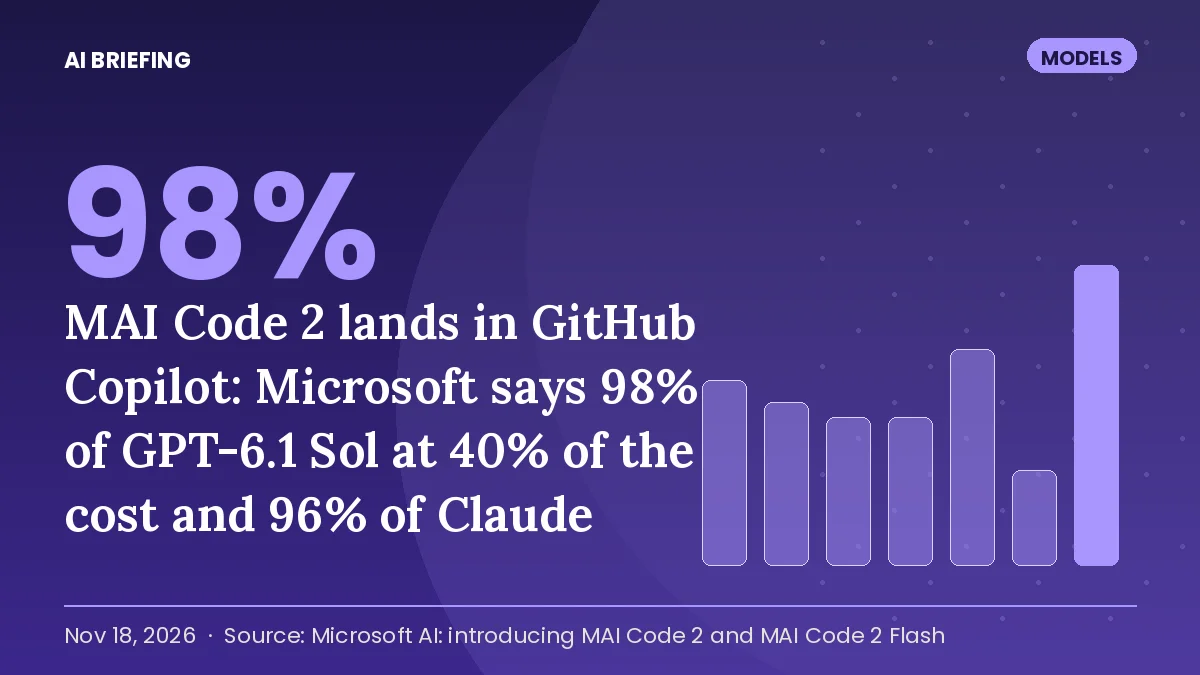
MAI Code 2 lands in GitHub Copilot: Microsoft says 98% of GPT-6.1 Sol at 40% of the cost and 96% of Claude Opus 5.5 at 5%. What the claims hide, and what Ignite changed for anyone building agents
Microsoft now ships its own frontier-adjacent coding model inside the subscription it already sells, and starts metering agent run-time in Foundry on December 1. The benchmark averages are the least important part.
Microsoft AI released MAI Code 2 and MAI Code 2 Flash on Tuesday as Ignite opened in San Francisco. Both are generally available in GitHub Copilot the same day: Code 2 on the Pro, Pro+, Max, Business and Enterprise plans, Flash additionally on Free and Student, across VS Code, Visual Studio, JetBrains, Xcode, Eclipse, the command line, the cloud coding agent and the mobile app. Flash is also in limited preview on Microsoft Foundry, and both are promised soon on OpenRouter, Vercel, OpenCode and Kilo.
The claims
Microsoft's numbers are relative, not absolute. It says Code 2 reaches 98% of GPT-6.1 Sol's performance at 40% of its cost, and 96% of Claude Opus 5.5 at 5% of its cost, averaged across DeepSWE 1.1, Terminal Bench 2.1, SWE-Atlas and FrontierCode v1.1. Flash is described as comparable to GPT-6 Luna and Claude Haiku 5.5 at 65% and 20% of their prices. A blind front-end preference test of 258 annotators preferred Code 2 to GPT-6 Sol 67% of the time on the model page and 64% on the Ignite page. No raw benchmark scores are published, no per-token price is published, and the cost ratios are computed on a 50% promotional price with no end date. A reader cannot reconstruct any of the comparisons from the announcement.
That does not make the model bad. It makes the announcement a marketing document, and the right response is to put Code 2 on your own repository with your own task set and measure completion rate per dollar against whatever you use now.
What else Ignite shipped
MAI Cyber 2 Flash is available to defenders through the Microsoft Defender programme and scored 83.2% on CyberGym end-to-end in a third-party test. MAI Image 2.7 Flash is priced at about $10 per thousand images and MAI Realtime 1 from one cent per audio minute. Decision 1.1 is generally available with a claimed 4,000 customers and a claim of being 50 times faster and 79 times cheaper than GPT-6.1 Sol on the scoring tasks it is built for. GPT-6.2 is described as coming to Foundry. The Copilot harness, Microsoft's agent runtime, enters public preview in Foundry Agent Service with more than twenty frontier models behind it, and runtime billing begins on December 1. GitHub's changelog of November 16 also retired Claude Opus 4.8, Opus 5 and GPT-5.6 Terra from the Copilot picker, added Claude Fable 5.2 and Gemini 4 Carbon, and introduced an Agents inbox in VS Code.
Why it matters more than a benchmark
Microsoft pays OpenAI for every Copilot completion served by an OpenAI model. A first-party model that it judges good enough for 98% of the work at 40% of the cost is a direct improvement in Copilot's gross margin and a reduction in what flows to OpenAI, on the same week OpenAI cut its own flagship price. It also changes the question a Copilot buyer should ask. Until now the pitch was access to the best models from every lab. From today the default may be Microsoft's own, and the routing decision is made in Redmond.
The counter-argument
Averages across four benchmarks hide the distribution; a model that is 98% as good on average can be 80% as good on the long-horizon tasks that matter most and 110% on the easy ones. Microsoft's own blind test used front-end tasks, the category where current models are strongest. And the deprecation list shows the cost of building on a picker: three models that teams had tuned prompts for disappeared on a Sunday.
What to do
Run Code 2 and Flash through your evaluation set this week and record cost per merged change, not per token. Set your Copilot organisation policy explicitly rather than inheriting the new default. If you use the Foundry harness preview, estimate December's bill now from the metering documentation. And treat the model-picker deprecations as a recurring event: keep prompts and evals portable across models, because the next retirement will also arrive on a weekend.
Sources
Microsoft AI: introducing MAI Code 2 and MAI Code 2 Flash ↗GitHub changelog ↗Microsoft Ignite 2026 blog ↗The story so far
- Nov 18, 2026 Microsoft's agent-framework package was poisoned on PyPI for 45 minutes with a stealer that ran at every Python start-up…
- Nov 17, 2026 Qwen4-Max at $1.50 / $4.50: 2.4 trillion parameters, 71 billion active, a 1M window, and a benchmark story that depends …
- Nov 16, 2026 GXO's plan for up to 1,000 Apptronik Apollo humanoids over four years: what a robots-as-a-service letter of intent actua…
- Nov 15, 2026 Microsoft's Lazarus: seven edited neurons out of 12,000 backdoor a coding agent 98.8% of the time and pass every standar…
Key terms in this story
- Frontier model A model at or near the state of the art at the time, typically the newest top tier from a major lab.
- Evaluation (eval) A test set with known-good answers used to measure a model or system on your own tasks.
- Benchmark A standard test used to compare models, such as a set of coding tasks or exam questions.
- Token The unit models read and write; roughly three-quarters of an English word. Pricing and context limits are counted in tokens.
- Agent An AI system that pursues a goal by taking actions with tools, in a loop, rather than answering a single question.
More in Developer tools
All →
Perplexity's Brain: an agent memory that records its own work and rewrites its skills overnight, with correctness up 25% on repeat tasks. What to copy, and what to guard
Memory about the user is old news; memory about what the agent did, what failed and what was corrected is the new layer, and it is also a new place fo…
macOS 27.3 tightens Full Disk Access because of AI agents: silent denials, no one-click toggle, and a 'Private Folders' permission in the code. What agent developers should do before December
Apple is removing the shortcut that let an assistant app earn blanket access to Mail, Messages and backups with a single switch, and the scoped altern…
llama.cpp 1.0.0 after 3.5 years: semantic versioning, 35 deprecated functions gone, FP8 KV cache. What the stability promise changes for local AI
The engine under Ollama, LM Studio and most on-device inference now promises that breaking changes arrive only with a major version; for the teams tha…
Get the brief in your inbox
One email every morning: the stories that mattered in AI, each with a one-line "why it matters" for your role. Free, no ads, unsubscribe any time.
Published daily by AI Briefing. We never share your address.