Perplexity's Brain: an agent memory that records its own work and rewrites its skills overnight, with correctness up 25% on repeat tasks. What to copy, and what to guard
Memory about the user is old news; memory about what the agent did, what failed and what was corrected is the new layer, and it is also a new place for bad instructions to persist.
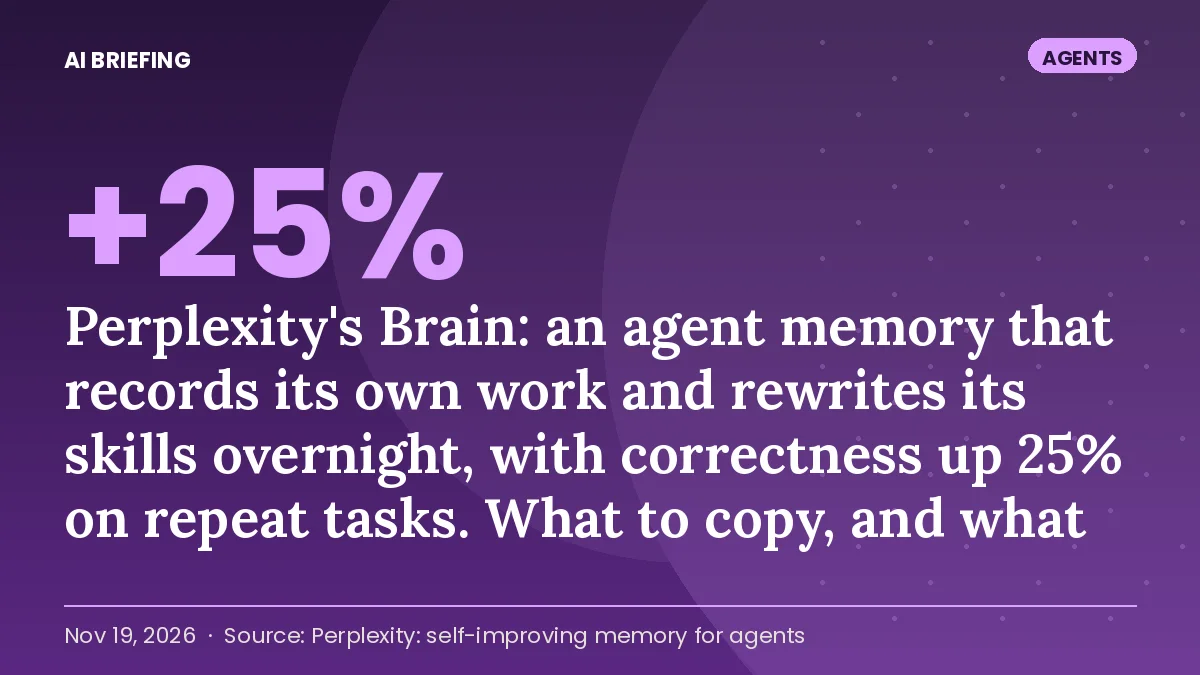
Perplexity has added a memory layer called Brain to its Computer agent, available as a research preview to Max and Enterprise Max subscribers. The design inverts the usual meaning of agent memory. Rather than storing facts about the user, their preferences, contacts and projects, Brain stores a record of the work itself: what the agent did on each task, what succeeded, what failed and what the user corrected. It builds that record into a context graph, reviews it at set intervals, typically overnight, and uses the review to update the skills and context the agent loads the next time it runs. The updated material lives in what Perplexity calls an LLM wiki, loaded automatically into the agent's sandbox and revised incrementally, and every entry links back to the session, file or source it was derived from.
The numbers
Perplexity reports early measurements rather than a benchmark: answer correctness up 25% on tasks the agent has encountered before, recall up 16%, and the cost of tasks that need historical context down 13%, because the agent no longer re-derives what it already learned. All three are internal figures with no published test set, and all three are scoped to repeated work. Nothing is claimed for tasks the agent has never seen, which is the honest boundary of the approach: a memory of past work helps when the future resembles the past.
Why it matters
Agent skills, the reusable instruction files that tell a model how to carry out a class of task, have become the main way teams encode process knowledge, and they are maintained by hand. Someone notices the agent keeps mishandling an expense-report format, edits the skill, and hopes the edit generalises. Brain automates that loop and, importantly, keeps the provenance of each change. That second part is what separates a usable system from a black box: when the agent's behaviour shifts, a reviewer can trace the new rule back to the session that produced it. The economics follow. If a meaningful share of enterprise agent work is repetitive, a 13% cost reduction on context-heavy tasks compounds across a workforce of agents, and the correctness gain reduces the human review that currently dominates the real cost of agent deployments.
The risk
A self-editing instruction layer is also a self-persisting attack surface. Indirect prompt injection today has to succeed in the session where the poisoned document is read. With an overnight review that converts observed sessions into standing skills, a malicious instruction encountered on Monday can become part of the agent's default behaviour on Tuesday, and it will carry a plausible provenance link because it did come from a real session. Perplexity's traceability helps detection; it does not prevent the write. The second risk is quieter: an agent that optimises for last week's tasks can drift away from the general behaviour the vendor shipped, and the drift is invisible unless you evaluate on held-out tasks. Google's GTIG report this week described a backdoor delivered through an agent's settings file; a memory layer is a richer version of the same target.
What to do
If you build agents, copy the architecture, not the claim: a work log with provenance, a scheduled review that proposes skill edits, and a human or policy gate between proposal and load. Keep memory entries in version control and diff them, treat the review job's output as untrusted input, and ban it from writing anything that grants permissions or changes tool access. If you buy agents, ask vendors three questions: can I see and approve what the agent learned overnight, can I roll a memory back, and are gains measured on tasks the agent has not seen. If you are a security team, add agent memory stores to the list of places you look for persistence; the CISO agent checklist on this site has a control for configuration files, and memory is the same control.
What to watch
Whether Perplexity publishes an evaluation with a held-out set, whether memory entries get a signing or approval step before they load, and how quickly OpenAI, Anthropic and Google ship equivalents; all three have skills systems and none has yet described one that rewrites them unattended.
The story so far
- Nov 18, 2026 Microsoft's agent-framework package was poisoned on PyPI for 45 minutes with a stealer that ran at every Python start-up…
- Nov 17, 2026 Google's GTIG finds 'exploit_agent', the first framework that turns a vendor patch into a live exploit with no human in …
- Nov 17, 2026 Qwen4-Max at $1.50 / $4.50: 2.4 trillion parameters, 71 billion active, a 1M window, and a benchmark story that depends …
- Nov 17, 2026 macOS 27.3 tightens Full Disk Access because of AI agents: silent denials, no one-click toggle, and a 'Private Folders' …
Key terms in this story
- Indirect prompt injection An attack in which malicious instructions are hidden in content the model reads (a web page, email, document or tool result) rather than typed by the user.
- Prompt injection An attack in which text the model reads, such as a web page or email, contains instructions that hijack its behaviour.
- Evaluation (eval) A test set with known-good answers used to measure a model or system on your own tasks.
- Benchmark A standard test used to compare models, such as a set of coding tasks or exam questions.
- Agent An AI system that pursues a goal by taking actions with tools, in a loop, rather than answering a single question.
More in Developer tools
All →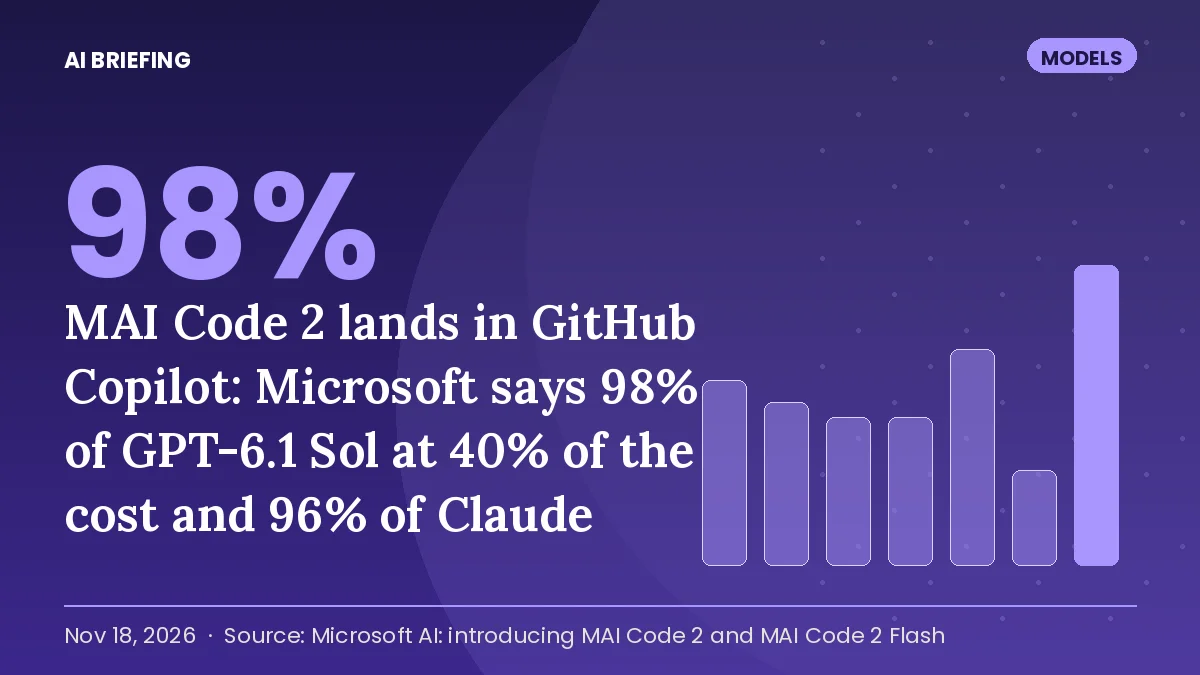
MAI Code 2 lands in GitHub Copilot: Microsoft says 98% of GPT-6.1 Sol at 40% of the cost and 96% of Claude Opus 5.5 at 5%. What the claims hide, and what Ignite changed for anyone building agents
Microsoft now ships its own frontier-adjacent coding model inside the subscription it already sells, and starts metering agent run-time in Foundry on …
macOS 27.3 tightens Full Disk Access because of AI agents: silent denials, no one-click toggle, and a 'Private Folders' permission in the code. What agent developers should do before December
Apple is removing the shortcut that let an assistant app earn blanket access to Mail, Messages and backups with a single switch, and the scoped altern…
llama.cpp 1.0.0 after 3.5 years: semantic versioning, 35 deprecated functions gone, FP8 KV cache. What the stability promise changes for local AI
The engine under Ollama, LM Studio and most on-device inference now promises that breaking changes arrive only with a major version; for the teams tha…
Get the brief in your inbox
One email every morning: the stories that mattered in AI, each with a one-line "why it matters" for your role. Free, no ads, unsubscribe any time.
Published daily by AI Briefing. We never share your address.