Isomorphic Labs raises $5 billion with no drug in a human: the largest private biotech round ever, $7.7 billion in twenty months, and what the money is actually buying
The DeepMind spinout has now raised more than most public biotechs are worth, on preclinical data it has not published. The bet is that an AI design engine changes the clock, and the first trial is the test.
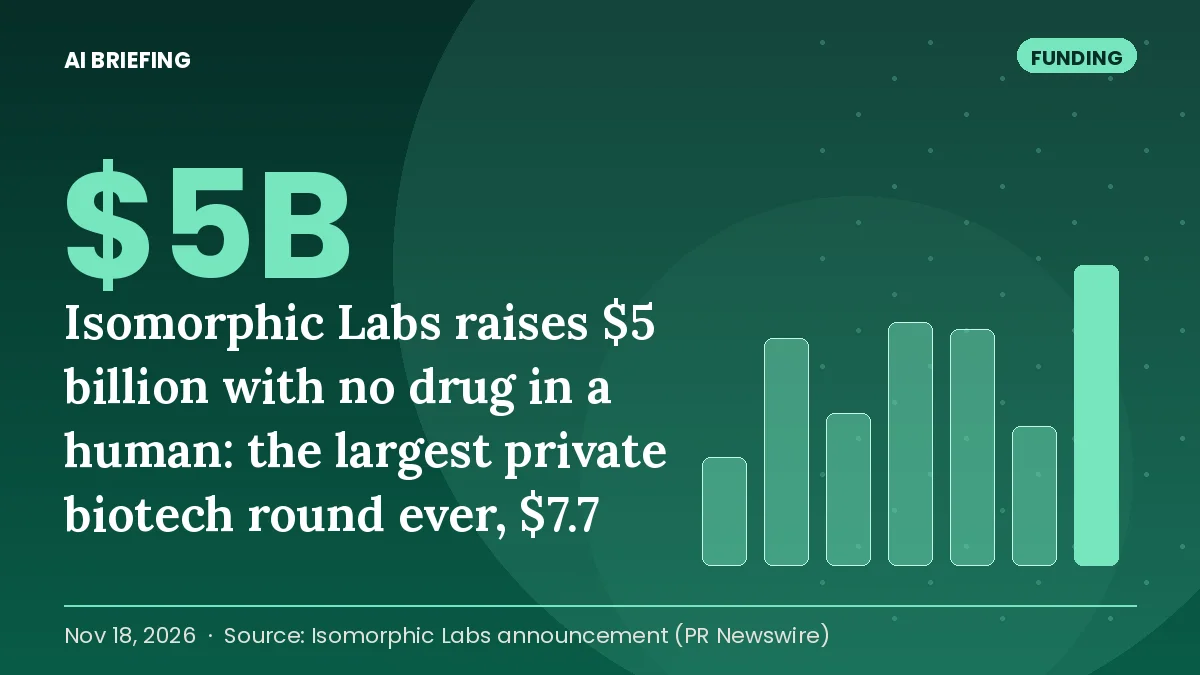
Isomorphic Labs announced on Tuesday an oversubscribed $5 billion Series C, co-led by Greenoaks and Sequoia Capital, with Andreessen Horowitz joining as a new investor and Alphabet, which spun the company out of DeepMind in 2021, continuing with what the release calls a significant investment. Thrive Capital, MGX, GV, CapitalG, Temasek and the UK Sovereign AI Fund returned. BioSpace describes it as the largest fundraise in the history of the biotech industry. It follows a $600 million first external round in March 2025 and a $2.1 billion Series B led by Thrive in May, which puts external funding at about $7.7 billion in twenty months. The company disclosed no valuation; Bloomberg reported earlier this month that talks were at around $50 billion.
What the money is for
The release names four uses: maturing the IsoDDE drug design engine and the simulation models behind it, building a partner ecosystem, global AI-bioengineering infrastructure, and what it calls AI-first translational and clinical development infrastructure. The last item is the new one. Isomorphic has to date presented itself as a design company that hands molecules to partners; building its own clinical capability means it intends to take programmes into humans itself. The release says positive preclinical results in oncology and immunology set the stage for clinical entry, but names no candidate, target, indication or date. Demis Hassabis has said in interviews that the first trial could begin by the end of this year.
The existing partnerships are the only revenue on the table: Eli Lilly, with up to $1.7 billion in milestones, and Novartis, with up to $1.2 billion, both signed in January 2024, and Johnson & Johnson, which joined in January on undisclosed terms. Milestone payments arrive when programmes advance, which is to say the partnerships pay out on the same event the Series C is waiting for.
The market it sits in
Menlo Ventures' healthcare report, published Monday, estimates 2026 spending on AI drug discovery at $700 million, up from $30 million a year earlier, the fastest-growing category in a healthcare AI market the firm puts at $3.7 billion. That whole category's annual spend is a seventh of what Isomorphic raised in one round. The comparison makes the point: this is not a company selling into the drug-discovery software market, it is a company that intends to own drugs, and it is being valued as a pharmaceutical platform rather than as a vendor.
The counter-argument
Every AI drug-discovery company that reached the clinic before Isomorphic has learned that the bottleneck was never the design step. Phase 2 failure rates for AI-designed molecules have so far matched the industry average, because efficacy in humans depends on target biology that no structure model has changed. Isomorphic's published evidence remains the AlphaFold lineage, which predicts structure; its claims about binding, selectivity and toxicity prediction are internal. A $5 billion round for a company whose first human dose is still ahead of it is a statement about the investors' cost of capital at least as much as about the science. And the alternative use of that capital, forty $125 million Series A rounds in the same field, would have bought a great deal of diversification.
What to watch
An IND filing or a first-patient-dosed announcement before the end of December, which would convert Hassabis's statement into a dated programme and start the milestone clock with Lilly or Novartis. Any disclosure of the valuation, which determines whether the company is now worth more than the partners it designs for. Whether the new clinical infrastructure is built or bought; a CRO acquisition would be the fastest route. And the next Menlo-style spending survey: if the drug-discovery category is still measured in hundreds of millions while its leading company is measured in tens of billions, the gap is the risk.
Sources
Isomorphic Labs announcement (PR Newswire) ↗BioSpace ↗Menlo Ventures, 2026 State of AI in Healthcare (PDF) ↗The story so far
- Nov 18, 2026 Genesis AI raises $500 million at $3.5 billion for a robot trained on glove data from 100 workers, and GlobalFoundries b…
- Nov 17, 2026 Google's GTIG finds 'exploit_agent', the first framework that turns a vendor patch into a live exploit with no human in …
- Nov 16, 2026 Project Zero's 'Full X' policy: 90 days now, 60 from February, 30 from January 2028, fixed or not. What LLM-speed exploi…
- Nov 15, 2026 Mirendil's $1 billion Series A at a reported $5 billion, eleven months after founding: what investors are buying when th…
Key terms in this story
- Oversubscribed (IPO book) When investors have placed orders for more shares than a company is offering in its initial public offering.
- Network token (payments) A substitute card number issued by Visa, Mastercard or American Express for one transaction or merchant, so the real card details never reach the merchant or the software making the purchase.
More in Health & medicine
All →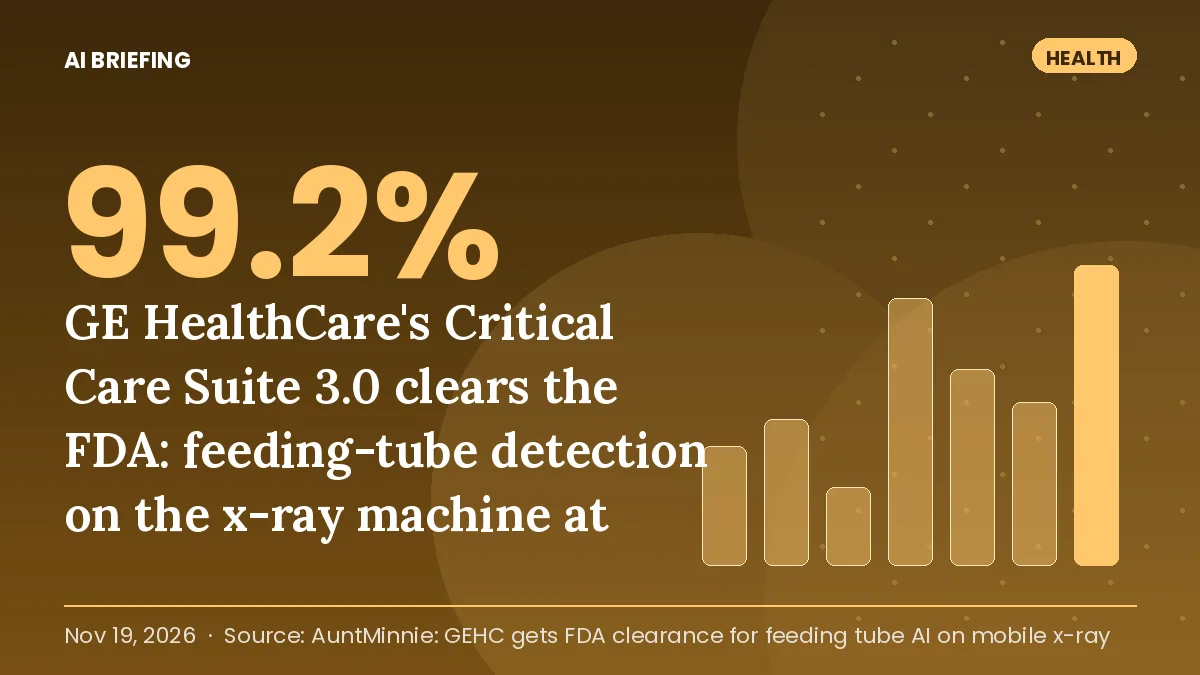
GE HealthCare's Critical Care Suite 3.0 clears the FDA: feeding-tube detection on the x-ray machine at 99.2% sensitivity, offline, and for children for the first time. What hospitals should ask before switching it on
On-device imaging AI sidesteps the integration and data-sharing problems that stall most hospital deployments; the questions that remain are about the…
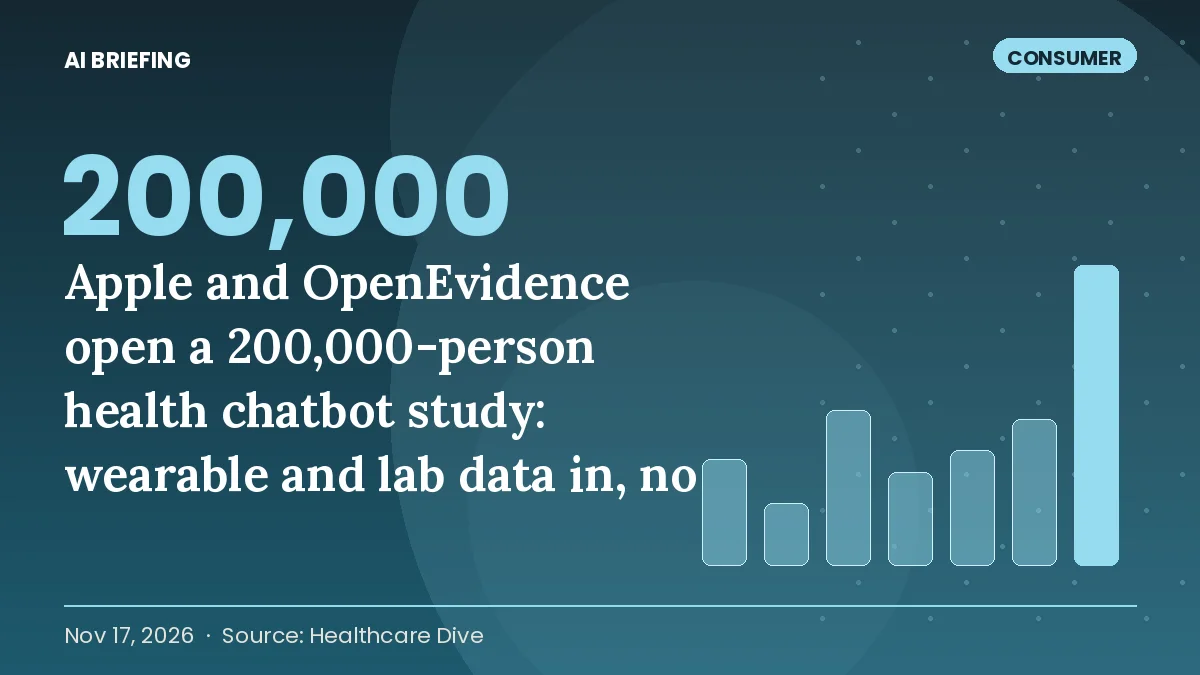
Apple and OpenEvidence open a 200,000-person health chatbot study: wearable and lab data in, no model training, no device claim. What health systems should watch
Apple has chosen the clinical search tool most US doctors already use as the engine for its first consumer health conversation, and is running it as r…
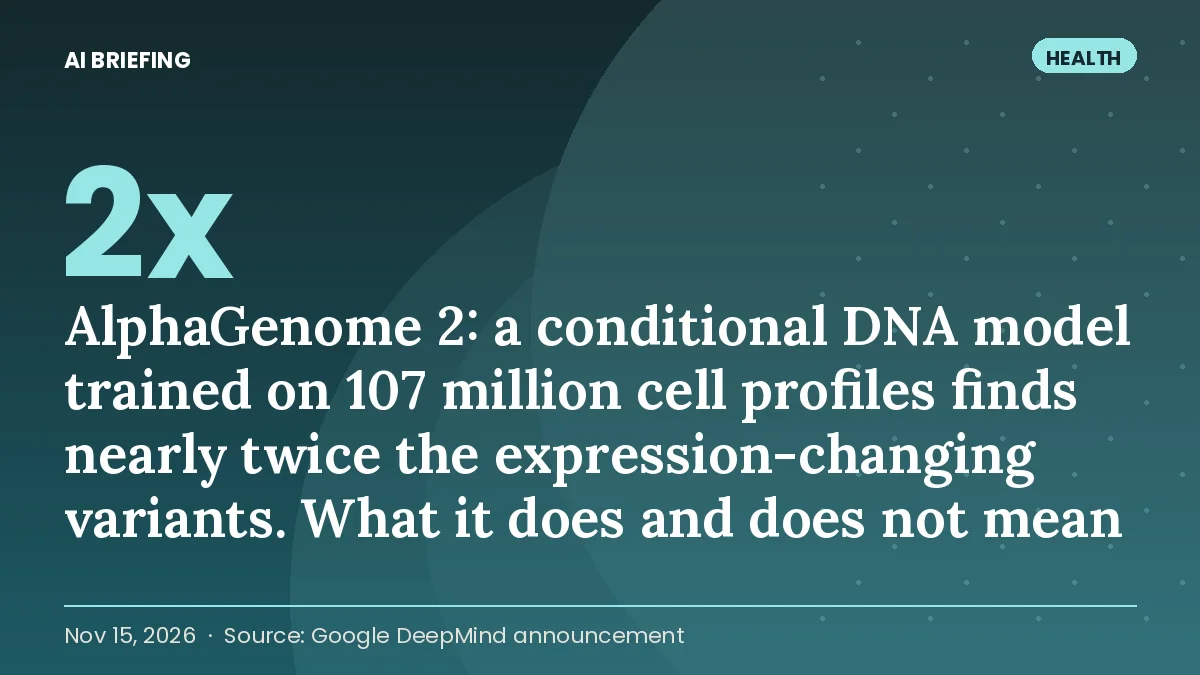
AlphaGenome 2: a conditional DNA model trained on 107 million cell profiles finds nearly twice the expression-changing variants. What it does and does not mean for drug discovery
DeepMind's second genome model answers the question the first could not: what a variant does in this cell type. That is the question target-discovery …
Get the brief in your inbox
One email every morning: the stories that mattered in AI, each with a one-line "why it matters" for your role. Free, no ads, unsubscribe any time.
Published daily by AI Briefing. We never share your address.