Mirendil's $1 billion Series A at a reported $5 billion, eleven months after founding: what investors are buying when they buy 'AI that does AI research'
A 5x step-up in five months with no disclosed revenue is a bet on a thesis; here is the thesis, the three claims that support it, and the two numbers that would prove or disprove it.
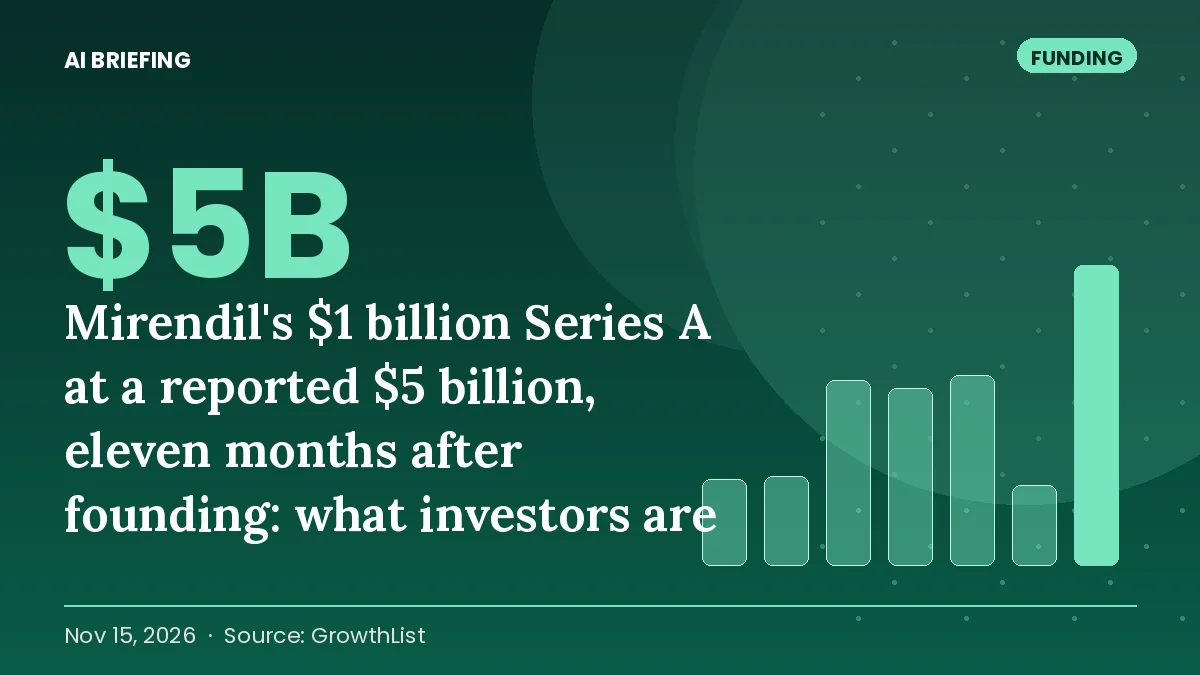
Mirendil announced a $1 billion Series A on November 12, led by Kleiner Perkins and Clearlake Capital, with Google, Battery Ventures, Doerr Capital, Gil & Co, M13, Pear VC and S32 joining alongside existing investors. The company was founded in December 2025 and raised a $200 million seed in June, co-led by Andreessen Horowitz and Kleiner Perkins, at a valuation of about $1 billion. It has not disclosed the new valuation. A16z's jobs newsletter described the round as closing at $5 billion, and Bloomberg reported that figure in September as the target of the talks. No major outlet has yet confirmed it as the closed-round number, so we treat it as reported.
Who they are
The founders are Behnam Neyshabur, who co-led Google DeepMind's Blueshift team working on reasoning and mathematics for Gemini, and Harsh Mehta, who built the first version of Anthropic's internal research platform. Both joined Anthropic in late 2024 and left together in December 2025 with two colleagues, Shayan Salehian from xAI and MIT graduate Tara Rezaei Kheirkhah. Neyshabur's one-line pitch is that the most important application of AI is AI itself.
What they say they have built
Three claims support the valuation, and each is checkable in principle. Mirendil-Base is a coding model the company says one researcher, working with agents, pretrained from scratch in three and a half months for under $10 million of compute. Fern is a post-trained model with a context window the company puts at up to 10 million tokens. Lor, in private beta, is the product: a system that coordinates hundreds of agents to write code, design experiments, run them and iterate, which Mirendil says it uses daily for its own research. Compute comes in part from a Google Cloud agreement reported in August at more than $100 million, covering both TPUs and Nvidia GPUs; Google's presence in the round is not a coincidence.
Why investors paid up
The funding market has spent this year rewarding two kinds of company: those with revenue (LangChain's $300 million at $3 billion on 7,000 LangSmith customers, announced the same Friday) and those with a thesis investors cannot afford to miss. Mirendil is the second kind. If research agents can run the experimental loop of a frontier lab, the binding constraint on model progress shifts from researcher headcount to compute, and the handful of labs with thousands of researchers lose part of their advantage. Thinking Machines raised on a similar premise last year; Mirendil's twist is to sell the loop rather than the model. The round also lands in a week when Anthropic's IPO is reportedly covered several times over, which tells you how much capital is looking for AI exposure outside the public offering.
The counter-argument
The sceptical case is simple. Automated research is the claim every frontier lab now makes about its own internal agents. If the incumbents already have it, the market for a standalone research loop is other labs, and there are few of them. A 10 million token context and a sub-$10 million pretraining run are headline figures without published evaluations. And a $5 billion valuation implies a path to several hundred million dollars of revenue from a private beta product, in a year when two of the most capitalised labs in the world are about to be public companies competing for the same customers.
What the numbers would need to show
Two disclosures would settle most of the argument. A benchmark table for Mirendil-Base against open models of similar size, with the token count of the pretraining run, would show whether the cost claim is real or an accounting of marginal compute. And a named Lor customer running experiments it did not design would show the product generalises beyond its maker. Until then, this is a well-backed research lab with a strong team and a thesis, priced as if the thesis were proven.
What to watch
Whether Mirendil publishes evaluations for Fern and the base model before year end; whether Lor leaves private beta with pricing; and whether the Google Cloud relationship grows into the kind of compute commitment that would make Google both investor, supplier and, potentially, acquirer.
Sources
GrowthList ↗Dealroom, reporting Bloomberg's September account of the talks ↗SiliconANGLE on the June seed round ↗The story so far
- Nov 15, 2026 Microsoft's Lazarus: seven edited neurons out of 12,000 backdoor a coding agent 98.8% of the time and pass every standar…
- Nov 15, 2026 AlphaGenome 2: a conditional DNA model trained on 107 million cell profiles finds nearly twice the expression-changing v…
- Nov 14, 2026 Nvidia approached Arm's Rene Haas, FT reports, as VCs count the 105 startup rounds Huang's Nvidia joined this year
- Nov 14, 2026 IBM's Granite 4.1 LLMON previews train the model to separate instructions from data, claiming near-zero indirect prompt-…
Key terms in this story
- Context window The maximum text a model can consider in one request: prompt, documents, conversation and answer combined.
- Evaluation (eval) A test set with known-good answers used to measure a model or system on your own tasks.
- Benchmark A standard test used to compare models, such as a set of coding tasks or exam questions.
- Token The unit models read and write; roughly three-quarters of an English word. Pricing and context limits are counted in tokens.
- Agent An AI system that pursues a goal by taking actions with tools, in a loop, rather than answering a single question.
More in Finance & markets
All →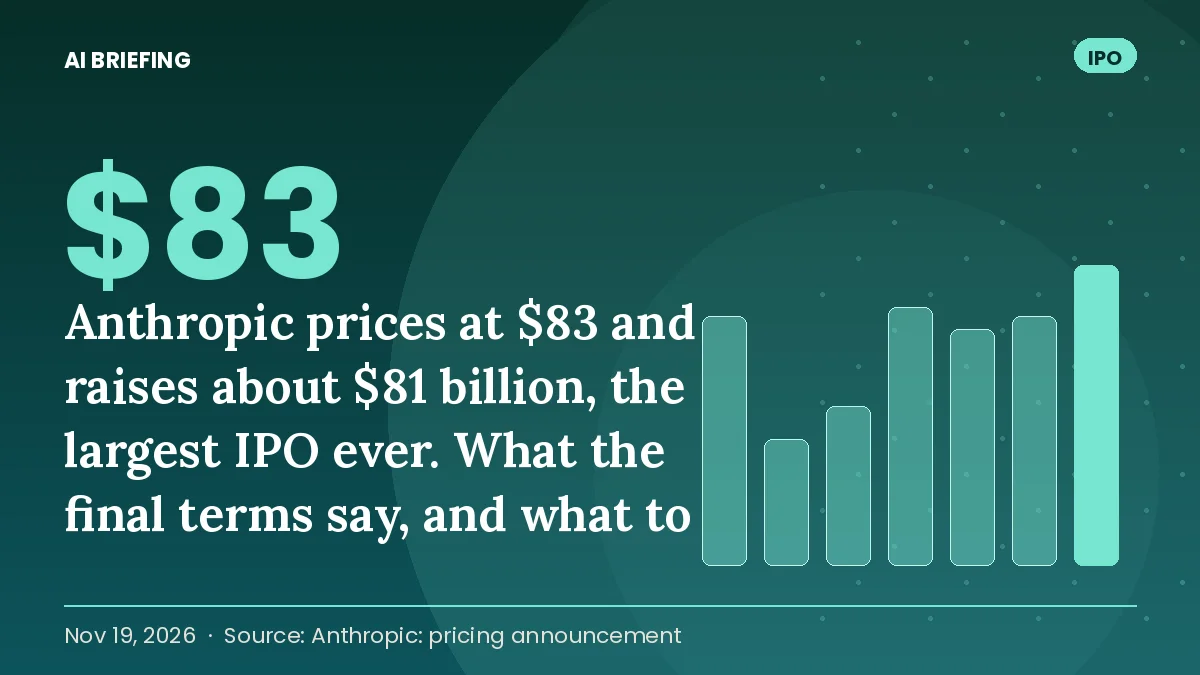
Anthropic prices at $83 and raises about $81 billion, the largest IPO ever. What the final terms say, and what to watch when ANT opens today
The price landed $5 above the top of the range and the share count grew, which tells you how the book filled; the prospectus numbers tell you what the…
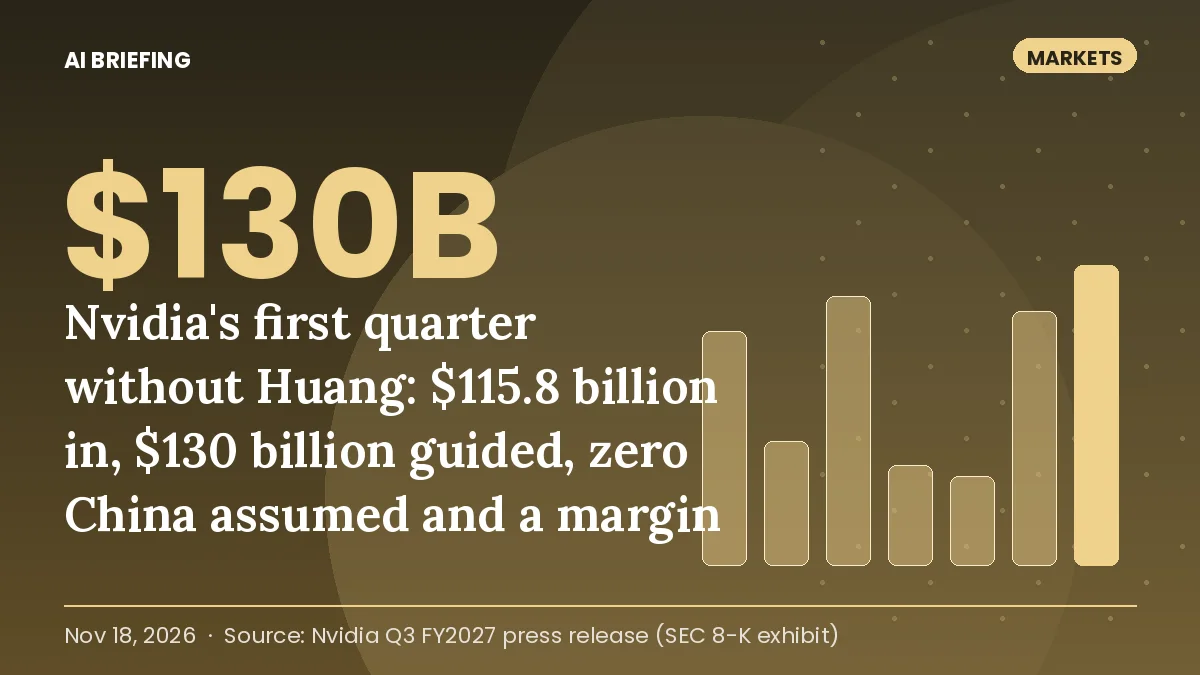
Nvidia's first quarter without Huang: $115.8 billion in, $130 billion guided, zero China assumed and a margin that falls to 71%. What the numbers say about 2027
The beat was expected; the shape of the guide was not. Nvidia is now telling investors that the next quarter will be bigger, less profitable per dolla…
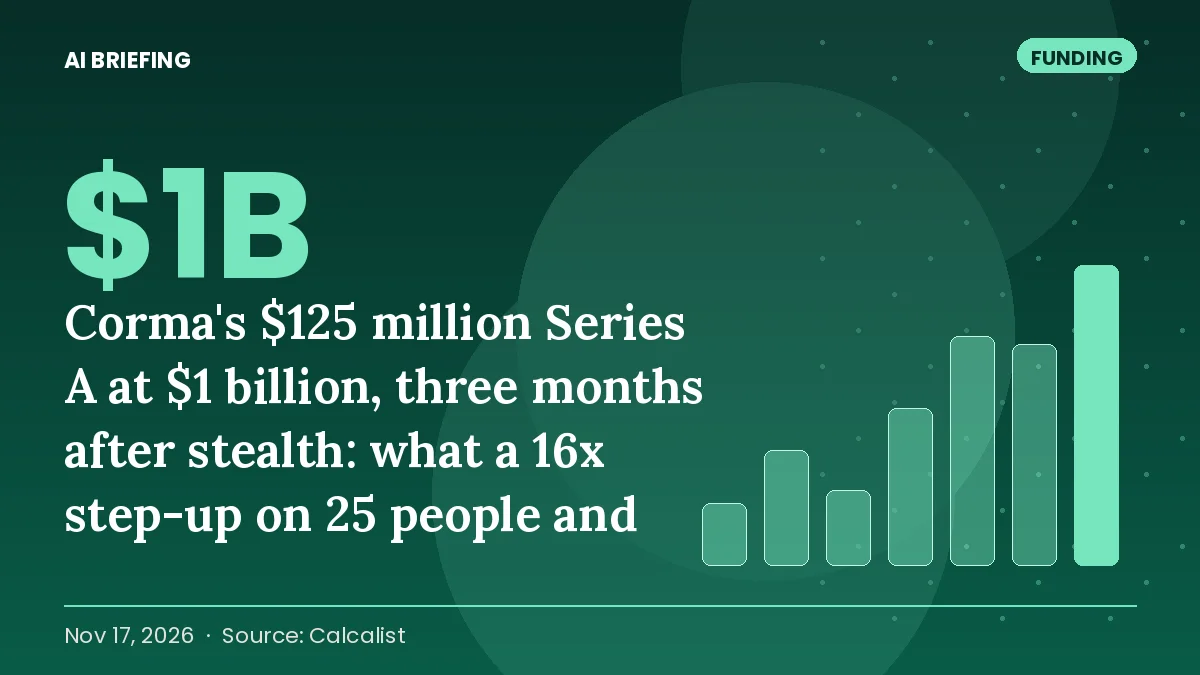
Corma's $125 million Series A at $1 billion, three months after stealth: what a 16x step-up on 25 people and undisclosed revenue says about the defensive-AI market
NEA has priced a defensive cybersecurity foundation-model lab as a unicorn before it has named a customer, betting that the autonomous attack tools in…
Get the brief in your inbox
One email every morning: the stories that mattered in AI, each with a one-line "why it matters" for your role. Free, no ads, unsubscribe any time.
Published daily by AI Briefing. We never share your address.