DevelopingNvidia approached Arm's Rene Haas, FT reports, as VCs count the 105 startup rounds Huang's Nvidia joined this year
The succession search is weeks from a decision at best; the money Nvidia poured into neoclouds and model labs under Huang may change faster than the CEO's office does.
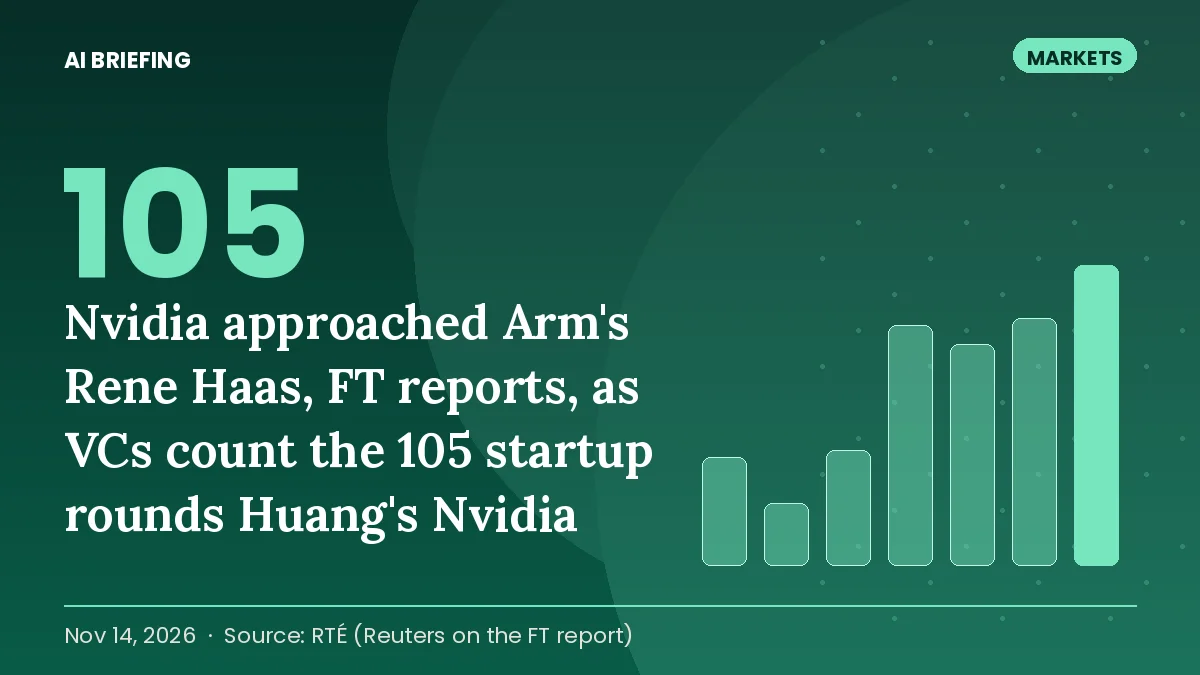
Two stories about Nvidia ran on Friday, and the second matters more to most readers than the first. The Financial Times reported that Nvidia's board has approached Rene Haas, chief executive of Arm, as a possible successor to Jensen Huang; Reuters could not verify it, Arm declined to comment, and Nvidia said it is still selecting a search firm and that speculation about any candidate, internal or external, is premature. Separately, TechCrunch gathered venture investors who put a number on what Huang's departure removes from the startup market: Nvidia took part in 105 funding rounds this year, often as the largest cheque.
The Haas approach, and why it is slow
Haas, 64, is a plausible name because he is a former Nvidia executive. He joined in 2006, ran the computing products business for seven years, moved to Arm in 2013 and has been its CEO since February 2022, taking it public on Nasdaq in September 2023 at roughly $54.5 billion. He also sits on SoftBank's board and since April has run SoftBank Group International, the unit that holds SoftBank's AI bets. Any move to Nvidia would mean untangling all three.
The FT described him as one of several candidates with no guarantee of an offer or an acceptance. Analysts quoted by Decrypt have also floated Nvidia's data-centre head Ian Buck and AMD's Lisa Su; neither is more than a name on a list. Inside Nvidia, Wired reported, a suggestion-box thread has drawn more than 1,600 comments, many asking the board to bring Huang back. That is a measure of staff sentiment, not of board intent. Arm's US shares closed down more than 5% and Nvidia's more than 3%.
The funding gap is already open
Under Huang, Nvidia behaved like the largest AI venture fund in the world. TechCrunch's reporting lists CoreWeave, Crusoe (including a $1.4 billion Series E), Mistral, Lambda, Black Forest Labs and an $800 million cheque into Reflection AI's $2 billion Series B before that company had meaningful revenue, alongside the pending $13 billion Hugging Face acquisition expected to close in 2027. Investors described a pattern: an infrastructure startup needing $100 million to $500 million of GPUs could raise roughly half of it from Nvidia at a $1 billion-plus valuation, and the deal locked the startup into Nvidia hardware.
Several investors said those decisions ran through Huang personally and that interim CEO Colette Kress is seen as more conservative. The expectation is smaller follow-on cheques and a narrower set of new bets. Battery Ventures' Dharmesh Thakker doubted Google, Amazon, Microsoft or AMD would write hundreds of millions into pre-revenue infrastructure companies the way Nvidia did; others argued the ecosystem is now bigger than one person.
The counter-argument
Nvidia's 8-K promised no change to the roadmap or customer commitments, and a board that just pushed out a founder over governance is unlikely to announce a strategy shift before earnings. Kress has co-signed every one of those investments as CFO. The venture pullback is an expectation, not an announcement, and Nvidia still has the balance sheet to keep investing if it chooses. The $500 billion AI data-centre financing pact announced in August has not produced deals, but that was true before Huang left.
What to watch
Tuesday's third-quarter call is the first with Kress alone and the first since Anthropic's prospectus disclosed a $10 billion Nvidia commitment; listen for the phrase 'strategic investments' in the guidance. Watch whether any Nvidia-backed neocloud reprices or delays a round in the next month. And watch Arm: if Haas is named, SoftBank has a succession problem of its own, and Nvidia would be run by someone whose last decade was spent making CPUs matter in AI servers.
The story so far
- Nov 13, 2026 Huang resigns from Nvidia: what the 8-K says, what the 14% intraday drop prices in, and why November 17 now matters more
- Nov 12, 2026 Nvidia's board weighs removing Jensen Huang: what an 8.6% after-hours drop and a $200 price target are pricing in
- Nov 11, 2026 Anthropic's IPO range is $70–78: what the amended S-1 says about dilution, lock-ups and the $26 billion partner placemen…
- Nov 8, 2026 OpenAI at $1.25T, Anthropic talked down to $1.2–1.3T: the week AI's two giants got repriced
Key terms in this story
- GPU Graphics processing unit: the chip type, dominated by Nvidia, that performs the parallel arithmetic AI training and inference require.
More in Finance & markets
All →
Anthropic prices at $83 and raises about $81 billion, the largest IPO ever. What the final terms say, and what to watch when ANT opens today
The price landed $5 above the top of the range and the share count grew, which tells you how the book filled; the prospectus numbers tell you what the…
Nvidia's first quarter without Huang: $115.8 billion in, $130 billion guided, zero China assumed and a margin that falls to 71%. What the numbers say about 2027
The beat was expected; the shape of the guide was not. Nvidia is now telling investors that the next quarter will be bigger, less profitable per dolla…
Corma's $125 million Series A at $1 billion, three months after stealth: what a 16x step-up on 25 people and undisclosed revenue says about the defensive-AI market
NEA has priced a defensive cybersecurity foundation-model lab as a unicorn before it has named a customer, betting that the autonomous attack tools in…
Get the brief in your inbox
One email every morning: the stories that mattered in AI, each with a one-line "why it matters" for your role. Free, no ads, unsubscribe any time.
Published daily by AI Briefing. We never share your address.