DevelopingHuang resigns from Nvidia: what the 8-K says, what the 14% intraday drop prices in, and why November 17 now matters more
The founder who ran the company for 33 years is gone with immediate effect, the CFO is running it, and the first earnings call without him is four days away.
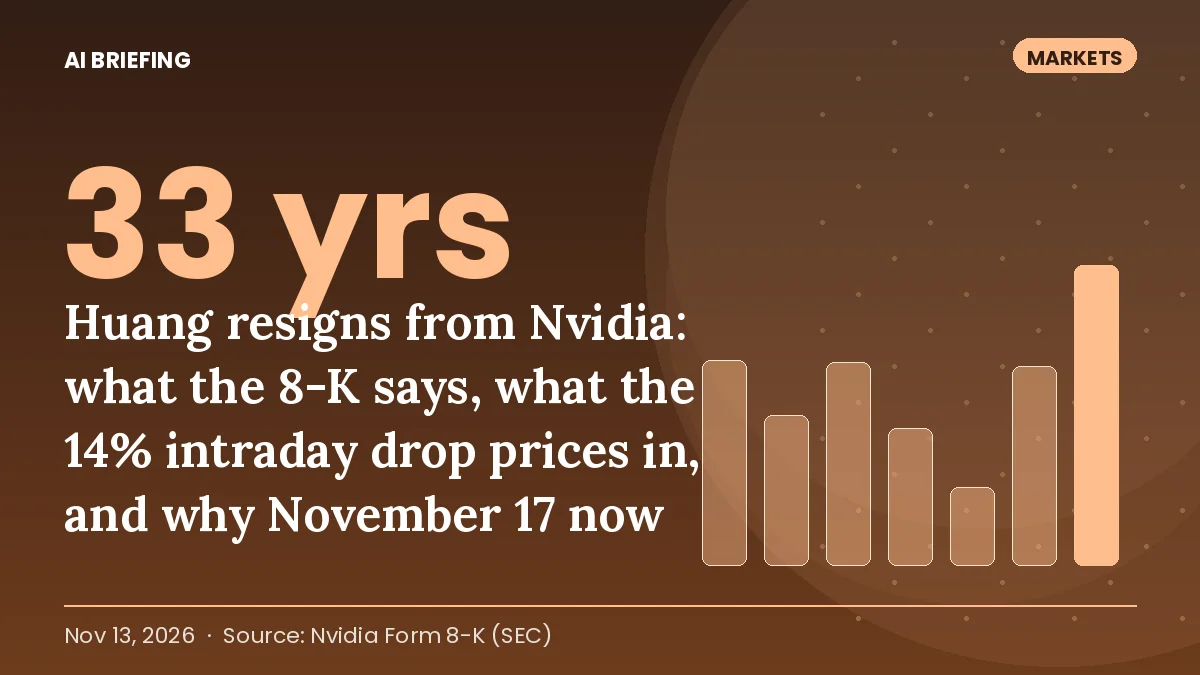
Nvidia filed a Form 8-K on November 12 saying Jensen Huang has resigned as president, chief executive and director, effective immediately. Colette Kress, the chief financial officer since 2013, is interim CEO and keeps the CFO job. Harvey Jones, the former Synopsys chief executive who has sat on Nvidia's board for decades, becomes the company's first-ever chair. The board says it will consider internal and external candidates for a permanent successor.
What the filing does and does not say
The 8-K gives no reason for the departure. It thanks Huang for 33 years, says the board has "full confidence" in Kress and the leadership team, and repeats that operations, customer commitments and the product roadmap continue without interruption. The resignation follows a week of reporting on Huang's personal relationships, including one with a senior executive who reported to him and alleged contact with a former Megaspeed executive accused of working for Chinese intelligence. Huang admitted infidelity on Sunday and apologised to employees. The board opened an independent investigation and says it has no reason to believe national security was compromised; no evidence has been published that company secrets were lost. Those allegations remain allegations.
The one hard date in the filing is unchanged: third-quarter fiscal 2027 results on Tuesday, November 17, at 1:20 p.m. Pacific, with the call at 2 p.m.
What the market did
Shares fell more than 14% at one point on Thursday before recovering some ground, on top of the 8.6% after-hours drop on Wednesday when the board meeting was first reported. US indexes closed lower. The intraday swing is the market trying to price two different things at once: a key-person discount on a founder-led company, and a political discount, because the reporting has pulled lawmakers into the question of how Nvidia's chips reach China. Semafor reported Thursday that there is "a high probability" Congress tightens export controls in response, and OpenAI publicly backed a set of chip-control bills the same day.
Three things that now hang on November 17
First, guidance. Kress has delivered the numbers on every call for a decade, so the figures will be familiar; what investors have not heard is her set the forward tone alone. Second, the Anthropic placement. Nvidia agreed to buy $10 billion of Anthropic's Class N stock at the IPO price, which is expected to be set on November 18. Al Jazeera reported the commitment is still expected to go ahead; the call is the obvious moment to confirm it. Third, Hugging Face. The $12.9 billion acquisition announced in September is still expected to close in 2027, and Hugging Face's chief executive said Thursday he will keep defending open-source AI. Any wobble on either deal would tell you the interim leadership is narrowing its ambitions.
The counter-argument
Nvidia is not a one-person company in the way the stock reaction implies. Its moat is CUDA, a two-year supply book and a product cadence that the data-centre and software teams run day to day. Kress knows every customer contract. Several analysts told Al Jazeera that investors were already rotating rather than panicking. Trump's public defence of Huang, and his suggestion of Tim Cook as a successor, also signals that the administration is not about to punish the company itself.
What to watch
The successor shortlist (Kress, Buck, Rene Haas, Lisa Su and Jones have all been floated); whether the 8-K's "no interruption" promise survives the earnings call; the Anthropic placement confirmation; and the first markup of the Chip Security Act or Remote Access Security Act, which would change how overseas GPU rentals are policed regardless of who runs Nvidia.
More in Finance & markets
All →
Nvidia's board weighs removing Jensen Huang: what an 8.6% after-hours drop and a $200 price target are pricing in
Five days before earnings, the world's second-most-valuable company may replace the only chief executive it has ever had; here is how to read the stoc…
Anthropic's IPO range is $70–78: what the amended S-1 says about dilution, lock-ups and the $26 billion partner placement
The largest technology listing ever attempted now has a price, a share count and a list of suppliers buying in; here is how to read the numbers before…
SoftBank's $7 billion loss lands on the day Anthropic starts selling a $1.1–1.3 trillion IPO
The largest outside holder of OpenAI just reported its first quarterly loss in two years, and the valuation range for Anthropic's listing has fallen f…
Get the brief in your inbox
One email every morning: the stories that mattered in AI, each with a one-line "why it matters" for your role. Free, no ads, unsubscribe any time.
Published daily by AI Briefing. We never share your address.