DevelopingNvidia's board weighs removing Jensen Huang: what an 8.6% after-hours drop and a $200 price target are pricing in
Five days before earnings, the world's second-most-valuable company may replace the only chief executive it has ever had; here is how to read the stock, the succession options and the export-control risk underneath.
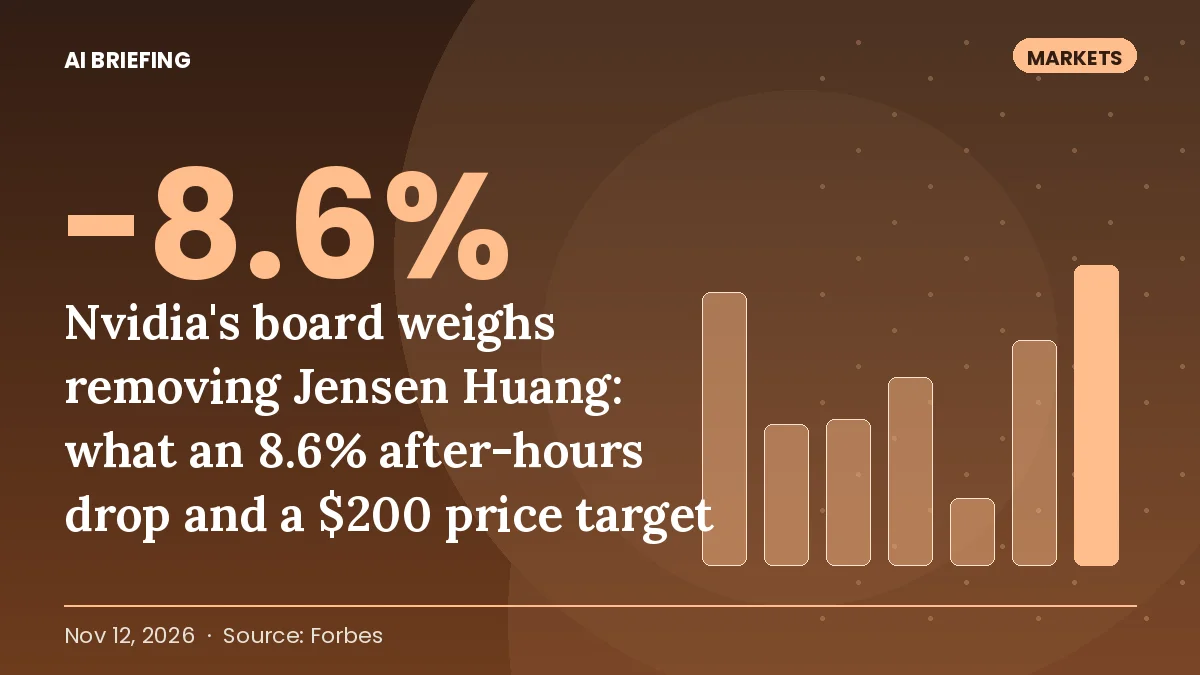
Nvidia's independent directors met late on Wednesday, November 11, to decide whether Jensen Huang remains chief executive, according to Reuters, after the Wall Street Journal reported the board was preparing to remove him. Bloomberg reported the board is already working with an outside firm to identify candidates and is weighing an interim appointment while it searches. By Thursday morning no decision had been announced. The stock, which had closed up 2.9% at $173.73, fell 8.6% to $158.78 after hours and was down roughly 6% again in premarket trading.
How we got here in four days
On Sunday, November 8, the board disclosed an inquiry into whether Huang had been the target of a foreign intelligence operation, after he admitted a relationship with a former executive at Megaspeed, the Singapore cloud company that rents Nvidia capacity to Chinese customers including Alibaba. US officials reportedly believe she worked for Chinese intelligence; China's foreign ministry called the claim groundless. The board expressed confidence in Huang that day and hired Wachtell Lipton. On Wednesday the New York Times reported, citing five current and former employees, a second relationship with Kimberly Powell, Nvidia's vice-president of healthcare, who reports to Huang. Nvidia and Powell did not respond. The second report changed the board's calculus from protecting a founder under foreign pressure to a direct-report relationship that most public-company codes of conduct prohibit outright.
What the stock is pricing
Nvidia has shed more than $450 billion of market value since the November 8 disclosure and is about 27% below its early-October high. Bernstein cut its target to $200 from $400 and Baird to $200 from $500 before any decision. Several banks estimate a further 20% fall if Huang goes; Dan Ives puts the company at $300 a share with Huang and $225 without. Those are opinions, not models, and they ignore the fact that AMD rose 3.9% and Broadcom 3% on the news, which says the market expects Nvidia's customers to hedge rather than buy less silicon. Alibaba fell as much as 7.1% in Hong Kong on fears that its Megaspeed-routed chip access draws new US scrutiny.
The succession problem is structural
Huang co-founded Nvidia in 1993, has run it ever since, and has about 60 direct reports. He told Bloomberg in 2023 that the company was built so that he knows how to run it and that he does not believe in succession planning. Under Nvidia's bylaws a majority of the 11 directors, all independent but him, can remove the chief executive with or without cause. Seeking Alpha reports chief financial officer Colette Kress is a candidate for interim chief. An outside appointment within days of a November 17 earnings report would be unusual; a more likely sequence is an interim chief from inside, a muted guide, and a search that runs into 2027. Elon Musk, whose companies are among Nvidia's largest customers, said hiring Huang would be an honour, which is the kind of remark boards notice.
The counter-argument
Nvidia's product cycle does not depend on one person in the way its culture does. Blackwell and its successors are committed, supply is contracted through TSMC, and the software moat is CUDA, not the keynote. On that view the 27% drawdown is already more than the governance risk deserves, and a clean leadership decision could be a relief rally. The risk that view misses is political: Senators Warren and Coons have asked Commerce, State and the White House to preserve records on Nvidia's China exports and the alleged intelligence operation, and a shareholder class action alleging investors were defrauded is already filed. Those run on their own clocks regardless of who is chief executive.
What to watch
A board statement, which could come any hour; whether an interim chief is named from inside; the November 17 earnings call and whether guidance is withheld; any Commerce Department action on Megaspeed or on rentals of restricted H100 and H200 capacity to Chinese customers; and the S&P and Nasdaq weightings, since Nvidia's size means its move is the index's move. For buyers of Nvidia hardware, nothing about allocation or pricing has changed this week, and the people who negotiate your contracts are not the ones in the boardroom.
More in Finance & markets
All →
Anthropic's IPO range is $70–78: what the amended S-1 says about dilution, lock-ups and the $26 billion partner placement
The largest technology listing ever attempted now has a price, a share count and a list of suppliers buying in; here is how to read the numbers before…
SoftBank's $7 billion loss lands on the day Anthropic starts selling a $1.1–1.3 trillion IPO
The largest outside holder of OpenAI just reported its first quarterly loss in two years, and the valuation range for Anthropic's listing has fallen f…
Anthropic's reported $3.4B generator buy makes power a capital expense for AI labs
Taking over 1.7 gigawatts of Caterpillar orders is the biggest known power-equipment purchase by an AI company. It tells you how the labs now think ab…
Get the brief in your inbox
One email every morning: the stories that mattered in AI, each with a one-line "why it matters" for your role. Free, no ads, unsubscribe any time.
Published daily by AI Briefing. We never share your address.