Nvidia's first quarter without Huang: $115.8 billion in, $130 billion guided, zero China assumed and a margin that falls to 71%. What the numbers say about 2027
The beat was expected; the shape of the guide was not. Nvidia is now telling investors that the next quarter will be bigger, less profitable per dollar and entirely ex-China, and that the founder is not coming back.
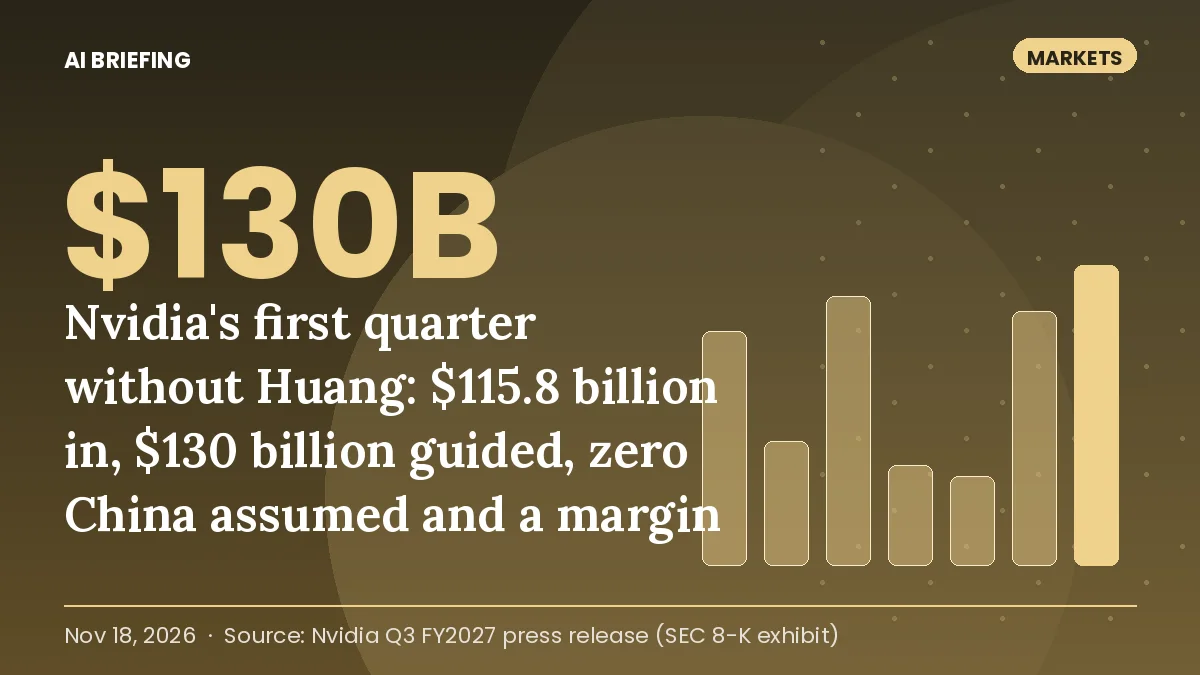
Nvidia reported revenue of $115.8 billion for the quarter ended October 25, up 103% on a year earlier and 20% on the previous quarter, with non-GAAP earnings of $2.68 a share against the $2.47 analysts expected and a 74.9% non-GAAP gross margin. Data-centre revenue was $107.6 billion, up 110% year on year; the segment Nvidia now calls edge computing added $8.2 billion. It was the first set of results presented by Colette Kress, chief financial officer and interim chief executive since Jensen Huang resigned on November 12, and the first in which the company's forecast assumed nothing at all from China.
The guide, not the beat
Fourth-quarter revenue is guided to $130 billion plus or minus 3%, a figure that includes a fifty-third week in the fiscal calendar. The gross-margin outlook of 71% to 72% is the detail that matters. It is roughly three points below the quarter just reported, and at a $130 billion run rate three points is about $4 billion of gross profit a quarter that will go to memory suppliers rather than to Nvidia. Kress attributed the drop to higher component costs; high-bandwidth memory is the component in shortest supply, and its price is rising faster than Nvidia's.
The press release states that the outlook assumes no data-centre compute revenue from China. Tech Times, citing the call, reports that Kress said Nvidia is no longer shipping licensed Hopper products there, and that Jefferies puts the annual revenue forgone at $44 billion to $62 billion. Those figures are secondary; the policy fact is primary. The remote-access rule published by the Commerce Department on Monday closes the route by which Chinese customers rented Nvidia chips abroad, and Nvidia has chosen to forecast as if that route is gone for good.
The commitments
Purchase commitments, the contracts Nvidia has signed with its own suppliers, rose to $390 billion, up from the $279 billion disclosed in July. Neocloud commitments, the capacity Nvidia has agreed to buy back from the rental providers it invests in, stood at $32 billion. Nvidia returned $28.1 billion to shareholders in the quarter and has $227.3 billion of repurchase authorisation remaining after the $150 billion increase approved in September; the company says it intends to use all of it by the end of fiscal 2028.
Read together, the numbers describe a company spending its balance sheet to lock in supply for a demand curve it believes is still steepening, while using the cash left over to support its own share price through a leadership crisis. Kress raised the annual growth forecast to 75% from 70% and said demand is accelerating.
The CEO question
Chair Harvey Jones said on the call that the board does not intend to bring Huang back and that the search for a permanent chief executive, covering internal and external candidates, will not be rushed. That ends a week of reports about allies lobbying for a return. Kress declined to discuss the circumstances of the departure. Nvidia's shares, which closed Monday at their lowest level since June 2025 and about 35% below the October 6 record, rose around 4% in after-hours trading.
The counter-argument
A guide that beats consensus by $20 billion while margins fall is the pattern that preceded every previous semiconductor peak: volume up, pricing power down. SemiAnalysis is reported to have cut its 2028 accelerator-spend forecast by 28% last week on slower revenue growth at frontier labs and tighter project financing. Nvidia's $390 billion of purchase commitments are a bet against that view, and if it is wrong the inventory charge would be historic. The Anthropic IPO prices tonight on exactly this question.
What to watch
The Senate Banking hearing on December 3, at which Huang and Commerce Secretary Lutnick have been asked to testify about export controls. Whether the permanent CEO is named before the next report in February and whether it is an insider. The first Vera Rubin volume-shipment disclosure. And the gross-margin line next quarter: if it lands below 71%, the memory suppliers, not Nvidia, are winning the cycle.
Sources
Nvidia Q3 FY2027 press release (SEC 8-K exhibit) ↗Kiplinger live coverage of the results and call ↗Tech Times on the China statement and Jefferies estimate ↗The story so far
- Nov 17, 2026 BIS's remote-access rule: a licence for any data centre giving China-linked firms more than 12 million TPP, five new lic…
- Nov 16, 2026 The Fed's Financial Stability Report: 87% of market contacts now name AI as the top risk, and $680 billion of computing …
- Nov 16, 2026 'National champions' and a Shenzhen summit: the US plans to package Nvidia, OpenAI, Anthropic, Microsoft and Amazon for …
- Nov 14, 2026 Nvidia approached Arm's Rene Haas, FT reports, as VCs count the 105 startup rounds Huang's Nvidia joined this year
Key terms in this story
- Purchase commitments Contracts a company has signed to buy components, capacity or services in future, disclosed in its financial statements even though the cash has not yet been spent.
- Technology export catalogue (China) China's list of technologies whose export is prohibited or requires a licence, maintained by MOFCOM and MOST; a 2026 draft adds 23 AI technologies.
More in Finance & markets
All →
Anthropic prices at $83 and raises about $81 billion, the largest IPO ever. What the final terms say, and what to watch when ANT opens today
The price landed $5 above the top of the range and the share count grew, which tells you how the book filled; the prospectus numbers tell you what the…
Corma's $125 million Series A at $1 billion, three months after stealth: what a 16x step-up on 25 people and undisclosed revenue says about the defensive-AI market
NEA has priced a defensive cybersecurity foundation-model lab as a unicorn before it has named a customer, betting that the autonomous attack tools in…
The Fed's Financial Stability Report: 87% of market contacts now name AI as the top risk, and $680 billion of computing debt is a third of investment-grade issuance. What the numbers mean before Nvidia and Anthropic report
AI has gone from a 30% mention a year ago to the single most-cited threat in the Fed's survey, and the report puts hard figures on the financing stack…
Get the brief in your inbox
One email every morning: the stories that mattered in AI, each with a one-line "why it matters" for your role. Free, no ads, unsubscribe any time.
Published daily by AI Briefing. We never share your address.