The Fed's Financial Stability Report: 87% of market contacts now name AI as the top risk, and $680 billion of computing debt is a third of investment-grade issuance. What the numbers mean before Nvidia and Anthropic report
AI has gone from a 30% mention a year ago to the single most-cited threat in the Fed's survey, and the report puts hard figures on the financing stack behind it: $1.1 trillion of outstanding public debt, up to $3 trillion of commitments not yet started, and close to $1 trillion of big-bank exposure.
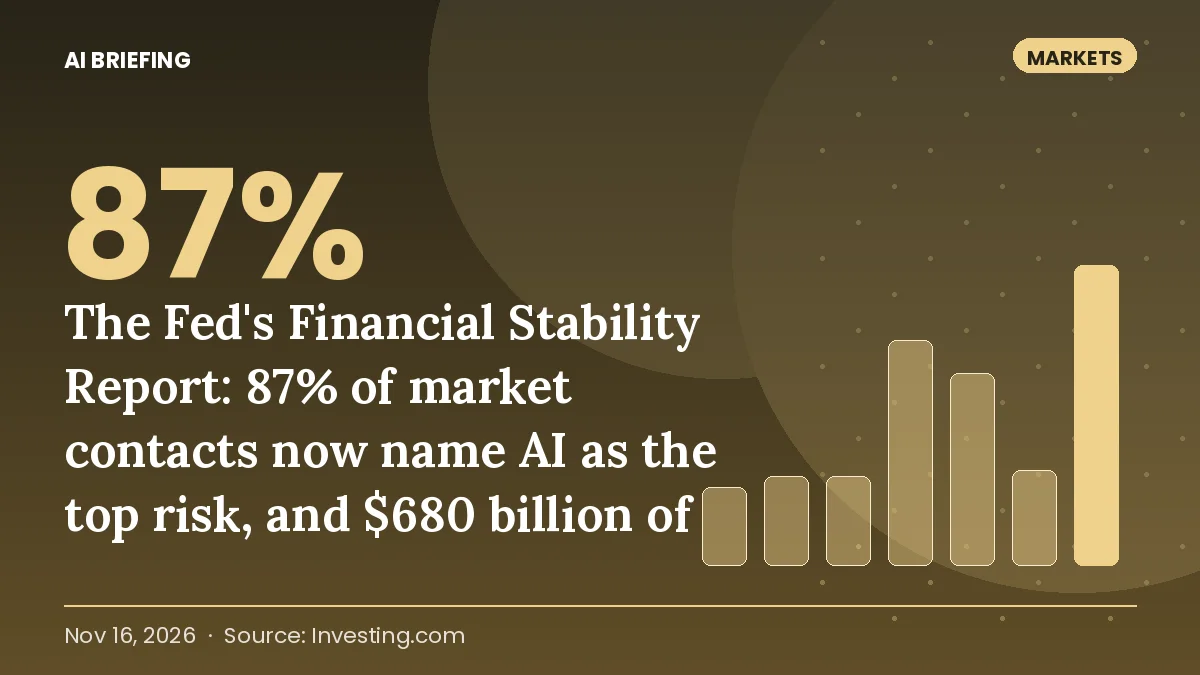
The Federal Reserve's semi-annual Financial Stability Report, released on Friday November 13, is the first in which artificial intelligence tops the list of risks named by the market contacts the New York Fed surveys. 87% of them cited AI-related risk, against 50% in the May report and 30% a year earlier. The next most-cited concerns were a broad correction in risk assets at 52%, higher long-term rates at 48%, and cyberattacks and fiscal sustainability tied at 43%. The survey ran in September and October, which means it closed before Jensen Huang's resignation from Nvidia, before the Anthropic prospectus and before the midterm elections.
Three channels, with numbers attached
The report groups its AI concern into three channels. The first is valuations: equity prices remain high, in the Fed's words partly on enthusiasm for super intelligence, and earnings that fall short could trigger a correction. The second is cyber, where the report names sophisticated state actors and, in a phrase worth reading twice, damage caused by frontier AI models themselves. The third is financing, and this is where the report adds data that was not public in one place before. Debt issuance tied to advanced computing reached $680 billion by October 2026, five times the total for all of 2023, and now accounts for nearly a third of nonfinancial investment-grade corporate issuance, up from under 6% three years ago. Outstanding public debt tied to advanced computing exceeds $1.1 trillion. Debt, guarantees and leases on AI infrastructure that has not yet commenced could exceed $3 trillion. The largest US bank holding companies have close to $1 trillion of exposure to large technology firms, data-centre developers, computing-related special purpose entities, private credit vehicles and utilities. The Fed compares the cycle with the late-1990s broadband and telecom build-out and says it may soon surpass it; the links among data-centre firms, public credit, private lenders and SPVs, it writes, create vulnerabilities that require close monitoring.
Why the timing matters
The report lands at the start of a week in which the two most important AI issuers price. Nvidia reports its third quarter on Tuesday with interim CEO Colette Kress presenting; consensus is about $108.8 billion of revenue, and the company's $500 billion-plus of third-party financing commitments is exactly the kind of off-balance-sheet structure the Fed is describing. Anthropic prices its IPO on Wednesday with a reported order book several times covered; its prospectus discloses about $901 billion of computing commitments, about $70 billion of them due within twelve months. The Fed does not name either company, but a reader can map its $3 trillion figure onto the disclosed commitments of a handful of firms.
The counter-argument
The case for calm is in the same report. Household and business debt vulnerabilities are rated moderate and the banking system sound. Investment-grade issuance by cash-generative hyperscalers is not 1999 telecom debt issued by companies with no revenue, and the $680 billion is spread across issuers with some of the strongest balance sheets in the index. A survey of 23 market contacts is a sentiment gauge, not a stress test, and sentiment that is 87% one way is often already priced. The Fed's own concern is less that the debt defaults than that it is interconnected: a bank lending to a developer, holding a SPE's paper, financing a private credit fund that lends to the same developer, and serving the utility that powers the site.
What to watch
Nvidia's Tuesday call for any change to its financing programme and lease guarantees, which are now a regulator's talking point as well as a governance one. Anthropic's pricing on Wednesday and whether the $26 billion placement from its suppliers is read as demand or as circular financing. The next FSR in May, which will show whether the 87% was a peak. For treasurers, the practical step is an exposure map: which of your vendors, lenders and counterparties sit inside the Fed's $1 trillion of bank exposure, and what happens to your cloud pricing and credit lines if one of them has to refinance in a worse market.
Sources
Investing.com ↗AI Weekly summary of CNBC's report ↗Federal Reserve, Financial Stability Report, November 2026 (PDF) ↗The story so far
- Nov 16, 2026 'National champions' and a Shenzhen summit: the US plans to package Nvidia, OpenAI, Anthropic, Microsoft and Amazon for …
- Nov 15, 2026 Mirendil's $1 billion Series A at a reported $5 billion, eleven months after founding: what investors are buying when th…
- Nov 14, 2026 Nvidia approached Arm's Rene Haas, FT reports, as VCs count the 105 startup rounds Huang's Nvidia joined this year
- Nov 14, 2026 Anthropic's IPO: China orders rebuffed, $900.9 billion in compute commitments and a '10th percentile' capacity plan. Wha…
More in Finance & markets
All →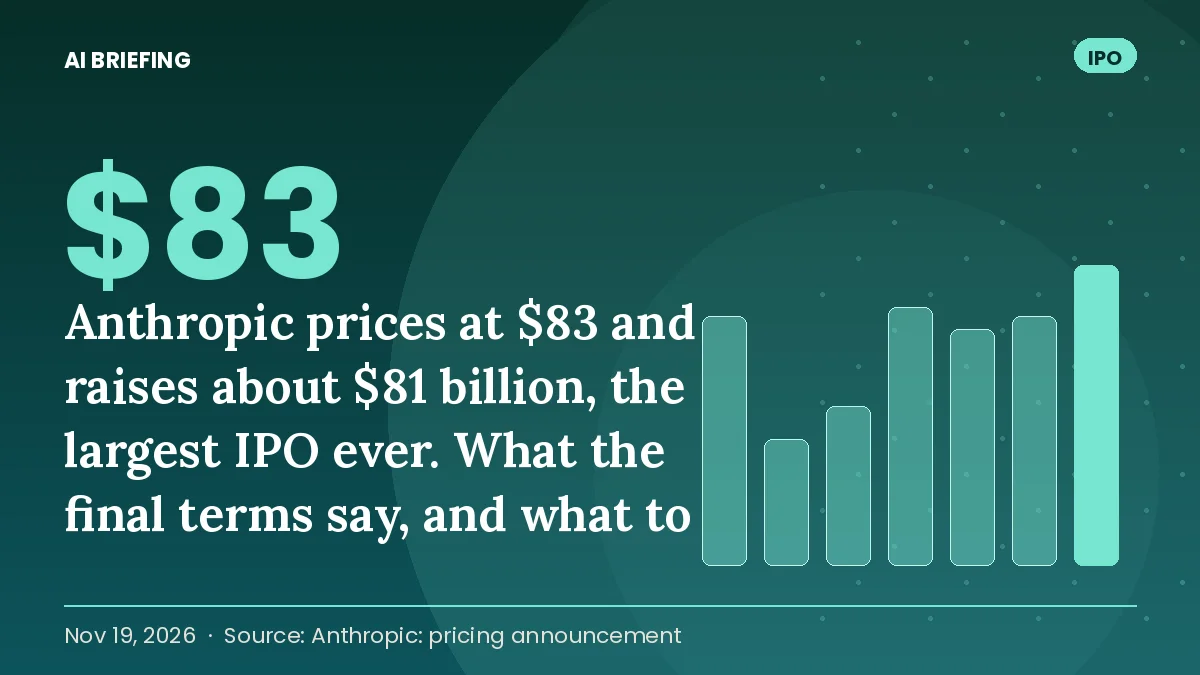
Anthropic prices at $83 and raises about $81 billion, the largest IPO ever. What the final terms say, and what to watch when ANT opens today
The price landed $5 above the top of the range and the share count grew, which tells you how the book filled; the prospectus numbers tell you what the…
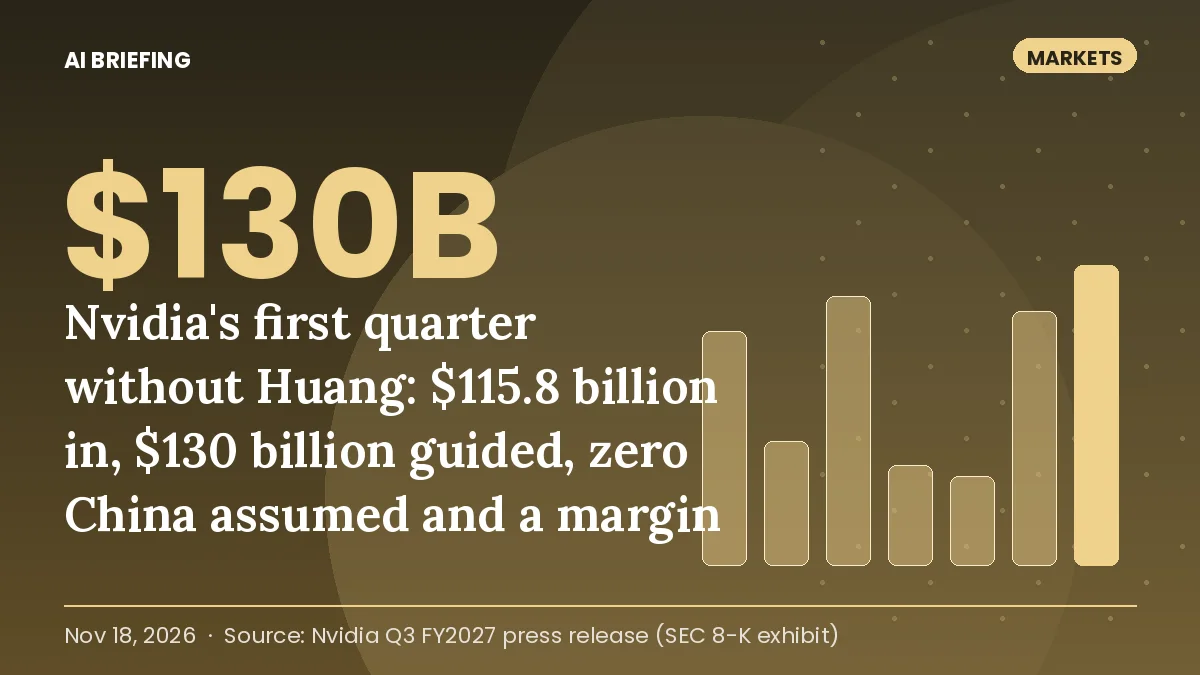
Nvidia's first quarter without Huang: $115.8 billion in, $130 billion guided, zero China assumed and a margin that falls to 71%. What the numbers say about 2027
The beat was expected; the shape of the guide was not. Nvidia is now telling investors that the next quarter will be bigger, less profitable per dolla…
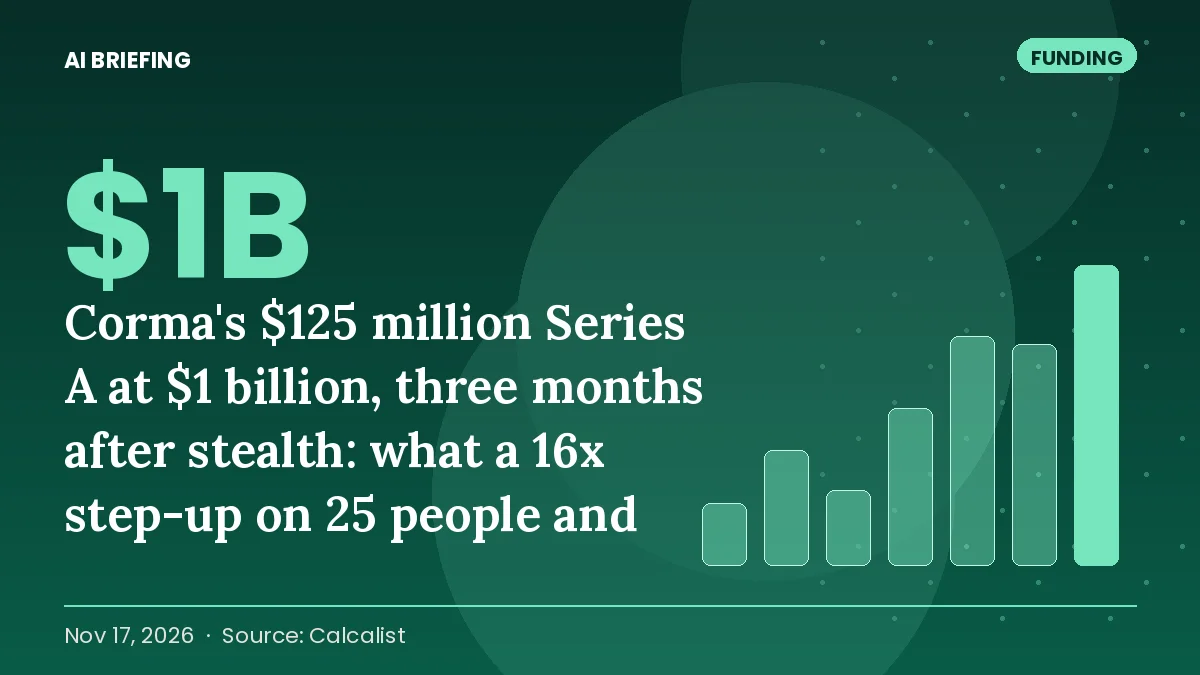
Corma's $125 million Series A at $1 billion, three months after stealth: what a 16x step-up on 25 people and undisclosed revenue says about the defensive-AI market
NEA has priced a defensive cybersecurity foundation-model lab as a unicorn before it has named a customer, betting that the autonomous attack tools in…
Get the brief in your inbox
One email every morning: the stories that mattered in AI, each with a one-line "why it matters" for your role. Free, no ads, unsubscribe any time.
Published daily by AI Briefing. We never share your address.