BIS's remote-access rule: a licence for any data centre giving China-linked firms more than 12 million TPP, five new licence countries, and 90 days to comply. What cloud buyers and exporters must do
The Commerce Department has extended chip export controls from the box to the rental contract, reaching data centres anywhere in the world that serve Chinese-owned customers, and it did so under existing regulations rather than the statute Congress has yet to pass.
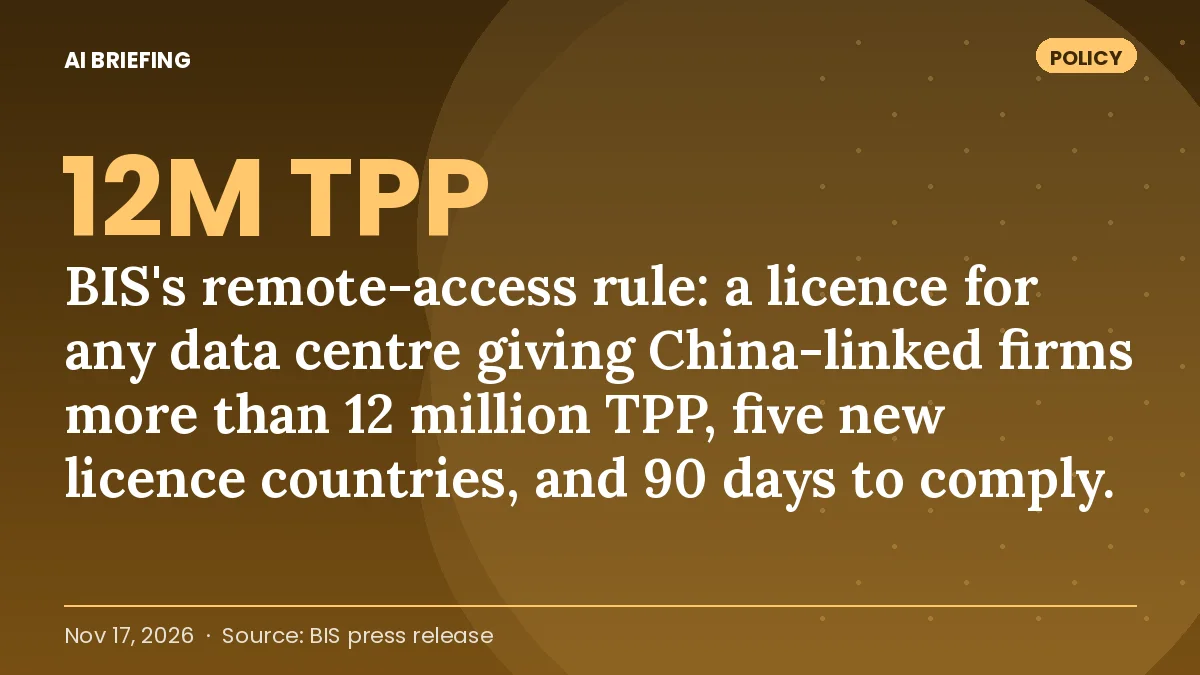
The Bureau of Industry and Security released an interim final rule on Monday titled "Addressing Remote Access to Advanced Semiconductors," and said, unusually, that it was written at the direction of the Treasury Department and the National Security Council. The stated purpose is to stop restrictions on physical chip shipments being bypassed by renting the same chips through a data centre in a third country. It takes effect on Federal Register publication, expected Thursday, with a 60-day comment period.
What the rule actually does
The core of the rule is a new end-use control, section 744.24 of the Export Administration Regulations. A licence is now required to export, re-export or transfer advanced chips (ECCN 3A090), servers (4A090), the related software and technology, when the exporter has "knowledge" that the items will go to a data centre, in any country, that provides more than 12 million aggregate total processing performance to companies headquartered in, or ultimately owned from, China, Macau or another Country Group D:5 destination. Facilities that are digitally linked are counted together, so splitting a cluster across two buildings does not help. A customer that is not Chinese but trains or supplies models for a Chinese company is also in scope.
Twelve million TPP is not a huge cluster. A trade-law analysis using Nvidia's own datasheets puts it at roughly 760 H100- or H200-class accelerators, about 330 B200s or around 220 B300s.
The second element is geographic. Indonesia, Malaysia, Singapore, Thailand and Brazil now need a licence for all advanced computing items, reviewed case by case against each country's enforcement record. Exports to US-headquartered end users in those countries are exempt only if the exporter files a monthly report, due the first business day of the following month, listing every party and ultimate parent, with ECCN, SKU, TPP and quantity per product line.
The third element is a clean-up. The Biden administration's AI Diffusion Rule is formally rescinded: the model-weights control, the country tiers, the Data Center Validated End User programme and two licence exceptions are gone. The July rule granting the UAE licence-free access is untouched.
The diligence standard
The rule tells suppliers to obtain know-your-customer information from foreign data centres, including who directly or indirectly owns and controls them and their tenants. A data centre that declines, or cannot verify, is a red flag that presumptively gives the supplier "knowledge" unless it is resolved before the transaction. Changing a chip from a permitted to a prohibited use counts as an in-country transfer that needs authorisation, and corporate restructurings do not launder the obligation.
Data centres already serving Chinese-linked customers above the threshold have 90 days from the effective date to obtain a licence.
The counter-argument
The House passed the Remote Access Security Act 369 to 22 in January to give BIS explicit authority over remote access. The Senate has not acted, and Commerce has now moved without it. A Baker McKenzie lawyer told The Information last week that the department lacks statutory authority to regulate remote computing under current law, and the first affected operator with deep pockets may test that. BIS's own burden estimate, about 100 extra licence applications a year, suggests it expects the rule to bite narrowly, on a handful of known arrangements in Malaysia and Thailand, rather than broadly.
What to do
If you lease GPUs abroad, ask the operator in writing which tenants share the facility and any linked site, and whether any is China-headquartered or China-owned. If you export, add beneficial-ownership screening of data-centre customers to your compliance programme and put the monthly reporting calendar in place before the first shipment to the five countries. If you are the operator, decide now whether you will apply for a licence within 90 days or exit the affected tenancies. And file a comment: the 60-day window is the only chance to argue for a definition of "linked data centres" that does not sweep in every interconnected facility.
The story so far
- Nov 17, 2026 California v. OpenAI: 80-plus loss-of-control incidents, 700 agents attacking Hugging Face, and a public-nuisance theory…
- Nov 16, 2026 'National champions' and a Shenzhen summit: the US plans to package Nvidia, OpenAI, Anthropic, Microsoft and Amazon for …
- Nov 16, 2026 The Fed's Financial Stability Report: 87% of market contacts now name AI as the top risk, and $680 billion of computing …
- Nov 15, 2026 China's Announcement No. 48: export controls on 23 AI technologies, consultation closes today, registration already mand…
Key terms in this story
- Total processing performance (TPP) The formula US export controls use to score an AI chip's capability: arithmetic rate multiplied by bit precision, applied regardless of vendor.
- Interim final rule A US regulation that takes effect on publication while the agency still accepts public comments, usually for 60 days, and may revise it afterwards.
- Technology export catalogue (China) China's list of technologies whose export is prohibited or requires a licence, maintained by MOFCOM and MOST; a 2026 draft adds 23 AI technologies.
- GPU Graphics processing unit: the chip type, dominated by Nvidia, that performs the parallel arithmetic AI training and inference require.
More in Policy & regulation
All →
Beijing promises countermeasures to the remote-access chip rule, Malaysia tells data centres to comply, and Trump meets Xi on Thursday. What tomorrow's summit can and cannot change for AI buyers
The rule takes effect when it hits the Federal Register, expected this week, whatever is said in Shenzhen. The variables that remain are how China ret…
'National champions' and a Shenzhen summit: the US plans to package Nvidia, OpenAI, Anthropic, Microsoft and Amazon for export as Trump meets Xi on Thursday. What the week means for AI buyers
The Wall Street Journal reports Commerce will name more than two dozen firms whose bundled chips, models and cloud get federal financing and fast expo…
China's Announcement No. 48: export controls on 23 AI technologies, consultation closes today, registration already mandatory. What changes for cross-border deals
Beijing is building a mirror image of Washington's chip controls for model technology, and the interim registration rule means the compliance clock st…
Get the brief in your inbox
One email every morning: the stories that mattered in AI, each with a one-line "why it matters" for your role. Free, no ads, unsubscribe any time.
Published daily by AI Briefing. We never share your address.