GE HealthCare's Critical Care Suite 3.0 clears the FDA: feeding-tube detection on the x-ray machine at 99.2% sensitivity, offline, and for children for the first time. What hospitals should ask before switching it on
On-device imaging AI sidesteps the integration and data-sharing problems that stall most hospital deployments; the questions that remain are about the 0.8% and about workflow.
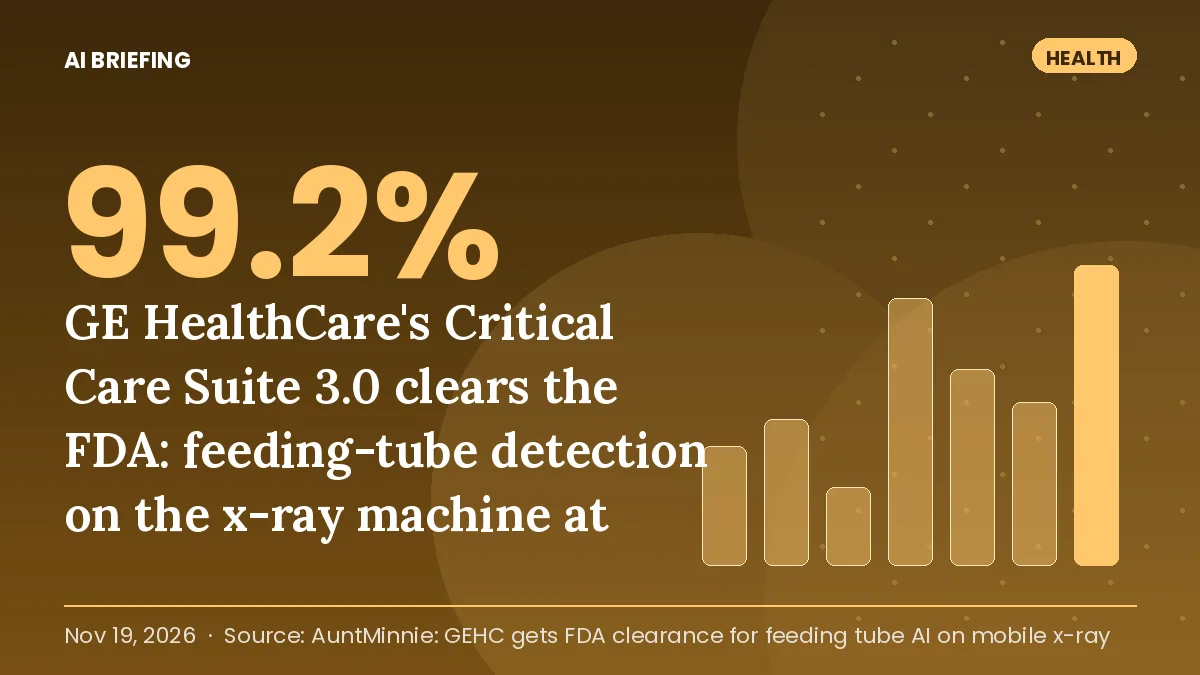
GE HealthCare has received FDA 510(k) clearance for Critical Care Suite 3.0, a software package that runs on its mobile x-ray systems and detects enteric feeding tubes on portable chest radiographs. The algorithm identifies the tube, traces its path, marks the tip and the side port, and highlights the airways and diaphragm as anatomical reference points so a clinician can judge placement at a glance. It supports adults and, for the first time in this product line, paediatric patients. In the company's testing against annotations by expert radiologists the detector reached 99.2% sensitivity and a mean Dice score of 91.6% for localisation. The suite also bundles GE's Quality Care Suite algorithms, which flag image-quality errors at the point of capture, and it runs on the device without an internet or cloud connection.
Why the problem matters
Enteric tubes are placed blind at the bedside, and a small fraction end up in the airway or lung. Feeding through a misplaced tube causes pneumonia, pneumothorax and death, and the standard safeguard is a chest x-ray read before the first feed. In practice that read can be delayed for hours on a busy ward, and the x-rays are often taken on portable machines at night, when radiologist cover is thinnest. A check that happens on the machine, in the seconds after the exposure, is aimed precisely at that gap. The paediatric extension matters because children's anatomy, smaller tubes and lower radiation doses make the images harder, and because most AI imaging tools have been cleared for adults only.
Why the deployment pattern matters
Most hospital AI projects stall at integration, not at accuracy: routing images to a cloud service, signing a data-processing agreement, getting IT to open a port, deciding where results appear. Critical Care Suite avoids nearly all of it. No protected health information leaves the machine, there is no per-study cloud bill, and the software was validated on the hardware it runs on, so the model does not drift as a hospital changes its PACS or network. It is the same pattern that Apple is using for on-device health inference and that security teams increasingly prefer for sensitive data. The cost is that the model can only be updated when the device is, and that the hospital's own data cannot be used to tune it.
The questions to ask
Sensitivity is the easy half of the number. A 99.2% detection rate means roughly one tube in 125 is missed, which is acceptable only if the tool is positioned as an aid rather than a replacement for the radiologist read, and that positioning needs to be written into the protocol. Specificity and the false-positive rate per exam are not in the public summary and decide whether staff learn to ignore the alert. The Dice score of 91.6% describes how well the drawn tube overlaps the true one, not whether the tip is placed on the correct side of the diaphragm, which is the clinical decision. Ask for the test-set size, the number of paediatric cases, the range of tube types and the performance on the worst images, since portable films at night are the ones that matter. Then ask the workflow questions: who sees the on-device alert, whether it reaches the ordering nurse or only the technologist, how it is logged, and how a miss is audited.
What to watch
The FDA's AI device list has been growing at a few hundred clearances a year, with radiology the dominant category, and the direction of travel is from cloud-connected triage tools toward software that lives on the modality. Watch for peer-reviewed external validation of this version, for the first reports of alert fatigue, and for whether competitors bring paediatric clearances to their own tube and line detectors. For the health-system buyer, the practical test is simple: pilot it on one ward's night shift, measure the time from exposure to confirmed placement before and after, and count the misses on both sides.
The story so far
- Nov 13, 2026 63% of US physicians now use AI for clinical decision support, up from 37% a year ago, Doximity's survey of 3,379 doctor…
- Nov 12, 2026 Gemini for healthcare: Google's agent reads Epic, Medicare rules and payer systems for seven launch customers; what to a…
- Nov 10, 2026 Abridge cuts staff at a $5.3 billion valuation: what it says about the AI scribe market, and what health systems should …
- Nov 9, 2026 The PATIENT AI Act draft: a third-party FDA review path and a Medicare pathway, comments due December 1
Key terms in this story
- 510(k) clearance The FDA pathway that lets a device, including AI software, reach market by showing it is substantially equivalent to an already-authorised predicate device.
- Dice score A measure from 0 to 1 of how well a predicted region (such as a tube or tumour outline on an image) overlaps the true region; 1 is a perfect match.
- Inference Running a trained model to produce output. What you pay for when you call an API.
More in Health & medicine
All →
Isomorphic Labs raises $5 billion with no drug in a human: the largest private biotech round ever, $7.7 billion in twenty months, and what the money is actually buying
The DeepMind spinout has now raised more than most public biotechs are worth, on preclinical data it has not published. The bet is that an AI design e…
Apple and OpenEvidence open a 200,000-person health chatbot study: wearable and lab data in, no model training, no device claim. What health systems should watch
Apple has chosen the clinical search tool most US doctors already use as the engine for its first consumer health conversation, and is running it as r…
AlphaGenome 2: a conditional DNA model trained on 107 million cell profiles finds nearly twice the expression-changing variants. What it does and does not mean for drug discovery
DeepMind's second genome model answers the question the first could not: what a variant does in this cell type. That is the question target-discovery …
Get the brief in your inbox
One email every morning: the stories that mattered in AI, each with a one-line "why it matters" for your role. Free, no ads, unsubscribe any time.
Published daily by AI Briefing. We never share your address.