63% of US physicians now use AI for clinical decision support, up from 37% a year ago, Doximity's survey of 3,379 doctors finds
The shift from note-taking to decision-making happened in twelve months, three in four doctors hit a factual error in the past year, and most worry trainees will never build the skills to catch one.
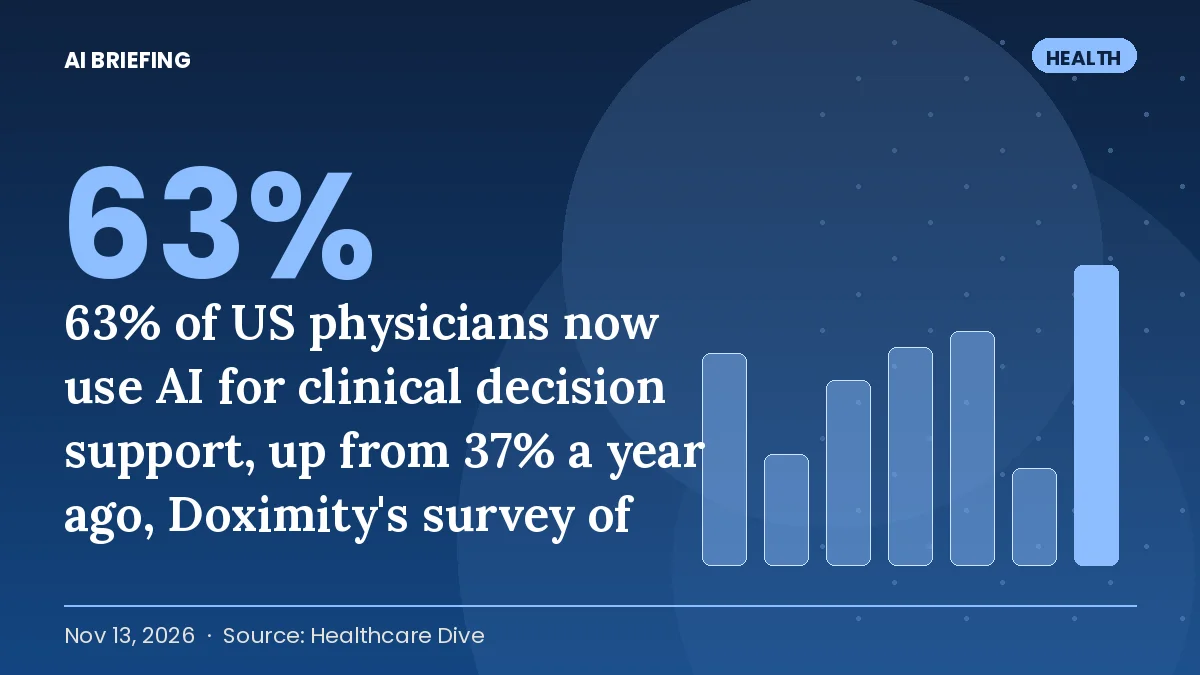
Doximity's Doctor-Driven AI report, released on November 12 and based on a September survey of 3,379 US physicians across 20 specialties, finds that more than half of doctors now use AI every day and another third use it at least weekly. The number that matters is what they use it for: 63% now use AI for clinical decision support, up from 37% in the 2025 survey. Use for reviewing medical literature rose to 70% from just over half.
From paperwork to judgment
Until this year the physician AI story was ambient scribes and inbox drafting, tools that save time without touching the diagnosis. The Doximity data says that boundary has moved. Doctors are asking models about differential diagnoses, treatment alternatives and guideline updates; 81% say AI has taught them something they did not know, and 65% say it has helped develop their clinical skills. That is a different risk profile from a scribe. A scribe that errs produces a wrong note that a clinician reads; a decision-support tool that errs produces a wrong idea that a clinician may act on.
The survey is candid about error rates. Three in four physicians encountered at least one factual inaccuracy in AI output over the past year, and more than half say inaccuracies are the main reason they have ever cut back. At the same time, over a quarter say the effort they spend checking and correcting output has fallen compared with a year ago. Read those together: errors are common, and the verification habit is weakening as trust grows.
The trainee problem
The finding health-system leaders should sit with is about residents. 61% of physicians worry that trainees will lean on AI and fail to build their own clinical skills; nearly half worry about over-reliance generally; more than a quarter name skill erosion as the main thing limiting their own use. Medicine has been here before with calculators, imaging and order sets, and the historical pattern is that skills migrate rather than vanish. But the speed is new. A resident starting in July 2026 has never practised without a model that answers clinical questions in seconds.
Context and the counter-argument
Doximity's sample skews toward its own engaged users, and self-reported "use" ranges from a quick literature check to a treatment plan; the report does not distinguish. Most of the tools in question are general chatbots, not FDA-reviewed decision-support devices, which is why the FDA's still-unsettled position on generative AI in clinical workflows matters more than it did. The counter-argument is simply that physicians are professionals who are checking: the error-encounter rate shows doctors are catching mistakes, not missing them, and the survey records no claim of patient harm.
What to do
Health systems should offer a sanctioned tool with logging and PHI controls before trying to block consumer ones; the survey says blocking will fail. Credentialing and CME programmes should add verification as an explicit skill, with case reviews that include the AI output the clinician saw. Residency directors should decide now which tasks trainees do without a model for their first year. And vendors pitching clinical AI should expect buyers to ask for their factual-error rate on real queries, because three in four of the clinicians in the room have already seen one.
What to watch
The FDA's next move on generative clinical decision support; whether the AMA or specialty boards publish AI-use competencies for residents; and the 2027 edition of this survey, where the checking-effort number will tell you whether trust is being earned or assumed.
More in Health & medicine
All →
Gemini for healthcare: Google's agent reads Epic, Medicare rules and payer systems for seven launch customers; what to ask before you pilot it
Northwell has 400 people fighting insurance denials and wins 90% of them; Google wants both sides of that fight running on its agent. The economics, t…
Oura pays $625 million for Counsel Health: a 70-person AI primary-care startup is now worth 17 times what it raised
A smart-ring maker that could not get its own IPO away is paying up for a chat-first clinic with physicians in the loop; the price says where consumer…
Abridge cuts staff at a $5.3 billion valuation: what it says about the AI scribe market, and what health systems should ask
The best-funded company in ambient clinical documentation is flattening its organisation as the category commoditises; buyers mid-contract should get …
Get the brief in your inbox
One email every morning: the stories that mattered in AI, each with a one-line "why it matters" for your role. Free, no ads, unsubscribe any time.
Published daily by AI Briefing. We never share your address.