Oura pays $625 million for Counsel Health: a 70-person AI primary-care startup is now worth 17 times what it raised
A smart-ring maker that could not get its own IPO away is paying up for a chat-first clinic with physicians in the loop; the price says where consumer health AI is heading and what regulators will be watching.
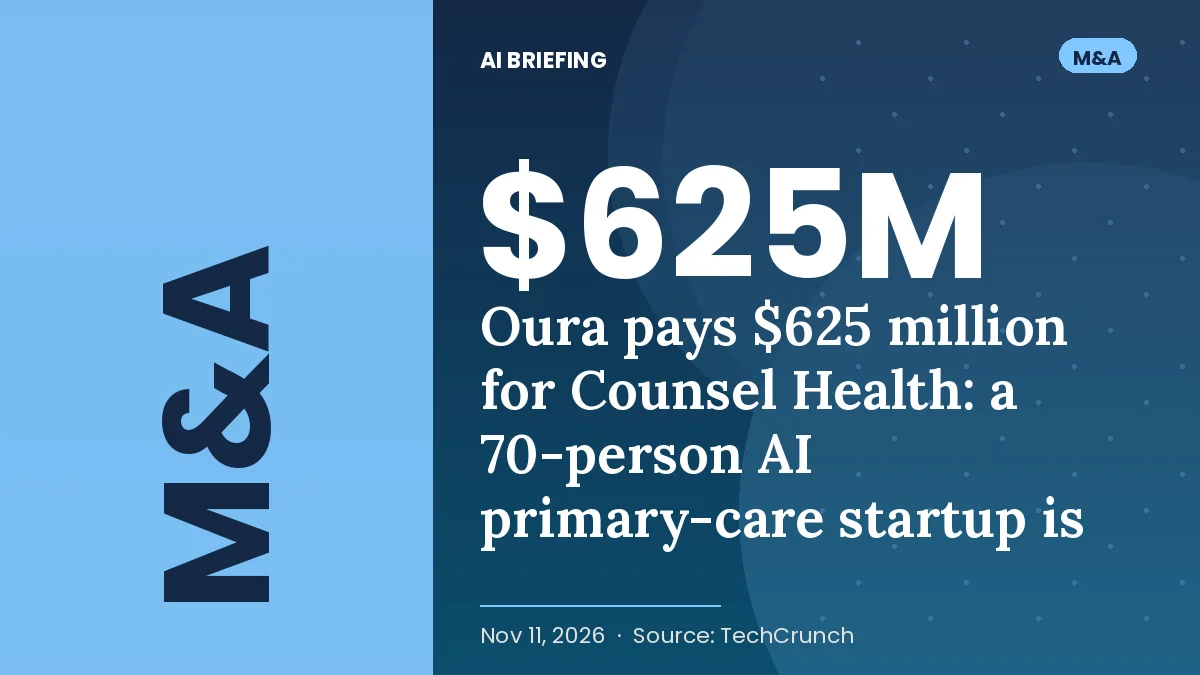
Oura, the Finnish smart-ring company, agreed on November 10 to acquire Counsel Health for $625 million. Counsel runs a chat-based medical service in which an AI assistant handles the conversation and hands off to a licensed physician for diagnosis and treatment over telehealth. The service has been available inside the Oura app since June. Counsel's chief executive, Muthu Alagappan, becomes Oura's chief clinical AI officer, its roughly 70 staff move across, and the companies expect to close before the end of 2027, which suggests a regulatory review of some length. The structure of the consideration was not disclosed.
The numbers
Counsel had raised about $36 million in total, including a $25 million Series A led by Andreessen Horowitz and GV roughly a year ago, so the price is about 17 times invested capital. Oura itself was valued at $11 billion after a $900 million round in October 2025, reported $533 million of revenue for the September quarter, up 153% year on year, and expects about $1.75 billion for its fiscal year, up 92%. In October it indefinitely postponed an IPO that had targeted up to $2.2 billion, citing uncertainty in the listing market. It is paying more than a third of a year's revenue for a company with no disclosed revenue of its own.
For context, the digital-health exit market has been thin. Abridge, the ambient-scribe leader valued at $5.3 billion, confirmed layoffs this week. The large deals of the past year have been infrastructure and scribes, not care delivery. A consumer hardware company paying nine figures for a care-delivery team is a different signal: that the valuable asset is the clinical workflow and the physician network, not the model.
What Oura is actually buying
Oura's rings produce continuous biometric data, and the company has spent the year acquiring the pieces to act on it: Doublepoint for gesture control in March, Galen's AI health companion in April, now Counsel. The pattern is a path from a sleep score to a conversation to a prescription without leaving the app. Counsel already serves enterprise partners and will keep doing so, which gives Oura a business-to-business channel into employers and plans alongside its consumer base.
Alagappan has been explicit that Counsel keeps "physicians in the loop for clinical decisions." That is both a safety design and a regulatory one. Software that recommends a diagnosis or treatment without a clinician making the call risks being a medical device under FDA rules; software that organises the conversation and routes it to a doctor generally does not. Keeping the physician as the decision-maker lets the AI handle intake, triage and follow-up at scale without a clearance. The question for anyone copying the model is where that line sits when the AI's suggestion is, in practice, what the physician signs.
The counter-argument
Chat-first care has been tried by Babylon, which collapsed, and by a dozen telehealth companies whose unit economics never closed because physician time does not scale like software. Counsel's bet, and now Oura's, is that the AI absorbs enough of the encounter to change the ratio; nothing public yet shows that it does. Oura also has no history of running a regulated clinical service, in a year when state attorneys general and the FTC have both been active on health-app data. And the combination of continuous biometrics, medical chat and physician records in one company creates a dataset that will draw both the most lucrative partnerships and the most serious breach consequences in consumer health.
What to watch
The closing timetable and whether it draws an FTC second request; how Oura prices Counsel for ring owners versus the standalone membership; whether Hims & Hers, Function Health, Whoop or Apple respond with acquisitions of their own; what the combined privacy policy says about joining biometric and clinical data; and any state medical-board scrutiny of AI-led intake. For health systems, the practical question is whether Counsel's physicians refer into your network or around it.
More in Health & medicine
All →
Abridge cuts staff at a $5.3 billion valuation: what it says about the AI scribe market, and what health systems should ask
The best-funded company in ambient clinical documentation is flattening its organisation as the category commoditises; buyers mid-contract should get …
The PATIENT AI Act draft: a third-party FDA review path and a Medicare pathway, comments due December 1
Senator Cassidy's discussion draft is the first serious attempt to legislate how clinical AI gets reviewed and paid for. FDA lawyers say the review ti…
OpenAI's BioBasicsBench: AI agents score 66.7% on routine lab work, and the failures are the story
A new 100-task benchmark tests whether AI can read gels, plates and microscopy like a bench scientist. The headline score is decent; the error cases s…
Get the brief in your inbox
One email every morning: the stories that mattered in AI, each with a one-line "why it matters" for your role. Free, no ads, unsubscribe any time.
Published daily by AI Briefing. We never share your address.