Abridge cuts staff at a $5.3 billion valuation: what it says about the AI scribe market, and what health systems should ask
The best-funded company in ambient clinical documentation is flattening its organisation as the category commoditises; buyers mid-contract should get roadmap and support commitments in writing.
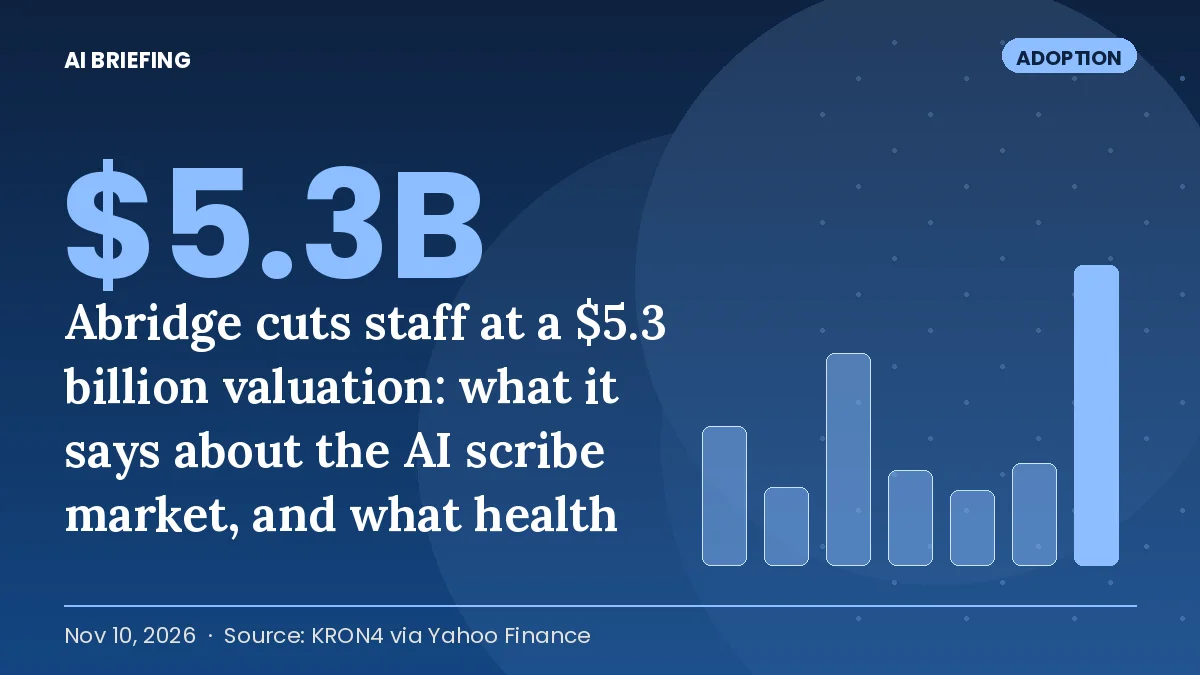
Abridge confirmed on November 9 that it has laid off employees in what a spokesperson called an organisation-wide realignment intended to flatten the company. It did not say how many roles were affected or where; two people describing themselves as former employees, both with the company less than a year, posted on LinkedIn that the cuts came sooner than expected, and one layoff tracker reported a figure of around 90 that Abridge has not confirmed. The company said it was realigning from a position of strength, remains very well capitalised and still holds more than half of all the capital it has ever raised.
The company
Founded in Pittsburgh in 2018, Abridge became the reference name in ambient clinical documentation: software that listens to a patient visit and drafts the clinical note, with later extensions into automated billing and nursing documentation. Its 2025 Series E, led by Andreessen Horowitz, raised $300 million at a $5.3 billion valuation, and earlier rounds brought in Nvidia and Eli Lilly as investors. It is embedded in Epic's marketplace and has signed large academic health systems.
Why a leader trims at the top
Ambient scribing is the most widely deployed category of clinical AI, which is exactly its problem. The underlying speech and language models have become cheap and interchangeable, the electronic health record vendors have built or bought their own scribes, and Microsoft's Nuance has bundled one into a suite that many hospitals already license. When every vendor can transcribe accurately, the price per clinician falls toward what the EHR vendor charges, and the start-up that raised at 2024 growth multiples has to show margin. Flattening an organisation is what that looks like from the inside.
The realignment also hints at where Abridge thinks the next value is. The company's recent product moves have been toward revenue-cycle work, coding accuracy and nursing workflows rather than better transcription. Those are harder integrations with longer sales cycles, and they need a different mix of staff than a land-grab for clinician seats.
The counter-argument
A company holding more than half its lifetime funding after a $300 million round is not in distress, and small cuts after rapid hiring are routine in late-stage start-ups. Abridge still has the deepest health-system footprint of any independent scribe vendor and an Epic integration competitors cannot easily replicate. It is also possible the cuts reflect automation inside Abridge's own operations, which would be an uncomfortable but unsurprising outcome for an AI company. Without a disclosed number, the LinkedIn posts and a tracker's estimate are thin evidence of anything structural.
What health systems should ask
If you are mid-contract, ask Abridge in writing for the support staffing assigned to your account, a twelve-month product roadmap and the data-portability terms if you leave. Benchmark the price per clinician against what your EHR vendor would charge for its native scribe, including the integration cost you would avoid. Put coding accuracy and documentation time saved, not transcription word-error rate, at the centre of your evaluation, because that is where vendors are now competing and where the dollars are. And treat the next Abridge financing as the signal: a flat or down round would confirm that ambient documentation has become a feature, not a company.
More in Health & medicine
All →
The PATIENT AI Act draft: a third-party FDA review path and a Medicare pathway, comments due December 1
Senator Cassidy's discussion draft is the first serious attempt to legislate how clinical AI gets reviewed and paid for. FDA lawyers say the review ti…
OpenAI's BioBasicsBench: AI agents score 66.7% on routine lab work, and the failures are the story
A new 100-task benchmark tests whether AI can read gels, plates and microscopy like a bench scientist. The headline score is decent; the error cases s…
SoftBank's $7 billion loss lands on the day Anthropic starts selling a $1.1–1.3 trillion IPO
The largest outside holder of OpenAI just reported its first quarterly loss in two years, and the valuation range for Anthropic's listing has fallen f…
Get the brief in your inbox
One email every morning: the stories that mattered in AI, each with a one-line "why it matters" for your role. Free, no ads, unsubscribe any time.
Published daily by AI Briefing. We never share your address.