Gemini for healthcare: Google's agent reads Epic, Medicare rules and payer systems for seven launch customers; what to ask before you pilot it
Northwell has 400 people fighting insurance denials and wins 90% of them; Google wants both sides of that fight running on its agent. The economics, the safeguards and the questions a health system should put in writing.
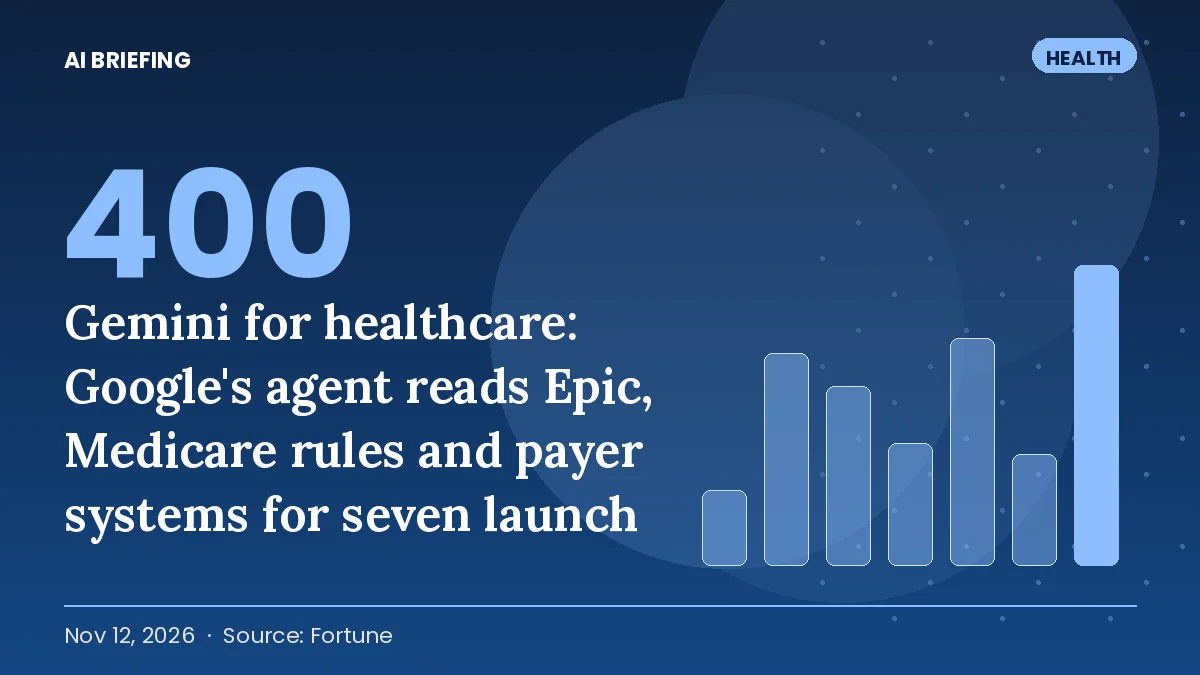
Google Cloud launched Gemini for healthcare on November 10 as a US preview. It is an agent built on Google's general Gemini agent that connects to the systems hospitals and insurers already run: electronic records from Epic and Oracle Health, billing platforms, federal Medicare coverage data and clinical guidelines from ASCO and the BMJ. It ships with five preset skills, among them summarising a medical record, preparing for an appointment, checking a patient's insurance benefits and preparing or reviewing a prior authorisation, and customers can build their own. Launch customers are Northwell Health, Highmark Health, HCA Healthcare, Optum, Blue Cross Blue Shield of Massachusetts, Hartford HealthCare and Stanford School of Medicine. Pricing is per seat or pay as you go, with no figures published.
What it does and does not touch
The agent reads records but cannot write to them; clinicians make any chart change. Every finding links to its source so staff can check it. Customers choose which models run which tasks, from Google, Anthropic or OpenAI, with simple administrative work routed to faster, cheaper models and complex clinical reasoning to stronger ones. Google says customer data is never used to train its foundation models. In a demonstration for Fortune, the agent compared an outside specialist's report with a patient's Epic chart in 35 seconds and flagged new lab results and a missed allergy. Seven partners announced the same day: GoodRx brings prescription prices into the agent, UiPath lets teams trigger its automations from it, Verato matches patient identities across systems, InterSystems connects its FHIR server, and Altimetrik, AuxoAI and Egen will do deployments. NextGen Healthcare support is due in the coming months.
The economics Google is selling
The numbers in Google's launch material are about paperwork, not diagnosis. Google's own Harris Poll study says clinicians lose nearly 28 hours a week to documentation and administration. The American Medical Association counts about 40 prior authorisations per physician per week, roughly 13 hours of physician and staff time, and 40% of practices employ people whose only job is handling them. Northwell's chief executive, John D'Angelo, told Fortune the system runs on a margin of 1% at best, that about 400 employees work solely on insurance denials, and that Northwell overturns more than 90% of them. Highmark says 78% of approved outpatient prior authorisations submitted digitally are already processed automatically and that a clinician reviews every case before a denial. The pitch, in other words, is to put the same agent on both sides of a transaction that currently employs thousands of people to argue with each other.
The counter-argument
If the agent makes it cheaper for a hospital to submit prior authorisations and cheaper for a payer to review them, the volume of both can rise without anyone's costs falling; the AMA's figures describe an arms race, and this is faster ammunition. The 35-second demonstration is a demonstration, not a controlled study. Errors in AI-generated clinical documentation are documented, including drug-name and diagnosis mistakes found in NHS records in August. And a read-only agent with access to Epic, Medicare datasets and payer portals under a single service identity is exactly the credential that the LLMjacking market, as the Railway post-mortem this week shows, now pays for.
What to ask before a pilot
Ask for the per-skill permission model: which systems each preset skill can read and whether a custom skill inherits more. Ask where the audit log of every record read lives, who can export it and how long it is retained. Ask which model vendor sees which data under the routing policy, and get all three named as sub-processors in the business associate agreement. Ask what the agent does when Epic and the outside report disagree, and who is told. Ask for a pilot design that measures staff hours per authorisation and per denial, turnaround time and overturn rate against a matched control, not a before-and-after. And ask the payer across the table whether they are running the same agent, because the answer changes what a faster submission is worth.
What to watch
Pricing once the preview ends; the first published outcome data from Northwell or Highmark; whether CMS's own prior-authorisation rules, which already set timelines for payers, treat agent-prepared submissions differently; and whether Epic, which the agent reads but which has its own AI roadmap, keeps the door open.
More in Health & medicine
All →
Oura pays $625 million for Counsel Health: a 70-person AI primary-care startup is now worth 17 times what it raised
A smart-ring maker that could not get its own IPO away is paying up for a chat-first clinic with physicians in the loop; the price says where consumer…
Abridge cuts staff at a $5.3 billion valuation: what it says about the AI scribe market, and what health systems should ask
The best-funded company in ambient clinical documentation is flattening its organisation as the category commoditises; buyers mid-contract should get …
The PATIENT AI Act draft: a third-party FDA review path and a Medicare pathway, comments due December 1
Senator Cassidy's discussion draft is the first serious attempt to legislate how clinical AI gets reviewed and paid for. FDA lawyers say the review ti…
Get the brief in your inbox
One email every morning: the stories that mattered in AI, each with a one-line "why it matters" for your role. Free, no ads, unsubscribe any time.
Published daily by AI Briefing. We never share your address.