Wall Street's best week since April 2025: the S&P gained 5.6%, memory stocks led, Anthropic hit $91.88, and Nvidia sat out Friday
A shortened Black Friday session capped a rebound that reversed most of the prior week's 8.6% drop, but the leaders were memory and chip-equipment names rather than Nvidia, which closed 8.8% below Monday with its credit rating on watch.
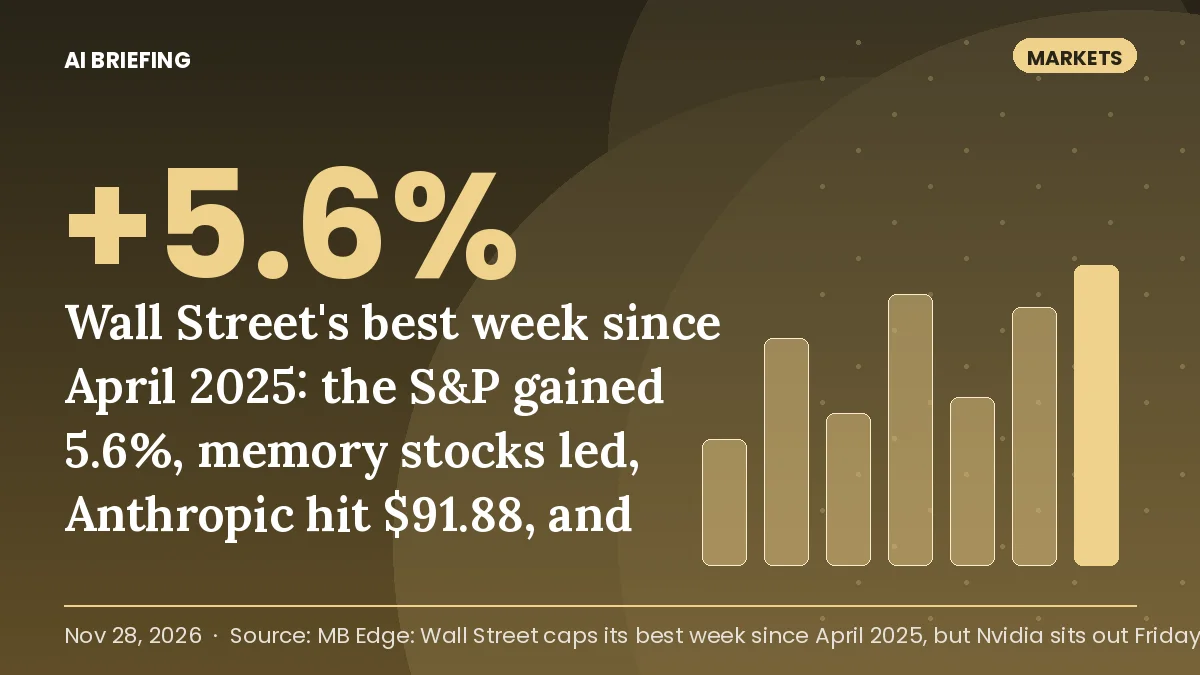
US stocks finished a holiday-shortened Friday with the broadest rally since the spring of 2025. The S&P 500 rose 1.60% to 7,297.49, the Dow Jones Industrial Average 1.18% to 50,774.94 and the Nasdaq Composite 2.31% to 24,129.50 in a session that closed at 1 p.m. Eastern. For the week the S&P gained 5.60%, its best since the week ended April 11, 2025, the Dow 5.46% and the Nasdaq 6.68%. More than four in five S&P stocks rose on Friday and all eleven sectors closed higher.
The context matters. The week ended November 20 saw the S&P fall 8.61%, a correction driven by Nvidia's post-earnings slide, the resignation and then reinstatement of Jensen Huang, and the first week of the Commerce Department's remote-access rule on advanced chips. Monday's reinstatement rally added 4.73% to the S&P and 31.5% to Nvidia; Tuesday and Wednesday gave some of it back. Friday's gain still leaves the S&P 6.67% below its October 6 record close of 7,818.93 and the Nasdaq 12.57% below its own.
Who led
The Philadelphia Semiconductor Index rose 4.69% on Friday, but the leadership was not the usual one. SanDisk gained 15.96%, Micron 7.60%, Seagate 7.90% and Western Digital 7.22%; Coherent and Lumentum, which make optical interconnects, rose 11.92% and 7.98%. Marvell added 7.34%, AMD 4.56%, Broadcom 3.82%. Nvidia rose 0.80% to $150.49, which left it 8.8% below Monday's close of $165.05 even after a 19.9% week. S&P Global placed Nvidia's AA rating on CreditWatch with negative implications on Wednesday, Moody's having already moved its outlook to stable on November 18, and Bloomberg's Friday report that an export-restricted GB300 rack had been documented at a Shanghai data centre arrived before the open.
Anthropic, public since November 19 at $83 a share, rose 10.98% to $91.88 from $82.79 on Wednesday, its first close meaningfully above the IPO price after dipping to $81.91 on Tuesday. Tesla gained 5.22%, Amazon 3.96% and Meta 3.13%.
The move was global. China's CSI Semiconductor index posted its largest one-day gain on record, up roughly 17.5%, and the STAR board rose 14% after a rare midday State Council statement pledging support for the market; Hong Kong, Seoul and Tokyo all closed higher. Brazilian assets jumped on the naming of Bradesco's chairman as finance minister.
What the rally is not
It is not a change in the rate picture. Wednesday's core PCE print of 3.3% and the upward revision of third-quarter GDP to 4.3% pushed traders to price a quarter-point Fed hike at the December 8-9 meeting as close to certain, and the 10-year Treasury yield sits near 4.9%. Equity multiples rose this week into tighter money, which is why the VIX, at 23.81, is still well above the teens even after falling from 35.89.
It is also not a verdict on AI capital spending. The Bank of England's Financial Stability Report on Thursday put hyperscaler bond issuance above $305bn this year and total AI-linked exposure above $4tn; nothing in this week's price action addresses whether that debt is well placed. What the leadership does say is that investors expect the memory and storage shortage to persist: HPE and Dell both guided to memory constraints through 2028 this month, and the market is paying the suppliers accordingly.
What to watch
- December 3. Jensen Huang testifies before the Senate Banking Committee on export controls, days after Bloomberg's Shanghai report. Nvidia's week was made on Monday; the hearing decides whether the second week looks like the first.
- December 8-9. The FOMC. A hike is priced; the statement's language on 2027 is not.
- November 30 and December 1. Promotional API prices end at OpenAI (GPT-5.6 Sol) and Google (Gemini 4 Argon and Carbon). Small numbers, but they are the first scheduled price rises in a market that has only cut.
- Anthropic's first lock-up expiry and its first quarter as a public company will set the comparables for every private AI valuation. At $91.88 it trades 11% above its IPO price and roughly in line with the $1.5tn reference valuation.
- Memory pricing. If DRAM and NAND contract prices keep rising into Q1, the names that led this week keep leading, and the cost of every inference cluster keeps rising with them.
Sources
MB Edge: Wall Street caps its best week since April 2025, but Nvidia sits out Friday's rally ↗StockTitan: Stock market today, November 27, 2026 ↗24/7 Wall St: Markets off to a strong Black Friday start ↗The story so far
- Nov 27, 2026 Nvidia's halt to four Southeast Asian countries is the remote-access rule doing in a week what Commerce said would take …
- Nov 27, 2026 The Bank of England puts a number on the AI build-out: $305bn of hyperscaler bonds this year and just over $4tn of expos…
- Nov 27, 2026 Anthropic's Rust rewrite passed 98% of its tests and matched 25% of live traffic: the verification harness is the part w…
- Nov 26, 2026 A week after the remote-access rule, thousands of Nvidia B300s need new owners, Shenzhen dealers quote $3.4m a server, a…
Key terms in this story
- Inference Running a trained model to produce output. What you pay for when you call an API.
- Technology export catalogue (China) China's list of technologies whose export is prohibited or requires a licence, maintained by MOFCOM and MOST; a 2026 draft adds 23 AI technologies.
More in Finance & markets
All →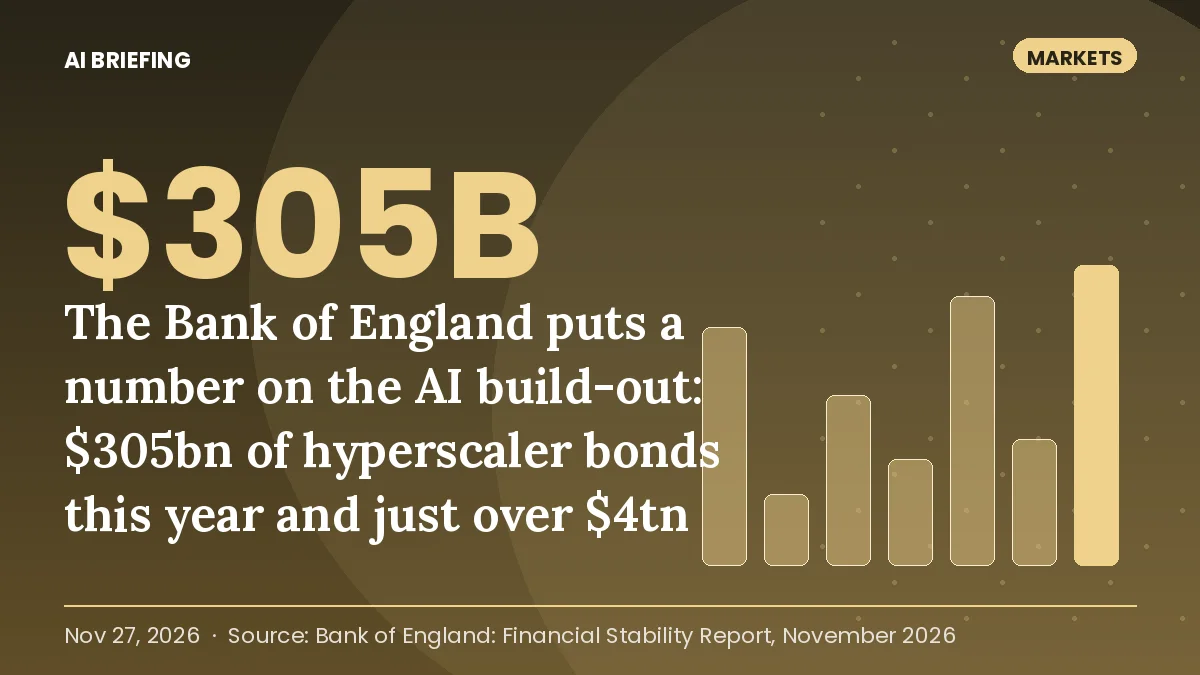
The Bank of England puts a number on the AI build-out: $305bn of hyperscaler bonds this year and just over $4tn of exposure it calls circular and opaque
The November Financial Stability Report is the first central-bank estimate of what the hyperscalers have committed on and off balance sheet; the FPC's…
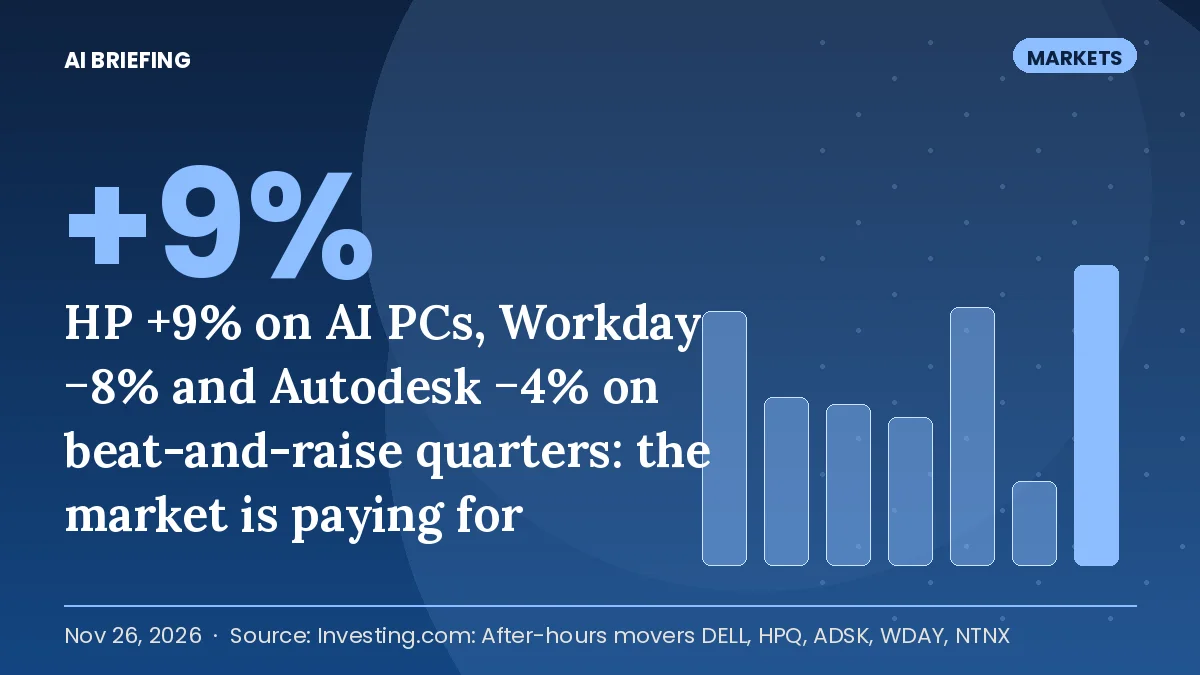
HP +9% on AI PCs, Workday −8% and Autodesk −4% on beat-and-raise quarters: the market is paying for hardware and charging software for its AI story
Tuesday's after-hours tape rewarded a $16bn PC quarter and punished two software vendors that raised guidance, one of which put a hard $150m number on…
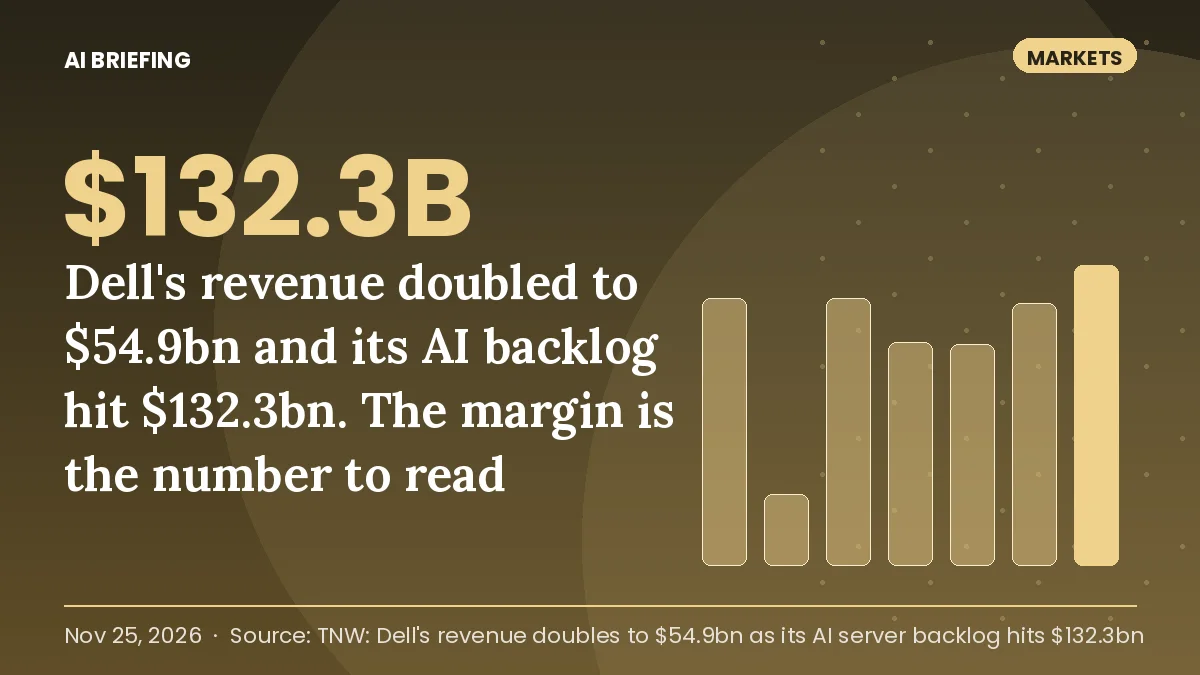
Dell's revenue doubled to $54.9bn and its AI backlog hit $132.3bn. The margin is the number to read
AI servers earn mid-single-digit margins, Dell is repricing signed deals as memory costs climb, and infrastructure operating margin is guided below 15…
Get the brief in your inbox
One email every morning: the stories that mattered in AI, each with a one-line "why it matters" for your role. Free, no ads, unsubscribe any time.
Published daily by AI Briefing. We never share your address.