Morgan Stanley's China humanoid call: investment accelerates, commercial use stays 'selective' in 2027, UBTECH targets 4,000 units, and the best model succeeds 41% of the time
The bank that doubled its China shipment forecast to 50,000 units in June now says the useful question is not how many robots ship but how many do a job; its answer for 2027 is a few, in chosen applications.
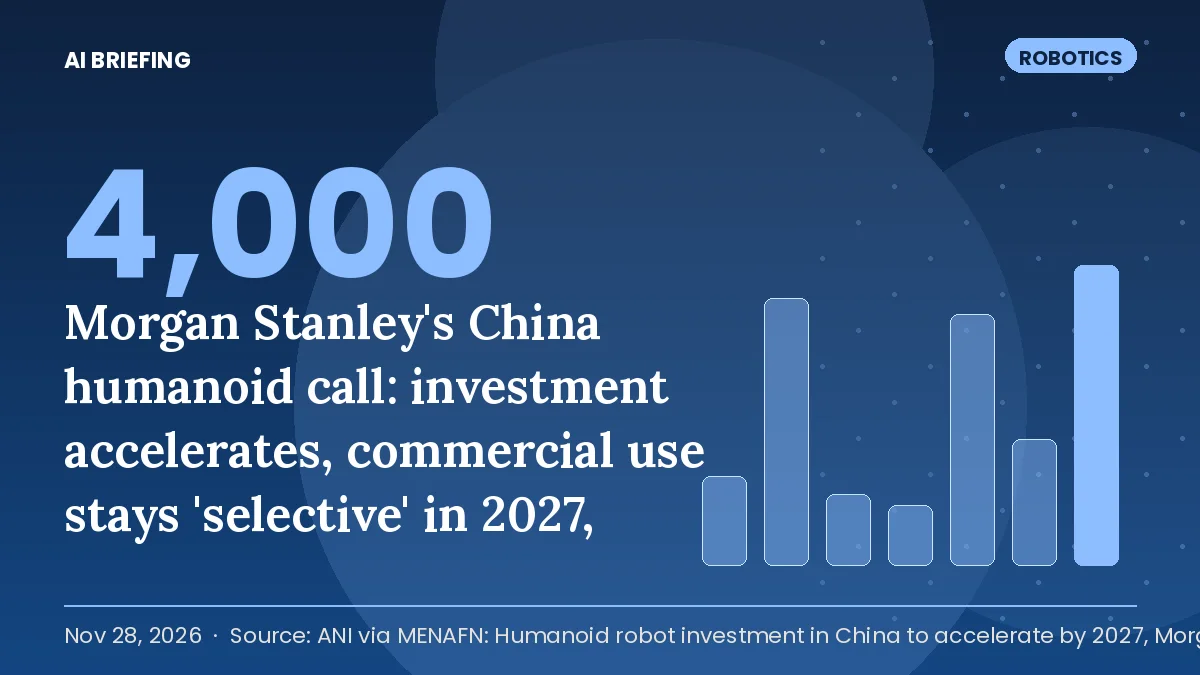
Morgan Stanley published a report on Friday on China's humanoid-robot industry whose headline, as carried by ANI, is that investment will accelerate and that commercial use in 2027 will be real but selective. Widespread adoption, the bank says, is 'some distance away', and the constraints it names are not software: precision machining, the availability of production equipment, skilled labour and manufacturing yields.
The report puts figures on the current leaders. UBTECH, the Shenzhen company whose Walker S models are in car plants for BYD, Geely and others, is targeting about 4,000 industrial and commercial deliveries in 2026 plus 1,500 to 2,000 household units. Geekplus, better known for warehouse robots, expects to have about 300 humanoids working by the end of this year or early next. The bank also cites one newer model whose success rate on a benchmark task set rose to 41.2% from 19.6% in a single generation while its average response time fell by a third. It does not name the model.
This is the same bank that in June raised its forecast for Chinese humanoid shipments in 2026 to 50,000 units, roughly doubling an earlier estimate, and whose 'Humanoid 100' list has become the index investors use for the sector. Friday's note does not retract the volume view; it qualifies it. Shipments can double while the number of robots doing a job for pay stays small, because the buyers of most units are integrators, research labs, showrooms and companies running pilots.
What 'selective' looks like
The week's other robotics news fills in the picture. Volvo Cars started training Hexagon's AEON robots at its Ghent plant on a single two-fixture task, with a larger pilot in the first half of 2027 and production use from mid-2027 if it works. XPeng told investors on Thursday that its Iron humanoid will appear in Chinese retail locations in the first quarter of 2027 and international ones in the second half, and that it is opening a ninth R&D centre in Hong Kong for humanoid motion control; its mass-production commitment from AI Day earlier this week is January 2027. Lute raised $20m this week to build robot models from wrist-camera video fused with touch, on the argument that tactile data is the bottleneck.
Each of these is one task, one site, one quarter. None is a fleet.
The number that matters
A success rate of 41.2% is a doubling, and it is also a failure rate of 58.8%. General-purpose manipulation on a varied task set is still something the best models fail more often than they succeed, which is why every commercial deployment is scoped to a single, repeatable task where success rates can be pushed toward 99% by engineering around the model. The bank's choice to publish that number alongside the shipment targets is the honest part of the report.
The counter-argument from the bulls is that this is what every industrial technology looked like two years before it scaled: yields and machining are solvable, response times are already falling, and 4,000 units at UBTECH is more than the entire Western industry will deliver this year. That is true. It is also why the bank frames 2027 as an investment year rather than a revenue year.
What to watch
- UBTECH's actual 2026 delivery figure, against the 4,000 target, in its annual report. The gap between target and delivery is the industry's yield problem in one number.
- XPeng Iron in retail, Q1 2027. A robot in a showroom is not a deployment, but a published price is.
- Volvo's Ghent pilot decision in the first half of 2027: the first Western car plant to say yes or no with numbers.
- Tactile data deals. If Lute, Lupa and Black AI's seed rounds turn into data partnerships with the Chinese manufacturers, the 41% number moves.
- Export rules in both directions. Chinese humanoids run on Chinese cloud stacks; US rules on remote access to compute and Chinese rules on technology export both touch them. A pilot outside China should ask where the policy updates come from.
Sources
ANI via MENAFN: Humanoid robot investment in China to accelerate by 2027, Morgan Stanley says ↗TokenPost: XPeng maps out 2027 global EV, robotaxi and humanoid-robot push ↗SCMP: Morgan Stanley raises China humanoid robot shipment forecast to 50,000 units (June) ↗The story so far
- Nov 27, 2026 Volvo's humanoid pilot at Ghent starts with one task, two fixtures and a wheeled robot, which is exactly how a factory d…
- Nov 27, 2026 SAP's reported 10,000-role cut would be its second in three years, and this time product and engineering are in the fram…
- Nov 26, 2026 Lute's $20m seed, Lupa's sensor gloves and Black AI's humanoid: three rounds in one day say the robot data bottleneck is…
- Nov 26, 2026 HP +9% on AI PCs, Workday −8% and Autodesk −4% on beat-and-raise quarters: the market is paying for hardware and chargin…
Key terms in this story
- Benchmark A standard test used to compare models, such as a set of coding tasks or exam questions.
- Degrees of freedom (robotics) The number of joints a robot can control independently; more means more dexterity and more to break, calibrate and power.
- Technology export catalogue (China) China's list of technologies whose export is prohibited or requires a licence, maintained by MOFCOM and MOST; a 2026 draft adds 23 AI technologies.
More in Robotics
All →
Volvo's humanoid pilot at Ghent starts with one task, two fixtures and a wheeled robot, which is exactly how a factory deployment should look
Hexagon's AEON is 1.65 m, 60 kg, rides on wheels and carries 10 kg; Volvo's own staff are teaching it by demonstration, with a larger pilot in early 2…
Lute's $20m seed, Lupa's sensor gloves and Black AI's humanoid: three rounds in one day say the robot data bottleneck is touch
A ten-month-old Warsaw startup raised one of Europe's largest robotics seeds for models that fuse wrist-camera video with tactile data, and two smalle…
XPeng puts a date on its humanoid: IRON hardware production in January 2027, and driver assistance becomes a subscription
The robot walked on stage in Guangzhou and took questions; the commercially significant announcement was that new car buyers will pay monthly for auto…
Get the brief in your inbox
One email every morning: the stories that mattered in AI, each with a one-line "why it matters" for your role. Free, no ads, unsubscribe any time.
Published daily by AI Briefing. We never share your address.