DevelopingMoonshot reportedly scraps a $150m Indonesian Blackwell lease, DeepSeek fears a nine-month gap and Tencent says the curbs 'set everyone back in China': what the first cancelled contract under the remote-access rule means
Thirteen days after the interim rule took effect there is a dollar figure on demand destruction, and it lands on a Southeast Asian data centre rather than on Nvidia.
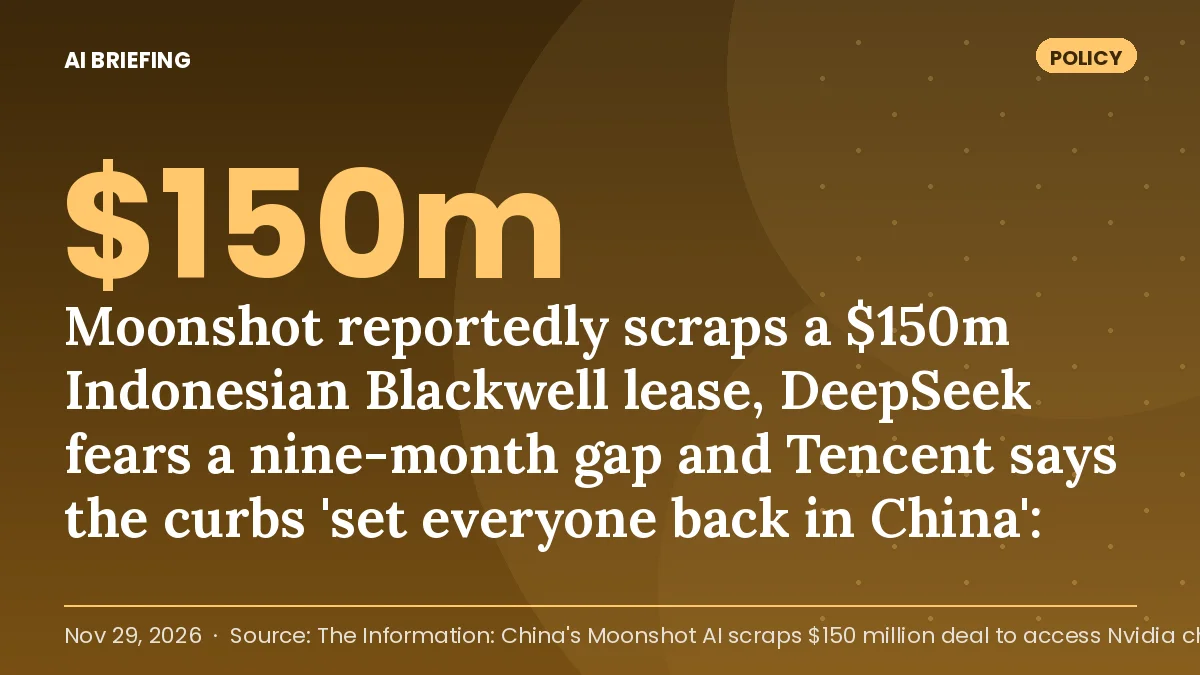
The Information reported this week, citing two people familiar with the matter, that Moonshot AI, the Beijing developer of the Kimi models, has cancelled a $150 million agreement to rent Nvidia Blackwell Ultra B300 capacity through a data centre in Indonesia. The report is paywalled and neither Moonshot nor the data-centre operator has commented, so we treat it as reported rather than confirmed. If accurate, it is the first specific contract known to have died because of the Commerce Department's November 16 interim rule.
The rule, briefly
The rule, which took effect November 19, does two things. It requires licences for sales of advanced computing chips to data centres in Indonesia, Malaysia, Singapore, Thailand and Brazil, the countries where Chinese firms had been renting rather than buying Nvidia capacity. And it restricts remote access to those chips by Chinese companies, with a 90-day window for data centres that already host covered customers to apply for licences. Nvidia told Dell and Supermicro this week to halt AI server shipments to four of the five countries with no end date, which this site covered on Thursday.
Moonshot was the obvious first casualty. Tom's Hardware reported in the summer that the company had used Blackwell chips to train Kimi K3 through arrangements that skirted both US export controls and China's own import restrictions, and that it had sought more. Renting B300s in Jakarta was the legal version of that strategy. The rule closes it.
What the Chinese labs are saying
The candour from Chinese executives is unusual. On Tencent's third-quarter call, president Martin Lau said the restrictions 'set everyone back in China' and that training the next Hunyuan model would take longer; chief strategy officer James Mitchell said the cloud business sees little impact because it mostly runs inference, which domestic chips can handle. Tencent's capital expenditure rose 527% year on year to RMB81.4 billion in the quarter. Alibaba's Eddie Wu said 'the new compute export control rules will affect next year's products and services' and suggested cloud growth could slow to a 30-45% range; Alibaba's Singapore unit Apex was added to the Entity List, which the company calls erroneous.
The Information's wider reporting, summarised by ROIC, says DeepSeek researchers fear the gap to US labs could widen from three-to-six months to nine, and Reuters reported on Thursday that Z.ai's GLM-5.5 has slipped to 2027 and Moonshot's own cycle could stretch to a year. Tencent's Lau has reportedly said Chinese release cycles may roughly double to twelve months or more.
Who actually loses
It is worth being precise about where the $150 million goes missing. Nvidia has already sold the chips, or will sell them to someone else; its guidance did not include China. The loss falls on the Indonesian operator that built or reserved capacity for Moonshot and now has B300s to re-let in a market where, as Musk noted this weekend, small-cluster prices are falling. Multiply across the region and the remote-access rule is a Southeast Asian data-centre story as much as a Chinese AI story. Maybank's Benjamin Ho argues the big platforms, Alibaba, Tencent and Baidu, are better placed than specialist labs like Moonshot and DeepSeek because they have cash, domestic chip supply and inference-heavy businesses. The first cancellation fits that view.
The counter-argument
The rule may slow Chinese frontier training by months, not years. Huawei's Ascend line and the domestic fabs are absorbing inference already, and Chinese labs have repeatedly shipped competitive models with less compute than their US rivals. The nine-month gap DeepSeek researchers reportedly fear is a fear, not a forecast. And licensing is not a ban: the 90-day window exists so that hosts can apply, and some will be approved. The honest summary is that the cost of Chinese frontier training has gone up, the timeline has gone out, and the first contract to break is a rental in Jakarta.
What to watch
- Whether the Indonesian operator is named and whether it re-lets the B300 capacity, and at what rate.
- The 90-day licence window, which closes around February 17; approvals or denials will set the real scope of the rule.
- Chinese model calendars: GLM-5.5 (now 2027), the next Kimi, DeepSeek V4's successor. Each slip is a data point.
- Nvidia's next guidance, which already excludes China, and any disclosure of Southeast Asian order cancellations by Dell or Supermicro.
Sources
The Information: China's Moonshot AI scraps $150 million deal to access Nvidia chips in Indonesia ↗Fortune: Alibaba and Tencent put their faith in Chinese chips as US curbs threaten to slow down their AI development ↗ROIC: Chinese AI model development faces severe delays, widening gap with US ↗The story so far
- Nov 29, 2026 Google wants more SpaceX compute on top of $920m a month for 110,000 GPUs, Musk says, as rental prices split: big traini…
- Nov 29, 2026 France's HAS and CNIL publish the rulebook for AI in clinical care: eleven lifecycle sheets, no specific patient consent…
- Nov 28, 2026 Wall Street's best week since April 2025: the S&P gained 5.6%, memory stocks led, Anthropic hit $91.88, and Nvidia sat o…
- Nov 28, 2026 Tencent's DFly2: a 0.85B drafter that borrows the target's sparse KV cache, claims up to 4.2x decode speed, and ships fo…
Key terms in this story
- Entity List The US Commerce Department's list of foreign organisations that need an export licence, usually with a presumption of denial, before receiving controlled US goods.
- Inference Running a trained model to produce output. What you pay for when you call an API.
- Technology export catalogue (China) China's list of technologies whose export is prohibited or requires a licence, maintained by MOFCOM and MOST; a 2026 draft adds 23 AI technologies.
More in Policy & regulation
All →
Japan's AI Act amendment: inspections, incident reporting and a three-step path to penalties for frontier providers, with a bill in the 2027 Diet
The country that passed the world's most permissive frontier-AI law in 2025 is drafting the enforcement it left out; the user threshold that decides w…
Nvidia's halt to four Southeast Asian countries is the remote-access rule doing in a week what Commerce said would take 90 days
Dell and Supermicro have stopped fulfilling AI-server orders in Malaysia, Singapore, Thailand and Indonesia; Chinese labs are already reporting delays…
A week after the remote-access rule, thousands of Nvidia B300s need new owners, Shenzhen dealers quote $3.4m a server, and banks are writing chip clauses into data-centre loans
The Commerce rule that took effect on November 19 is already moving hardware out of Southeast Asia and credit terms in New York; the licensing backlog…
Get the brief in your inbox
One email every morning: the stories that mattered in AI, each with a one-line "why it matters" for your role. Free, no ads, unsubscribe any time.
Published daily by AI Briefing. We never share your address.