France's HAS and CNIL publish the rulebook for AI in clinical care: eleven lifecycle sheets, no specific patient consent but mandatory information, and written hospital agreement before vendors reuse data. What health-AI vendors must change
The first joint guide from a national health authority and a privacy regulator settles the consent question in hospitals' favour and moves the burden onto contracts, logs and human supervision.
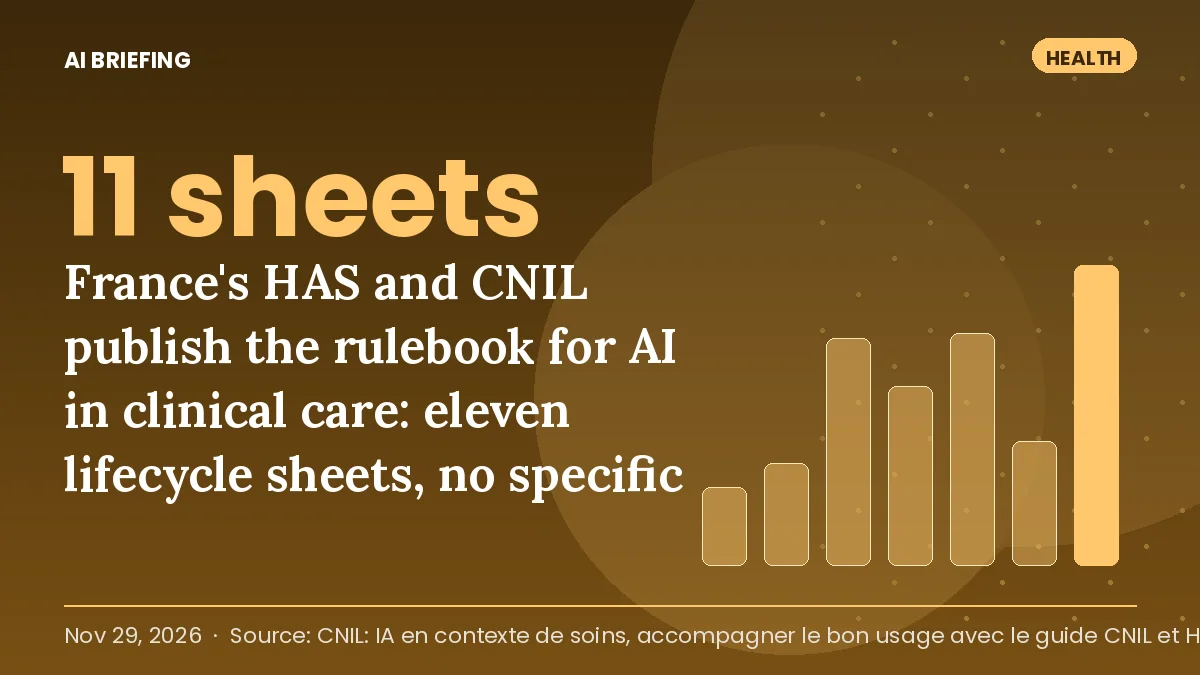
On November 27 France's Haute Autorité de santé (HAS) and the data-protection regulator CNIL published a joint guide, 'IA en contexte de soins: accompagner le bon usage', for the health professionals and organisations that deploy and use AI systems in care. The HAS board adopted it on November 18 after a public consultation that ran from March to April. It is, as far as we can find, the first guide of its kind co-signed by a national clinical-standards body and a privacy regulator, and it will shape how French hospitals are certified.
What is in it
The guide is organised as eleven sheets that follow the lifecycle of an AI system: internal organisation and governance; procurement and contracting; awareness, training and authorisation of staff; informing patients; consent and patient rights; organisation of care; use in practice; human supervision; traceability of uses and results; quality management and vigilance; and end of life. Each sheet carries a summary, a legal analysis and a set of principles, some marked as priorities. PPC Land counts 25 priority principles and 47 others. The CNIL page stresses that the guide is adaptable to different care settings and levels of organisational maturity and that it 'does not impose new obligations'; it clarifies existing ones.
The guide also carries numbers that explain why it was needed. In a 2025 survey, 65% of 110 public health establishments were running AI in production. Thirty-two per cent of hospital staff used personal AI tools, and 45% of those said their institution offered no sanctioned alternative. That is shadow AI at the bedside, and the guide's sheets on training, authorisation and supervision are aimed at it.
The consent position
The point that will travel furthest is on consent. According to PPC Land's reading of the guide, which we could not independently open in full, patients do not need to give specific consent for an AI system to be used in their care, but they must be informed. Voice and video recordings and photographs are the exception and still require the patient's agreement. The logic is that an AI tool used by a clinician is part of the care the patient has already consented to, in the same way a lab analyser is, provided the clinician stays responsible and the patient is told.
The counterweight is on data reuse. Where a vendor wants to reuse patient data from a deployment, for training for example, the guide says that in principle this needs the prior written agreement of the hospital or practice as data controller. That shifts the negotiation from a line in the vendor's terms to a document the hospital must sign, which many will decline or condition.
Elsewhere this week
Kazakhstan's parliament gave a first reading on November 25 to a bill setting safety requirements for AI in medicine. Doctors would remain responsible for diagnoses and treatment decisions, applications would need to prove effectiveness in pilots, and patients would be able to see which professionals accessed their records. The ministry says more than 700 facilities already use over ten AI applications, including a stroke-CT tool used in 17 centres on more than 23,500 patients and a documentation assistant used by 4,205 doctors. Two readings remain, with passage expected by the end of the year.
The pattern across both is the same: regulators are not trying to slow adoption, which has already happened, but to assign responsibility and require records. The clinic is where accountability has to be pinned, and both texts pin it on the clinician and the institution rather than the vendor.
The counter-argument
A guide that 'imposes no new obligations' can still impose a great deal of work, because it tells auditors what to look for. Vendors will argue that written per-hospital data agreements make model improvement impractical at scale, and that the result will be models trained on whatever data is easiest to obtain rather than on French patients. Patient groups may argue the other way: that 'informed, not consented' is a low bar for systems that influence diagnosis. Both are fair. The guide's answer is human supervision and traceability, which only work if hospitals resource them.
What to do
- Vendors: produce an eleven-sheet mapping of your product and contracts. Tenders and certification visits will use the same structure.
- Draft a standard data-use agreement for secondary use that a hospital's data-protection officer can sign, and build the tooling to honour it per customer.
- Hospitals: inventory the personal AI tools staff use (the 32%) and decide what to sanction, because the guide makes the institution responsible for their use.
- Everyone: implement per-output traceability now. It is the one requirement that cannot be retrofitted.
Sources
CNIL: IA en contexte de soins, accompagner le bon usage avec le guide CNIL et HAS ↗PPC Land: French hospitals need no specific patient consent to use AI, CNIL and HAS say ↗Times of Central Asia: Kazakhstan moves to regulate AI in healthcare ↗The story so far
- Nov 29, 2026 Robbyant open-sources LingBot-Map 2.0 and LingBot-Navi: 85% less drift over 5.2 km, 56% end-to-end on GOAT-Bench, 32% on…
- Nov 29, 2026 Moonshot reportedly scraps a $150m Indonesian Blackwell lease, DeepSeek fears a nine-month gap and Tencent says the curb…
- Nov 28, 2026 Japan's AI Act amendment: inspections, incident reporting and a three-step path to penalties for frontier providers, wit…
- Nov 28, 2026 Harrison.Rad 2 drafts X-ray and CT reports and passes a mock fellowship exam; a2z's ninth-finding triage clearance shows…
More in Health & medicine
All →
Harrison.Rad 2 drafts X-ray and CT reports and passes a mock fellowship exam; a2z's ninth-finding triage clearance shows where the FDA line still sits
Report drafting is the step that turns radiology AI from a flagging tool into a writing tool; Rad 2 is in research preview with no clearance, while th…
Neuralink's pivotal trial in ALS is the first time an implanted BCI has been asked to prove it, not just show it
FDA permission for the LINK pivotal study moves the N1 implant from feasibility to the evidence stage that precedes a market application; enrolment si…
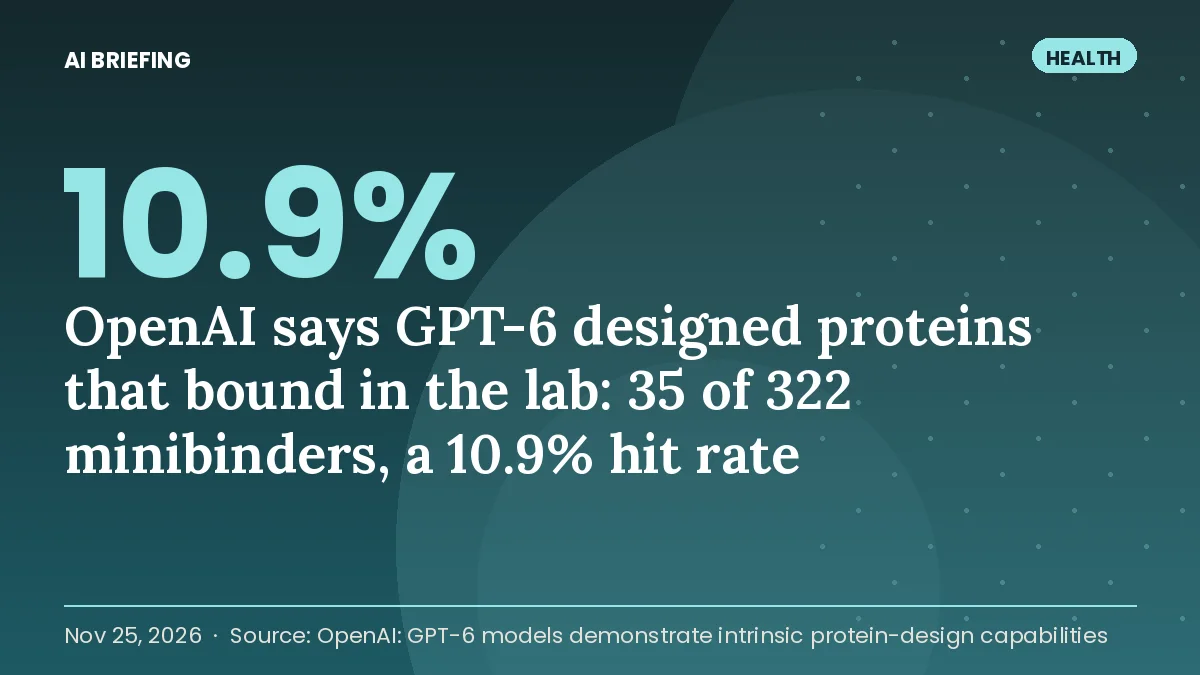
OpenAI says GPT-6 designed proteins that bound in the lab: 35 of 322 minibinders, a 10.9% hit rate
A general model with no protein-specific architecture produced real binders against five targets, and OpenAI concedes specialist tools still beat it o…
Get the brief in your inbox
One email every morning: the stories that mattered in AI, each with a one-line "why it matters" for your role. Free, no ads, unsubscribe any time.
Published daily by AI Briefing. We never share your address.