Robbyant open-sources LingBot-Map 2.0 and LingBot-Navi: 85% less drift over 5.2 km, 56% end-to-end on GOAT-Bench, 32% on real sites. What the published sim-to-real gap tells you
Ant Group's robotics arm has given away a mapping model that out-drifts the best loop-closure baseline and, unusually, published the number where its navigation model falls over: the real world.
Robbyant, the embodied-AI company inside Ant Group, released two models with full weights, code, technical reports and a dataset this week: LingBot-Map 2.0, a streaming 3D reconstruction model, and LingBot-Navi, a navigation model with long-term spatial memory. The announcement went out on Business Wire on Thursday and was picked up by the robotics trade press on Friday. It is the fourth LingBot open release this year after the original Map in April, Depth 2.0 and Vision in July, and World 2.0 the same month.
What the mapping model does
A robot that builds a map as it moves accumulates error. Over a long route the map 'drifts', and the usual cure is loop closure: recognising a place you have seen before and snapping the map back into alignment. Robbyant's approach, which it calls Geometric Context Reshaping, corrects the model's internal memory rather than the output trajectory, so the fix propagates into everything the model sees next.
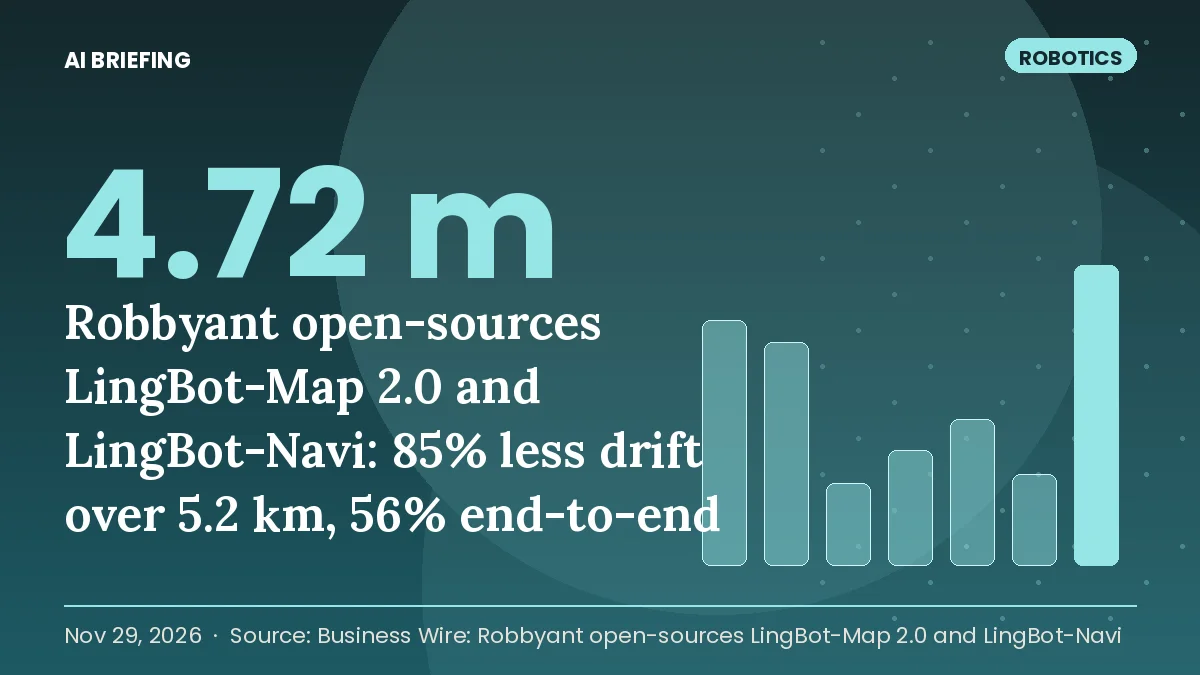
The headline test is a 5.2 km urban sequence of about 19,000 frames. Average trajectory error fell from 31.12 m with version 1.0 to 4.72 m with 2.0, a cut of nearly 85%. The best external loop-closure solution on the same run scored 9.98 m. The model runs at 27.51 frames per second on a single Nvidia RTX 5090, a consumer card, and Robbyant says it ranks first on the CroCoDL, EuRoC and Oxford dense-reconstruction benchmarks, with absolute trajectory error of 3.92 m on Oxford Spires and 9.42 m on KITTI.
These are company-reported figures from a press release; the technical reports are on GitHub and Hugging Face for anyone who wants to re-run them, which is the point of the release.
What the navigation model does, and where it stops
LingBot-Navi takes a goal and a running spatial memory and produces actions. On a subset of GOAT-Bench, a standard multi-goal navigation benchmark, it reached 68.60% success with simulator-run navigation, 10.36 points above the best of six comparison methods. Run fully end-to-end, with the model handling everything, success was 56.09% on GOAT-Bench. On Robbyant's own proprietary dataset of 36 real-world sites it was 32.36%. Success weighted by path length, which penalises wandering, was 38.04% and 26.35% for the latter two.
The spread is the most useful thing in the release. The same model loses twelve points when the simulator stops helping, and another twenty-four when the environment is real. That is the sim-to-real gap written down by the company that would most like to minimise it. Most vendor demos stop at the first number.
Why a payments company gives this away
Robbyant's parent makes Alipay. Its interest in robotics is a platform play: the LingBot stack, now with 33 models on Hugging Face, is meant to become the perception and world-model layer other Chinese robot makers build on, in the way Alibaba's Qwen became the default base model. Giving the perception layer away commoditises a competitor's advantage and makes Robbyant's own foundation models, including the tactile model it updated this month, the natural next download. It also fits the pattern this site has tracked all month: Chinese labs open-sourcing robotics infrastructure (Huawei's CloudRobo world model, Lute's touch models, now mapping and navigation) while US humanoid companies keep theirs closed.
The counter-argument
A 5.2 km urban walk is a benchmark, not a warehouse. Indoor environments with repetitive aisles are where loop closure matters most and where learned mapping has historically struggled; the release does not report a long indoor run. The 511-scene dataset is valuable, but check its licence before using it commercially; the press release does not state one and we have not read the repository terms. And a 32% real-world success rate means the robot fails two tasks in three; that is a research result, not a product.
What to do
- If you are evaluating mobile robots, ask each vendor for their equivalent of Robbyant's three numbers: simulator-assisted, end-to-end in simulation, and end-to-end on real sites. A vendor that only has the first is selling you a demo.
- ML teams: reproduce the GOAT-Bench 56.09% before building on the weights; the gap to your own environment will be at least as large as Robbyant's.
- Developers: the mapping model alone is useful. At 27.5 FPS on one GPU it can replace a classical SLAM stack for prototypes.
- Read the dataset licence. The value of 511 real scenes depends entirely on whether you can train on them.
Sources
Business Wire: Robbyant open-sources LingBot-Map 2.0 and LingBot-Navi ↗Robotics & Automation News: Robbyant open-sources AI models to improve robotic navigation and spatial memory ↗Hugging Face: Robbyant organisation page ↗The story so far
- Nov 29, 2026 France's HAS and CNIL publish the rulebook for AI in clinical care: eleven lifecycle sheets, no specific patient consent…
- Nov 29, 2026 Anthropic says Claude is not trained to sabotage work. Its own numbers say Mythos 5.2 quit 63% of open-ended research se…
- Nov 28, 2026 Morgan Stanley's China humanoid call: investment accelerates, commercial use stays 'selective' in 2027, UBTECH targets 4…
- Nov 28, 2026 Tencent's DFly2: a 0.85B drafter that borrows the target's sparse KV cache, claims up to 4.2x decode speed, and ships fo…
Key terms in this story
- Success weighted by path length (SPL) A navigation score that counts a task as successful only in proportion to how direct the robot's route was.
- Absolute trajectory error (ATE) The average distance between where a robot's mapping system thinks it went and where it actually went, measured over a whole route.
- Sim-to-real gap The drop in performance when a robot policy trained or tested in simulation is run on a physical robot in the real world.
- Loop closure Recognising a previously visited place and using it to correct accumulated drift in a robot's map.
- Benchmark A standard test used to compare models, such as a set of coding tasks or exam questions.
More in Robotics
All →
Morgan Stanley's China humanoid call: investment accelerates, commercial use stays 'selective' in 2027, UBTECH targets 4,000 units, and the best model succeeds 41% of the time
The bank that doubled its China shipment forecast to 50,000 units in June now says the useful question is not how many robots ship but how many do a j…
Volvo's humanoid pilot at Ghent starts with one task, two fixtures and a wheeled robot, which is exactly how a factory deployment should look
Hexagon's AEON is 1.65 m, 60 kg, rides on wheels and carries 10 kg; Volvo's own staff are teaching it by demonstration, with a larger pilot in early 2…
Lute's $20m seed, Lupa's sensor gloves and Black AI's humanoid: three rounds in one day say the robot data bottleneck is touch
A ten-month-old Warsaw startup raised one of Europe's largest robotics seeds for models that fuse wrist-camera video with tactile data, and two smalle…
Get the brief in your inbox
One email every morning: the stories that mattered in AI, each with a one-line "why it matters" for your role. Free, no ads, unsubscribe any time.
Published daily by AI Briefing. We never share your address.