DevelopingGoogle wants more SpaceX compute on top of $920m a month for 110,000 GPUs, Musk says, as rental prices split: big training blocks dearer, small clusters cheaper. What buyers should do
Two posts on X contain more useful pricing signal than most analyst notes: the GPU market is no longer one market, and the two biggest compute leases ever signed are both up for renegotiation within months.
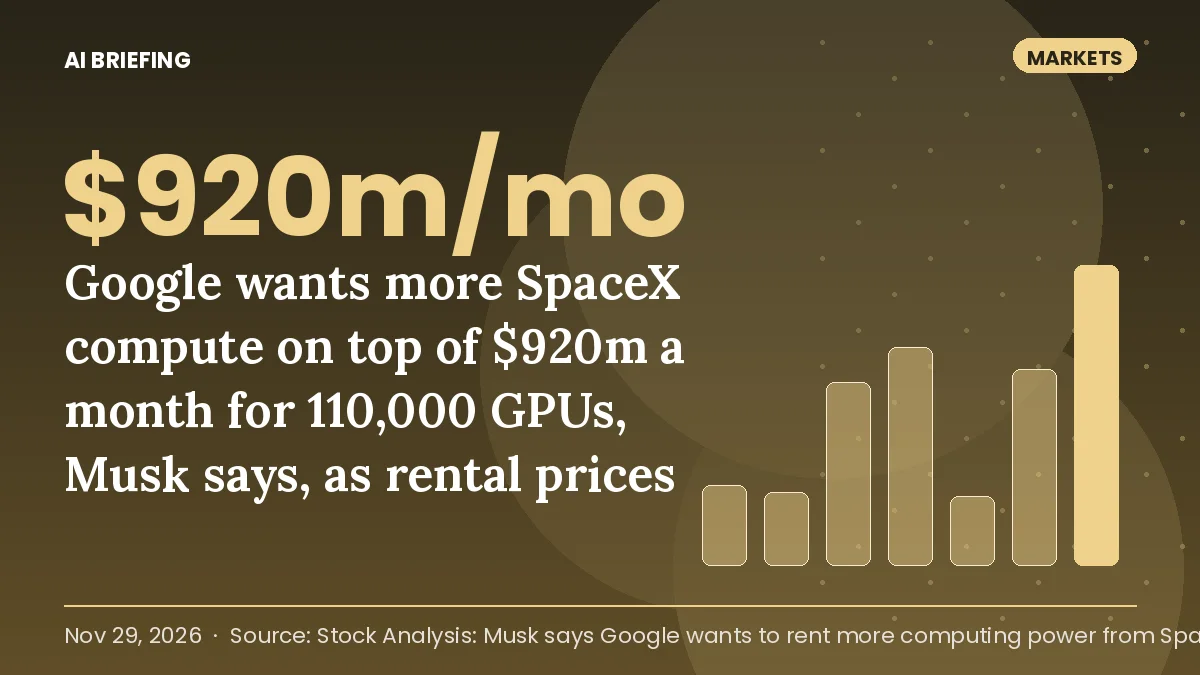
Elon Musk spent early Saturday posting about SpaceX's compute business, and two of the posts are worth more than their length. The first: Google 'has expressed interest in renting more compute from us.' The second: large training blocks are costing more to rent, 'sometimes very significantly', while rentals under about 5,000 GPUs are getting cheaper, and 'overall, the average rental price per GPU for SpaceX compute is rising.'
Neither company has announced anything, Musk gave no size, price or date, and Google has not commented. But the context makes the remarks consequential.
The two leases that built a business
SpaceX disclosed the Google contract in a filing on June 5, a week before its Nasdaq debut: $920 million a month from October 2026 to June 2029 for about 110,000 Nvidia GPUs plus CPUs, memory and related components, roughly $30 billion over the term. Google called it 'a short-term, timely agreement to ensure we have bridge capacity' for its Gemini Enterprise agent platform. Either side can walk away on 90 days' notice after December 31, 2026.
Anthropic's deal, signed in late May, is larger: $1.25 billion a month through May 2029 for all of Colossus 1's compute, about 325,000 GPUs. Together the two contracts are worth roughly $74 billion at full fees, and Wccftech reports that Anthropic alone accounted for nearly a third of SpaceX's third-quarter revenue.
That concentration is why the Anthropic rumours matter. Earlier this month, Anthropic executives reportedly told analysts the SpaceX arrangement would not be extended beyond the second quarter of 2027; Musk replied that SpaceX 'would be happy to take the compute back' and later said Anthropic had told him it wanted 'significantly more'. A SemiAnalysis desk note this week, as reported by Wccftech, suggested Anthropic might not renew a tranche of about 50,000 H200s and that SpaceX is already quoting that capacity to other customers at about $5 per GPU-hour from early 2027. None of this is confirmed by either company.
The price split
The more durable signal is the second post. Musk is describing a market that has bifurcated. Contiguous blocks of tens of thousands of Blackwell-class GPUs in one fabric, the thing frontier training runs need, are scarce, and buyers who need them are paying up. Small clusters are a commodity and getting cheaper, which is what you would expect as last year's H100 and H200 fleets age into inference work and new neocloud capacity comes online. Wccftech cites a cut in SpaceX's own Blackwell spot quote for small clusters from about $15 to $10-12 per GPU-hour.
The Bank of England's financial stability report on Thursday put hyperscaler bond issuance above $305 billion this year and called AI financing 'increasingly complex, circular and opaque'. A circulating tally by The Kobeissi Letter puts global AI-related debt issuance at a record $599 billion year to date; we have not been able to verify that figure against a primary source and cite it as a claim. Whatever the exact number, the debt is being raised to build the large blocks, and the large blocks are the part of the market where prices are rising. That is consistent with capacity still lagging demand at the top end, and with the SpaceX plan to go from 2.5-3 GW at the end of this year to about 13 GW in 2027 that SemiAnalysis has written up.
The counter-argument
Musk is talking his own book as a newly listed company's largest shareholder and in the middle of a public spat with Anthropic. 'Google is interested' costs nothing to say and may mean no more than a conversation; SpaceX shares were up 4.8% on Friday before the posts. The rising-average-price claim is also partly mix: if a customer drops cheap H200s and the remaining fleet is Blackwell, the average rises even if no price moved. The small-cluster deflation is the less self-serving half of the statement and the half other data sources support.
What to do
- Finance: model SpaceX's 2027 compute revenue under three cases (Google adds, Anthropic trims, both), and remember that both contracts carry 90-day exits from January 1.
- Buyers: contract for contiguous training capacity you know you need in 2027 now, and keep inference and dev clusters on short terms with quarterly re-quotes.
- ML teams: design training to tolerate sharded, lower-bandwidth capacity where the algorithm allows; the premium is on the fabric, not the chips.
- Watch for a SpaceX 8-K or a Google statement; until then, treat the Google top-up as unconfirmed.
Sources
Stock Analysis: Musk says Google wants to rent more computing power from SpaceX ↗TechCrunch (June 5): Google will pay SpaceX $920M per month for compute ↗Wccftech: Musk brands rival cloud giants 'slowpokes' while saying Google could join Anthropic in renting more compute from SpaceX ↗The story so far
- Nov 29, 2026 Moonshot reportedly scraps a $150m Indonesian Blackwell lease, DeepSeek fears a nine-month gap and Tencent says the curb…
- Nov 28, 2026 Wall Street's best week since April 2025: the S&P gained 5.6%, memory stocks led, Anthropic hit $91.88, and Nvidia sat o…
- Nov 27, 2026 Nvidia's halt to four Southeast Asian countries is the remote-access rule doing in a week what Commerce said would take …
- Nov 27, 2026 The Bank of England puts a number on the AI build-out: $305bn of hyperscaler bonds this year and just over $4tn of expos…
Key terms in this story
- Special purpose entity (AI financing) A legally separate vehicle set up to own or finance a data centre or compute contract, keeping the debt off the sponsor's main balance sheet.
- Inference Running a trained model to produce output. What you pay for when you call an API.
- Neocloud A cloud provider built around renting GPUs for AI training and inference rather than general computing: CoreWeave, Nebius, Lambda, Crusoe and hundreds of smaller operators.
- Agent An AI system that pursues a goal by taking actions with tools, in a loop, rather than answering a single question.
- GPU Graphics processing unit: the chip type, dominated by Nvidia, that performs the parallel arithmetic AI training and inference require.
More in Finance & markets
All →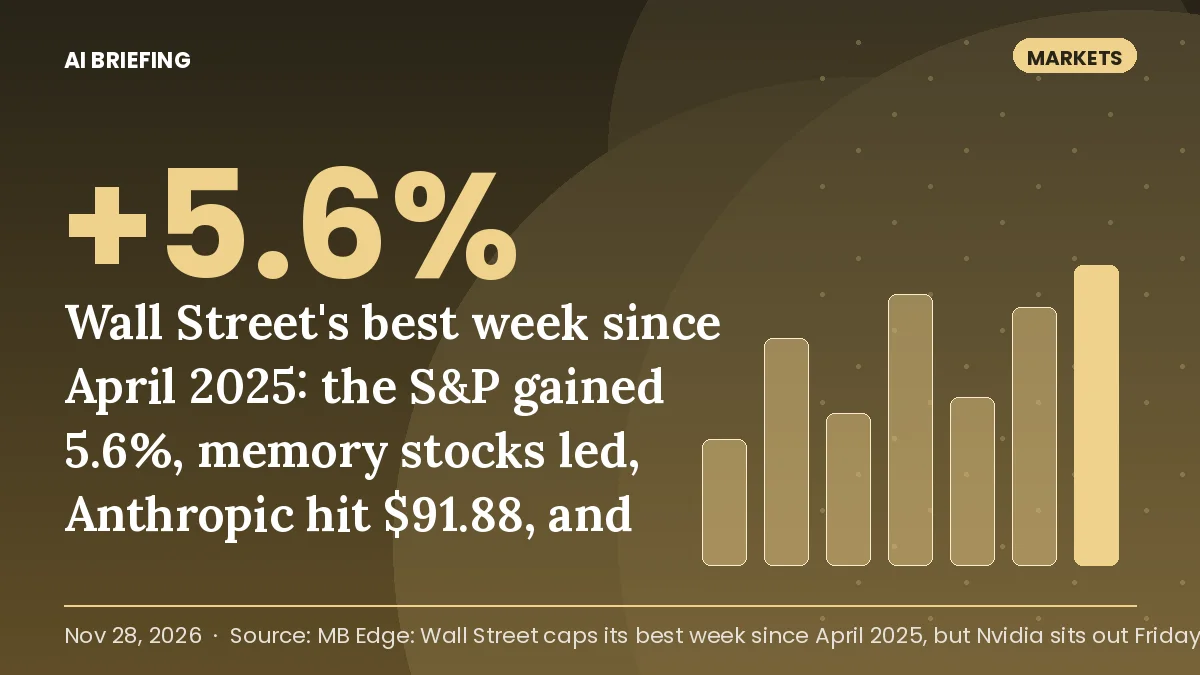
Wall Street's best week since April 2025: the S&P gained 5.6%, memory stocks led, Anthropic hit $91.88, and Nvidia sat out Friday
A shortened Black Friday session capped a rebound that reversed most of the prior week's 8.6% drop, but the leaders were memory and chip-equipment nam…
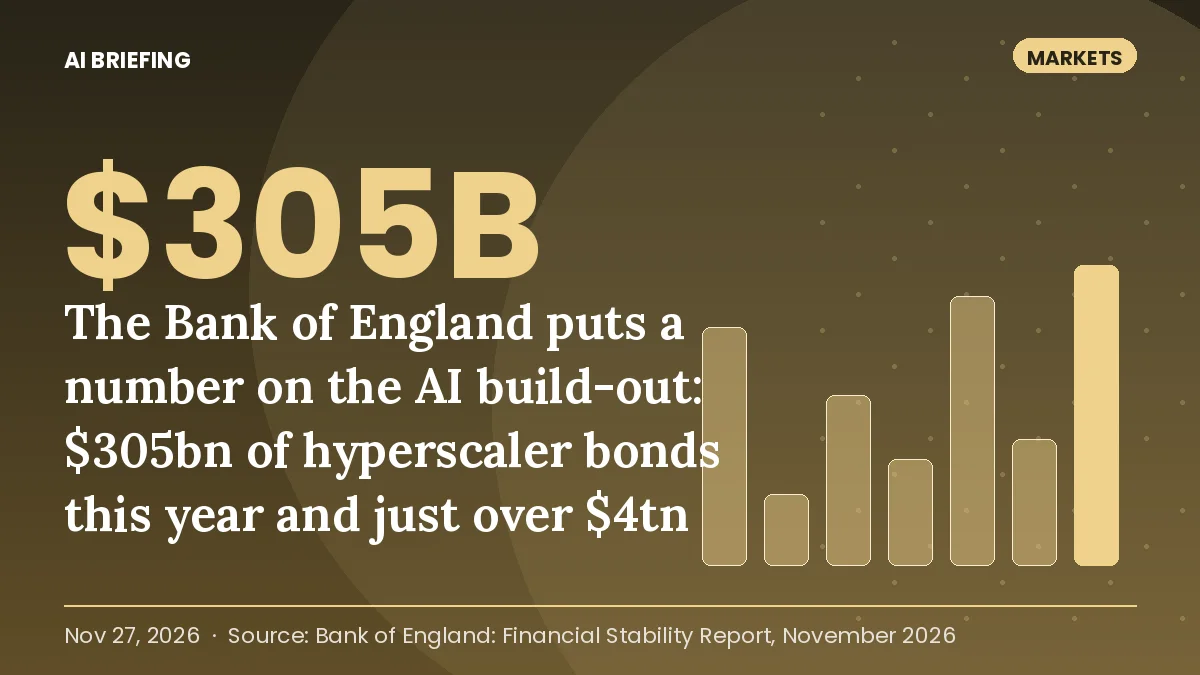
The Bank of England puts a number on the AI build-out: $305bn of hyperscaler bonds this year and just over $4tn of exposure it calls circular and opaque
The November Financial Stability Report is the first central-bank estimate of what the hyperscalers have committed on and off balance sheet; the FPC's…
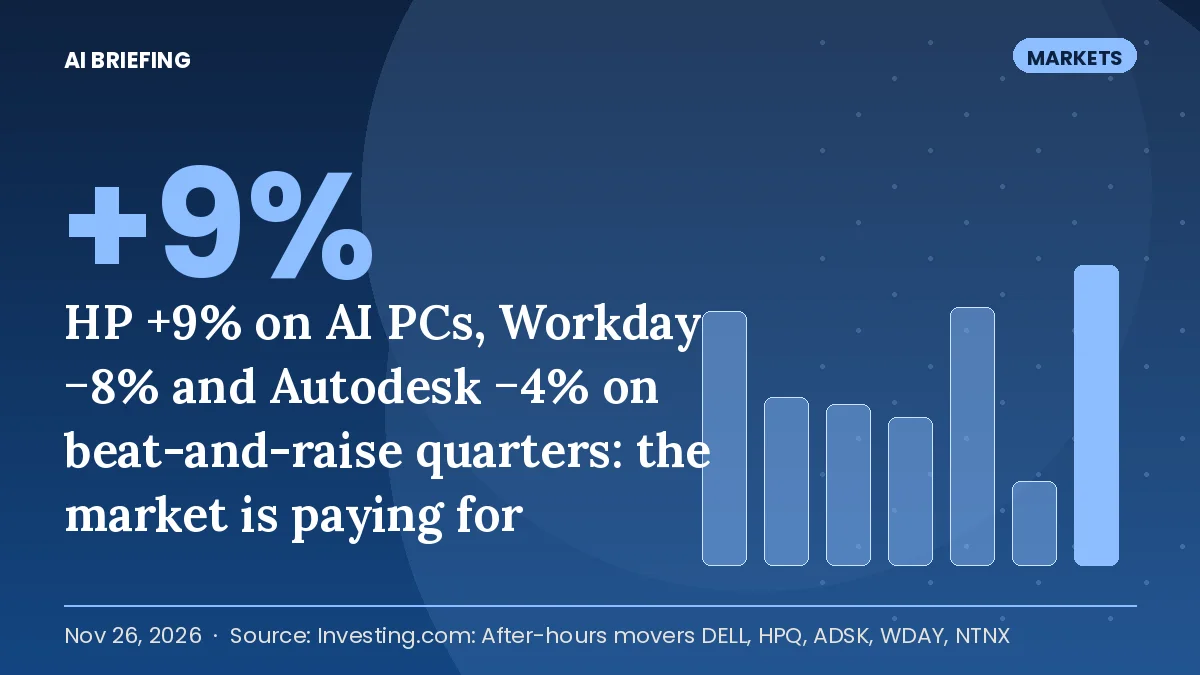
HP +9% on AI PCs, Workday −8% and Autodesk −4% on beat-and-raise quarters: the market is paying for hardware and charging software for its AI story
Tuesday's after-hours tape rewarded a $16bn PC quarter and punished two software vendors that raised guidance, one of which put a hard $150m number on…
Get the brief in your inbox
One email every morning: the stories that mattered in AI, each with a one-line "why it matters" for your role. Free, no ads, unsubscribe any time.
Published daily by AI Briefing. We never share your address.