OpenAI's new usage policy took effect Friday: routers and gateways need approval, outputs cannot train substitute models, 'protected reasoning' is off limits. What it means for anyone reselling or wrapping OpenAI models
Written in October and live from November 20, the rules arrive in the same week that the router ecosystem it targets suffered its biggest data-exposure scandal.
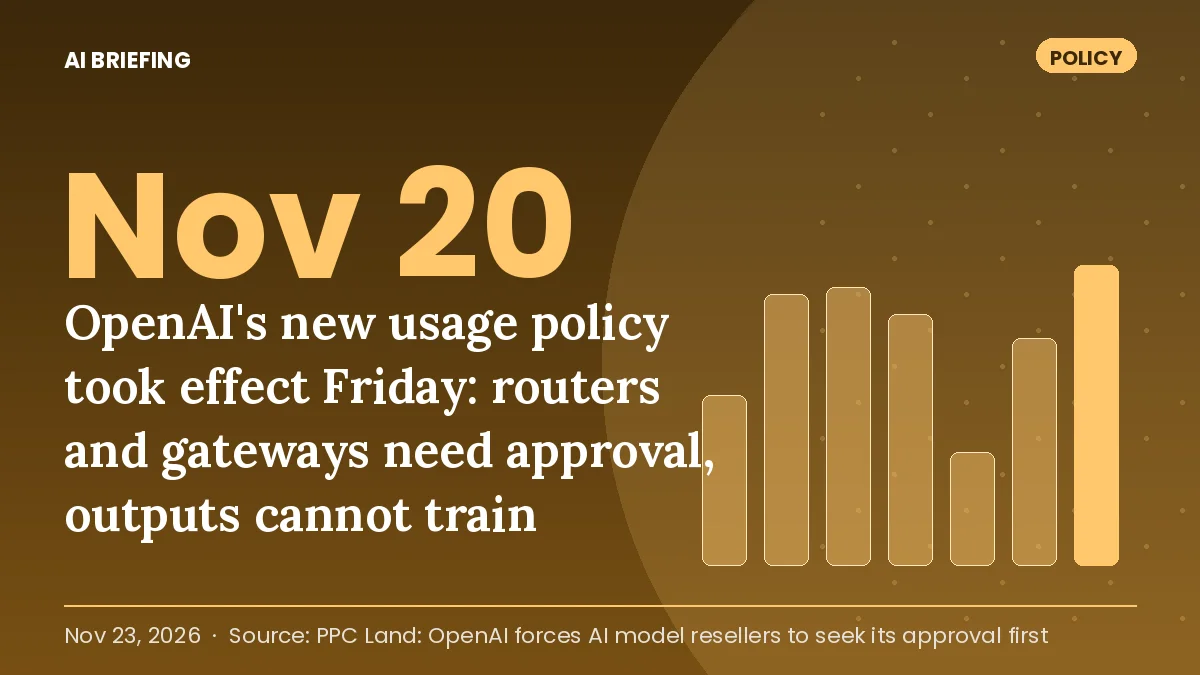
OpenAI's revised usage policies took effect on Friday, November 20, replacing the version dated October 29, 2025. The changes were posted to the company's changelog on October 21 with 30 days' notice and attracted little attention until Semafor reported on them last week. They matter now because the category they single out, routers, gateways and aggregators that give third parties direct access to OpenAI models, is the same category that spent the weekend explaining how customer prompts leaked through its providers.
What changed
Three provisions carry weight. First, any platform that offers third parties direct access to OpenAI models must obtain prior review and approval. First-party applications, where a developer uses the API inside its own product, are exempt. The policy names no companies; an outside lawyer quoted in coverage said OpenRouter is clearly in scope. Second, the policy bans using model outputs to produce training data or training signals for substitute models, and spells out that this includes rubrics, reinforcement-learning environments, labels and data filtering, whether done for yourself or on behalf of someone else. Earlier versions prohibited training competitors on outputs; this version closes the indirect routes that distillation pipelines actually use. Third, extracting what the policy calls protected reasoning, the hidden chain of thought behind reasoning models, is now explicitly barred.
Smaller changes round it out. Law enforcement joins the list of uses requiring approval, the high-stakes rule extends from advice to automated actions taken by agents, and a new section defines OpenAI-approved use exceptions, giving the company a formal channel to permit things the text otherwise forbids.
The context that makes it bite
The approval requirement reads differently after the weekend. Dragos's canary study and the disclosures from Together AI and OpenRouter showed that prompts marked zero-retention were being stored and read somewhere in the resale chain for open-weight models. OpenAI's models were not involved; its first-party API is not sold through those hosts. But its policy now gives it the right to decide which intermediaries may stand between it and a customer, and the exposure incidents make that right easier to defend. The distillation clause fits the same pattern: with export controls tightening around who may reach US frontier models, OpenAI has reasons beyond competition to show it is policing resale.
The counter-argument comes from the developers who built on routers precisely to avoid lock-in. An approval regime lets OpenAI slow or deny competitors' aggregation layers, and the distillation language is broad enough to chill legitimate evaluation work: building a rubric with a model and using it to grade another model's outputs is standard practice in research. OpenAI has said approved-use exceptions exist for such cases, but the burden of asking has shifted to the developer.
A price change in the same week
One more OpenAI change for developers to note: the public pricing page now lists GPT-6 Rosalind, the biomedical research model, at $10 per million input tokens and $50 output with $1 cached, a promotional rate through at least December 31. The tracker previously carried $15 / $75 from the model's launch page. We have updated the row; the page also confirms cached input at $0.40 for GPT-6.2 Astra and $0.10 for GPT-6.2 Sol, both unpublished when those models launched on Tuesday.
What to do
Map how OpenAI models reach your users. If customers bring their own prompts and choose models through you, read the platform definition and start the approval process now; access can be revoked for violations. Audit any pipeline that uses OpenAI outputs to build graders, labels or training environments for other models and either stop it or request an exception in writing. Check whether your contracts with intermediaries pass through OpenAI's terms, because they now must. And if you rely on a router for open-weight models too, apply the lesson from the Together and OpenRouter incidents regardless of what OpenAI's policy says: know which host serves each request, and plant canaries to prove it.
Sources
PPC Land: OpenAI forces AI model resellers to seek its approval first ↗OpenAI developer platform: API pricing ↗The story so far
- Nov 23, 2026 Inkling 2 Mini: a 26.4B open-weight model that runs its middle layers three times, fits in 20 GB and scores 79.2% on SWE…
- Nov 19, 2026 Perplexity's Brain: an agent memory that records its own work and rewrites its skills overnight, with correctness up 25%…
- Nov 19, 2026 Gemini 4 Neon: $3 / $15 per million tokens, 1M context, four thinking levels and a 32% cost-per-task claim against Carbo…
- Nov 18, 2026 GPT-6.2 Astra at $8 / $40: OpenAI cuts its flagship price by a fifth, matches Claude Fable 5.2 and ships the first model…
Key terms in this story
- Open-weight model A model whose trained parameters are published for anyone to download and run.
- Reasoning model A model trained to work through a problem step by step, generating intermediate 'thinking' tokens, before answering.
- Frontier model A model at or near the state of the art at the time, typically the newest top tier from a major lab.
- Distillation Training a smaller model to imitate a larger one's outputs, capturing much of its capability at lower cost.
- Evaluation (eval) A test set with known-good answers used to measure a model or system on your own tasks.
More in Policy & regulation
All →
Beijing promises countermeasures to the remote-access chip rule, Malaysia tells data centres to comply, and Trump meets Xi on Thursday. What tomorrow's summit can and cannot change for AI buyers
The rule takes effect when it hits the Federal Register, expected this week, whatever is said in Shenzhen. The variables that remain are how China ret…
BIS's remote-access rule: a licence for any data centre giving China-linked firms more than 12 million TPP, five new licence countries, and 90 days to comply. What cloud buyers and exporters must do
The Commerce Department has extended chip export controls from the box to the rental contract, reaching data centres anywhere in the world that serve …
'National champions' and a Shenzhen summit: the US plans to package Nvidia, OpenAI, Anthropic, Microsoft and Amazon for export as Trump meets Xi on Thursday. What the week means for AI buyers
The Wall Street Journal reports Commerce will name more than two dozen firms whose bundled chips, models and cloud get federal financing and fast expo…
Get the brief in your inbox
One email every morning: the stories that mattered in AI, each with a one-line "why it matters" for your role. Free, no ads, unsubscribe any time.
Published daily by AI Briefing. We never share your address.