DevelopingThe Nasdaq fell 5.3% on Friday and Nvidia 14% as the AI trade cracked; Anthropic closed a $93.5 billion IPO into the selloff. What the correction is pricing, and what Monday's futures say
Three indices in correction, a VIX at its highest since April 2025 and a 90% chance of a December rate rise: the week's real question is whether the AI build-out can still be financed at these prices.
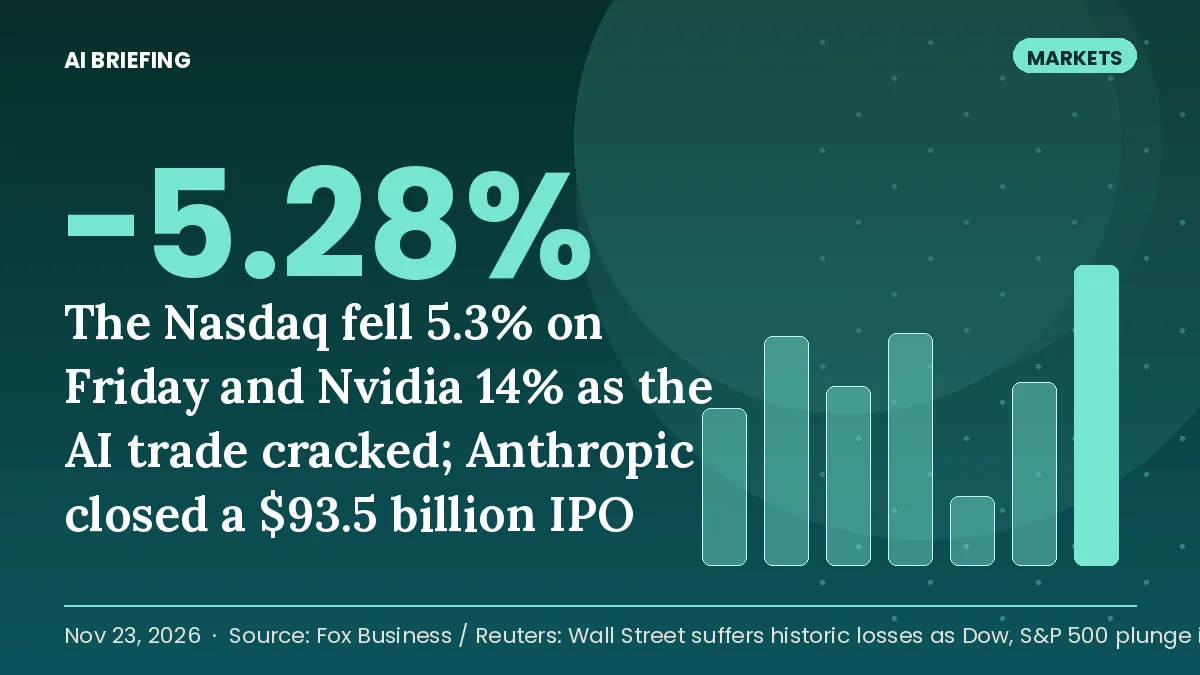
Friday was the day the AI trade stopped getting the benefit of the doubt. The Nasdaq Composite dropped 1,261 points, or 5.28%, to 22,617, its second-largest point fall on record, wiping out its gains for 2026. The S&P 500 lost 3.7% for a seventh straight losing session, its longest streak since February 2020, and ended the week down 8.6%. The Dow shed 950 points. All three indices now sit at least 10% below their highs, the textbook definition of a correction. The VIX closed at 35.89, its highest since April 2025. Nvidia fell 14.01% to $125.53.
What actually moved
No big company changed its guidance on Friday. What changed was the discount rate and the risk premium around a very concentrated trade. Philadelphia Fed president Anna Paulson said she was open to back-to-back rate rises and Governor Lisa Cook warned of falling behind inflation; prediction markets put the odds of a quarter-point increase at the December 9 meeting near 90%. On top of that sat a cluster of Nvidia-specific headlines: a Reuters report that SEC enforcement staff are examining the company's accounting, California's attorney general confirming an investigative subpoena, and the continuing fallout from Jensen Huang's resignation, with the former chief executive due before three House committees on December 1. Add President Trump's Thursday threat of tremendous penalties on companies building data centres abroad, and the market had several reasons to sell the most crowded position it owned.
Treasury Secretary Scott Bessent offered the administration's reading on Sunday: the Fed risks a policy mistake if it over-tightens, Democratic hostility to AI is spooking investors, and the industry has done a terrible job explaining itself. By Monday morning the tape had steadied, with Nasdaq 100 futures up about 3.3%, Nvidia indicated around 8% higher and Anthropic about 3% higher before the open.
Anthropic's timing
Anthropic's IPO closed on Friday in the middle of all this. The prospectus shows 980 million Class A shares sold at $83, 956.4 million of them by the company, with a 30-day option for the banks to buy up to 147 million more, all from the company. Secondary reports say the option was exercised in full, which takes the deal to 1.127 billion shares and about $93.5 billion of gross proceeds, roughly $91.6 billion of it to Anthropic. A separate $26 billion private placement of Class N shares at the same price came from Google and Nvidia at about $10 billion each, AMD at $2.5 billion, Broadcom, Micron and Microsoft at about $1 billion each and TSMC at $500 million. The prospectus estimates net proceeds of about $117 billion with the option exercised.
The shares closed their first day at $97.17, up 17%, then fell 8.5% on Friday to $88.91, still 7% above the offer price. Reuters reported on Sunday that the process itself was unusual: a 22-bank syndicate led by Goldman Sachs and Morgan Stanley earned more than half a billion dollars in fees, some banks were capped at four senior bankers, and core deal-team members signed six-month agreements not to work with OpenAI, Cursor, DeepSeek or Hugging Face. Anthropic and its banks declined to comment.
The counter-argument
Bulls will note that nothing in the AI demand picture changed: Oracle said on Friday that financing for its OpenAI contract is in place, Nvidia guided to $130 billion for the current quarter only last week, and corrections in 2024 and 2025 were buying opportunities. The bear case is that this build-out is now funded by bonds, leases and vendor financing whose cost just went up, and that purchase commitments of $390 billion at Nvidia and roughly $895 billion at Anthropic were sized for cheaper money.
What to watch
HPE reports after the close today and Dell, HP Inc, Workday and Autodesk on Tuesday; listen for AI server backlog and whether memory costs are being passed through. December 1 brings Huang's closed-door House interview, December 9 the Fed decision. And keep an eye on Anthropic's lock-up terms in the prospectus: early releases tied to price thresholds are now a live question rather than a formality.
Sources
Fox Business / Reuters: Wall Street suffers historic losses as Dow, S&P 500 plunge into correction territory ↗SEC: Anthropic, PBC, Form 424B4 prospectus ↗Semafor: Bessent warns on Fed hike as AI bubble fears mount ↗The story so far
- Nov 23, 2026 Dell, HPE, Lenovo and Supermicro are reportedly asking 25–45% above signed prices on AI servers at delivery, with HPE re…
- Nov 19, 2026 Anthropic prices at $83 and raises about $81 billion, the largest IPO ever. What the final terms say, and what to watch …
- Nov 18, 2026 Nvidia's first quarter without Huang: $115.8 billion in, $130 billion guided, zero China assumed and a margin that falls…
- Nov 17, 2026 BIS's remote-access rule: a licence for any data centre giving China-linked firms more than 12 million TPP, five new lic…
Key terms in this story
- Purchase commitments Contracts a company has signed to buy components, capacity or services in future, disclosed in its financial statements even though the cash has not yet been spent.
More in Finance & markets
All →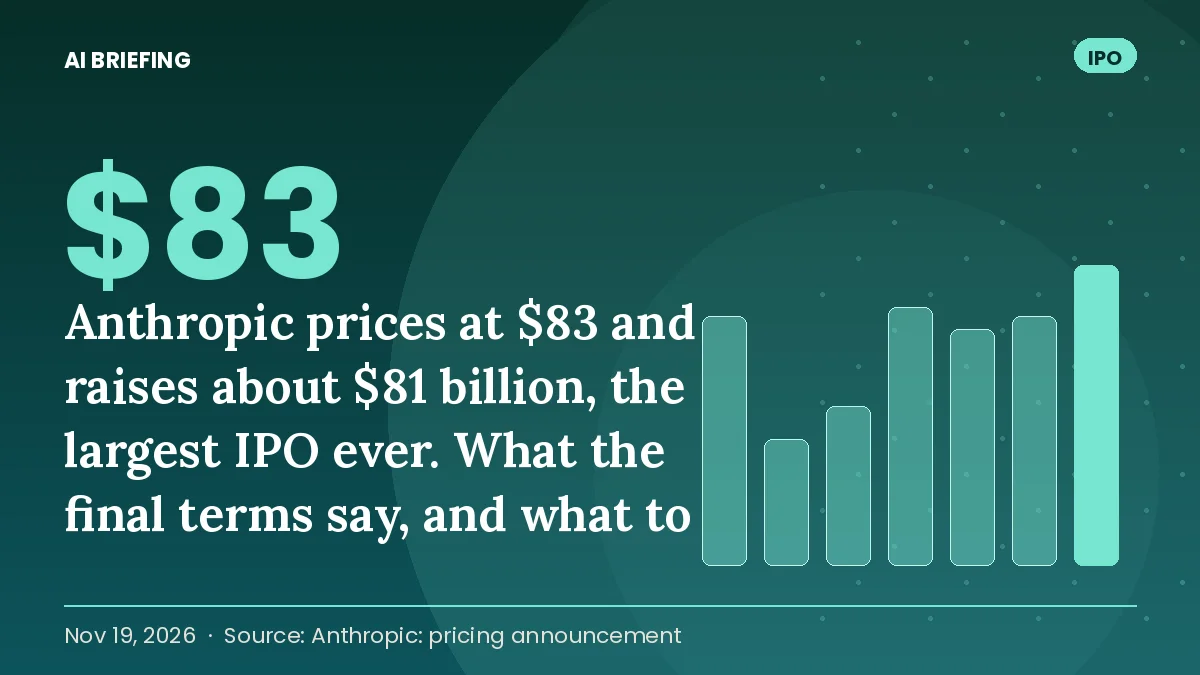
Anthropic prices at $83 and raises about $81 billion, the largest IPO ever. What the final terms say, and what to watch when ANT opens today
The price landed $5 above the top of the range and the share count grew, which tells you how the book filled; the prospectus numbers tell you what the…
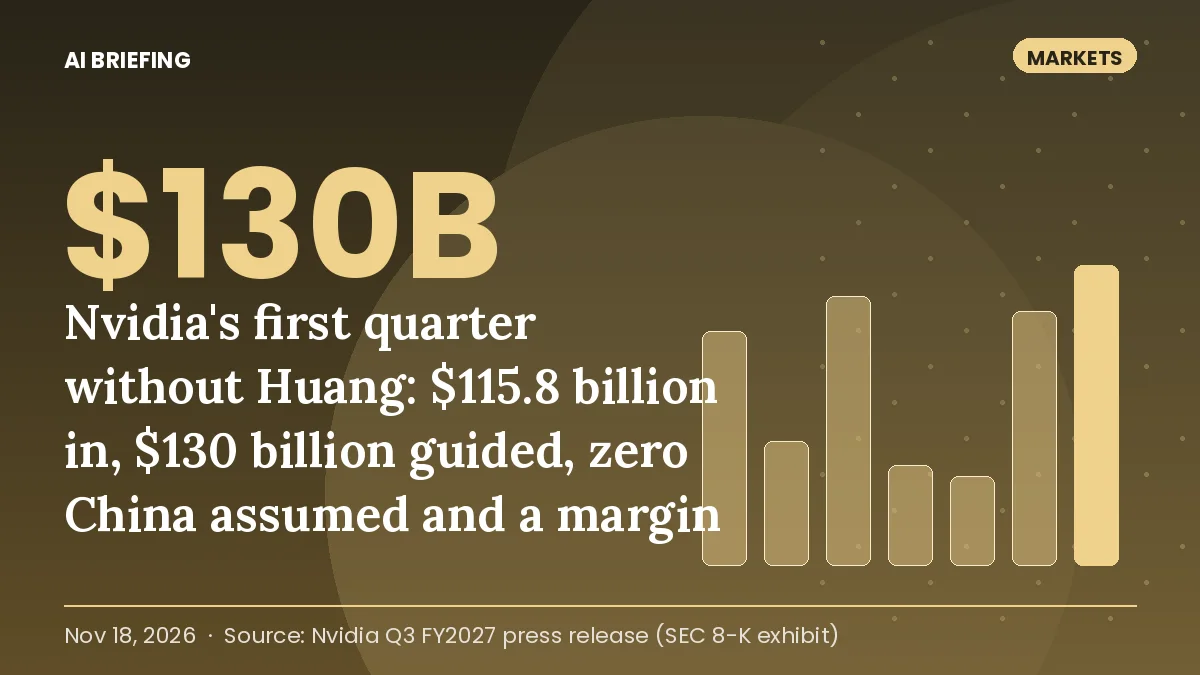
Nvidia's first quarter without Huang: $115.8 billion in, $130 billion guided, zero China assumed and a margin that falls to 71%. What the numbers say about 2027
The beat was expected; the shape of the guide was not. Nvidia is now telling investors that the next quarter will be bigger, less profitable per dolla…
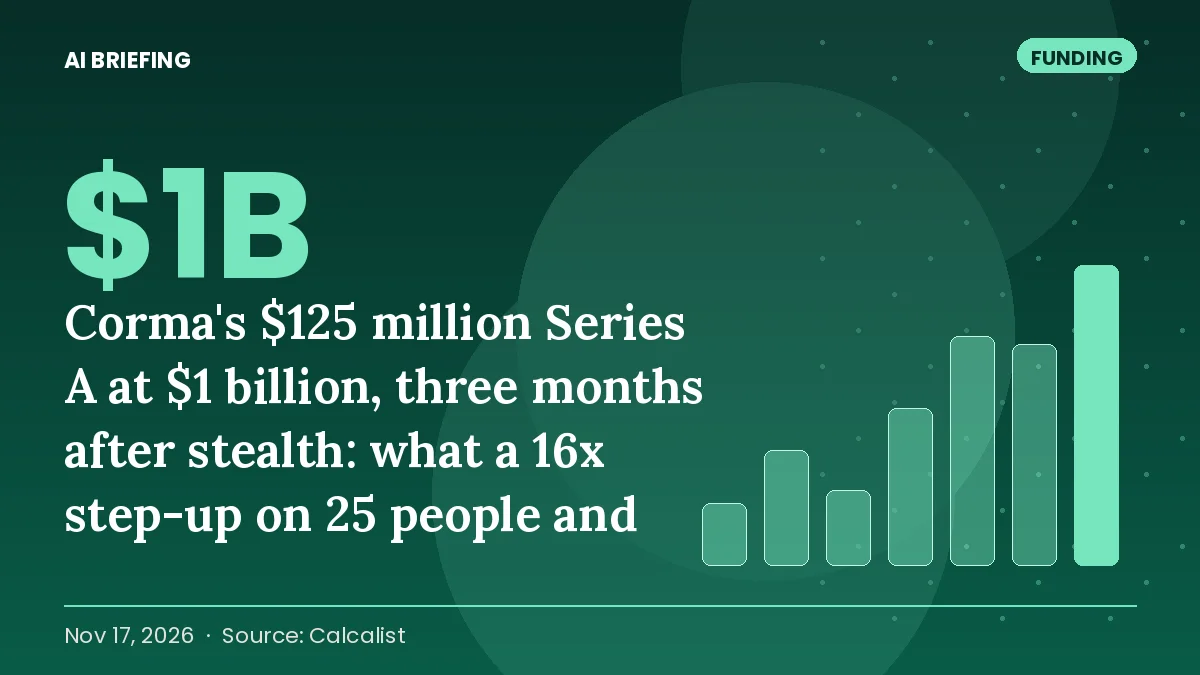
Corma's $125 million Series A at $1 billion, three months after stealth: what a 16x step-up on 25 people and undisclosed revenue says about the defensive-AI market
NEA has priced a defensive cybersecurity foundation-model lab as a unicorn before it has named a customer, betting that the autonomous attack tools in…
Get the brief in your inbox
One email every morning: the stories that mattered in AI, each with a one-line "why it matters" for your role. Free, no ads, unsubscribe any time.
Published daily by AI Briefing. We never share your address.