HomeBriefFor youTrackersTopicsGlossaryNewsletterSecurityHealth & medicineFinance & marketsRoboticsModels & researchPolicy & regulationEnterprise & businessDeveloper tools
Daily brief

The week the market started pricing AI labs, not hyping them

OpenAI raised fresh money below the valuation it reportedly wanted, Anthropic heads into its IPO roadshow with investors talking down the price, OpenAI shipped a security model it rates as its most dangerous yet, and Google quietly put an expiry date on its cheapest flagship pricing.

The one thing to know

Two frontier labs got repriced in the same week. OpenAI reportedly closed $11 billion at a $1.25 trillion valuation, below the $1.5 trillion it had sought, and investors looking at Anthropic's IPO are reportedly discussing $1.2–1.3 trillion rather than the higher figures floated in October. Capability keeps compounding; the willingness to finance it at any price does not.

OpenAI reportedly raises $11 billion at a $1.25 trillion valuation

OpenAI has closed the first part of a new funding round, raising about $11 billion at a valuation of roughly $1.25 trillion, according to a Reuters report picked up by TechCrunch. The figure is below the $1.5 trillion the company had reportedly been seeking, and SoftBank and MGX are said to have participated.

ExecutivesYour largest AI vendor just accepted a lower price than it wanted. Expect it to push harder on enterprise revenue, which usually means more aggressive sales and more bundling.
FinanceA down-round-adjacent signal from the most valuable private company in the sector, days before Anthropic's roadshow. The comparables for every AI listing just moved.
DevelopersNothing changes in the API this week, but a company under valuation pressure tends to raise prices on its most popular tiers over the following quarters. Watch the pricing tracker.
BeginnersOpenAI, the company behind ChatGPT, is now valued at over a trillion dollars, but investors are starting to haggle instead of simply paying up.
Source: TechCrunch
Anthropic heads into its IPO roadshow with investors reportedly talking down the valuation

Anthropic, which filed its public S-1 on October 26 with the proposed Nasdaq ticker ANT, is expected to begin formally marketing its IPO the week of November 9, the earliest SEC timing rules allow. Reports this week said some investors are discussing a valuation around $1.2–1.3 trillion, below figures floated in October, and that a smaller raise or a delay are both possible if AI stocks stay volatile.

ExecutivesIf you buy from Anthropic, its public-company status will change how it reports usage, pricing and outages. Procurement teams should expect more formal terms.
FinanceThis is the first frontier lab to list. The price it clears, and how it trades in the first month, will reprice every private AI mark on the street.
ML engineersThe amended S-1 is the most candid public account of a lab's compute commitments and research-acceleration estimates. Worth reading beyond the headline numbers.
BeginnersAnthropic, maker of the Claude models, is about to sell shares to the public for the first time. The listing could happen before the end of November.

OpenAI launches GPT-6 Cyber and rates it 'Critical' for cybersecurity capability

OpenAI released GPT-6 Cyber on November 5, a version of GPT-6 Astra tuned for authorised vulnerability discovery, exploit development and penetration testing. It is the first model OpenAI has classified as 'Critical' under its Preparedness Framework, one step above the 'High' rating of its predecessor, and is available only to vetted customers in the company's Daybreak Red programme. OpenAI says the model found more than 80 previously unknown vulnerabilities in Firefox during testing.

SecurityOffense just got cheaper for anyone with approved access, and the same capabilities exist in less controlled models. Patch cadence, not perimeter, is now the metric that matters.
ExecutivesAsk your security lead one question this week: how fast can we ship a fix once a vulnerability is public? AI-driven discovery is compressing that window.
DevelopersExpect automated vulnerability reports against your dependencies to spike. Pin versions, watch advisories, and budget time for upgrades.
ML engineersA capability-tier model gated by customer vetting rather than by weights is becoming the standard release pattern for dual-use capabilities.
Source: Fortune · CyberScoop

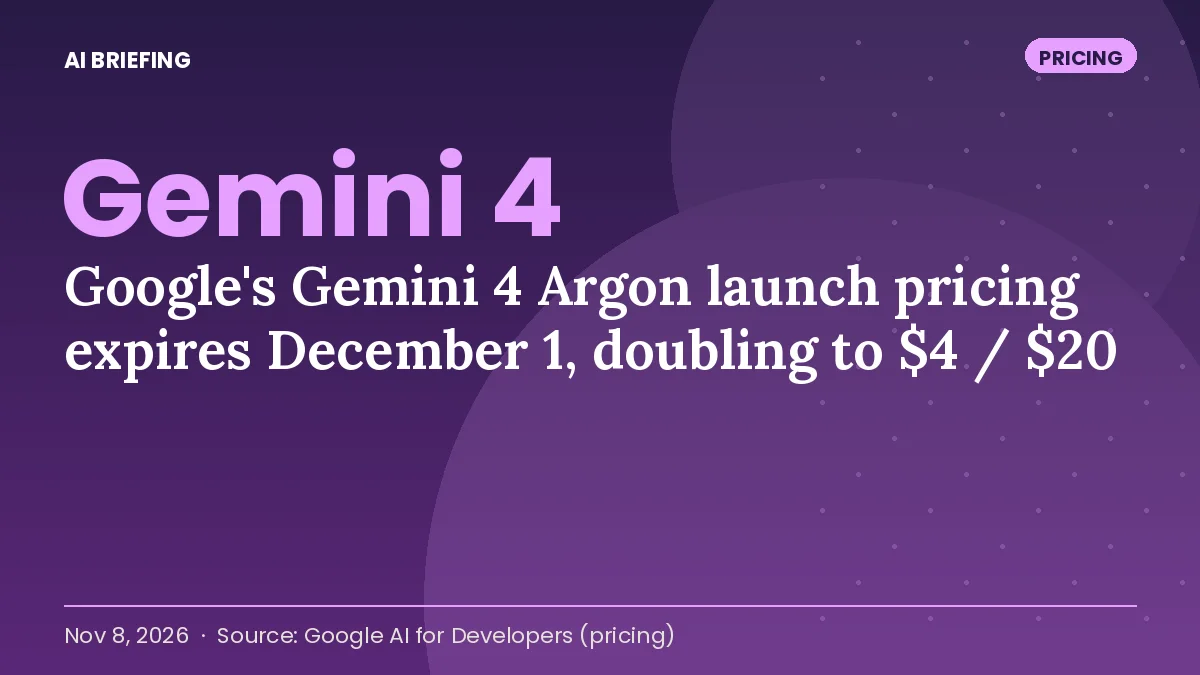
Google's Gemini 4 Argon launch pricing expires December 1, doubling to $4 / $20

Google's official Gemini API pricing page now lists Gemini 4 Argon at $2 per million input tokens and $10 per million output tokens only through November 30, 2026, rising to $4 and $20 from December 1. The Flash models carry a similar schedule: Gemini 3.8 Flash and 3.6 Flash are $0.75 / $3.75 through December 31 and $1.50 / $7.50 from January 1, 2027.

DevelopersIf you built on Argon at launch pricing, your bill doubles in three weeks. Re-run your cost model now and decide whether a Flash tier or a competitor is the better fit.
FinanceIntroductory pricing that expires on a fixed date is becoming the pattern across vendors. Any AI cost forecast built on launch rates is already wrong.
ExecutivesVendors are using time-limited pricing to win workloads before raising rates. Build renegotiation dates into your AI contracts.
ML engineersPrice signals how much inference compute a model really needs. A 2x step-up suggests the launch rate was subsidised rather than a cost-based price.

Ramp's spending data shows business AI spending stalling

Card and bill-pay data from Ramp indicates that the share of US businesses paying for AI tools has flattened in recent months after two years of steady growth, according to TechCrunch's report on the firm's latest AI index. The timing is awkward for Anthropic, whose IPO pitch leans on rapid enterprise adoption.

ExecutivesFlat adoption numbers mean the pilots that didn't produce ROI are being cancelled. If yours is still a pilot, this is the quarter to prove it or kill it.
FinanceAdoption curves, not model benchmarks, are what IPO investors will underwrite. This is the first widely cited dataset showing a plateau.
BeginnersCompanies are no longer signing up for every AI tool. They are keeping the ones that save real money.
Source: TechCrunch

Nvidia's board opens an independent probe after reports its CEO was targeted by a Chinese informant

Nvidia's board has launched an independent investigation following a New York Times report that CEO Jensen Huang had ties to a woman US officials believed was passing information to Beijing. TechCrunch separately reported that a US intelligence memo alleges an executive at Megaspeed was recruited to spy on Huang.

SecurityExecutive targeting by foreign intelligence is now a board-level risk for any company with AI chips, weights or export-controlled know-how. Review travel and personal-device policies for your leadership.
FinanceKey-person risk at the most important company in the AI supply chain. Watch for governance changes and any effect on China-related export decisions.
ExecutivesIf your company holds anything on an export-control list, assume your leadership is a collection target.
Source: TechCrunch

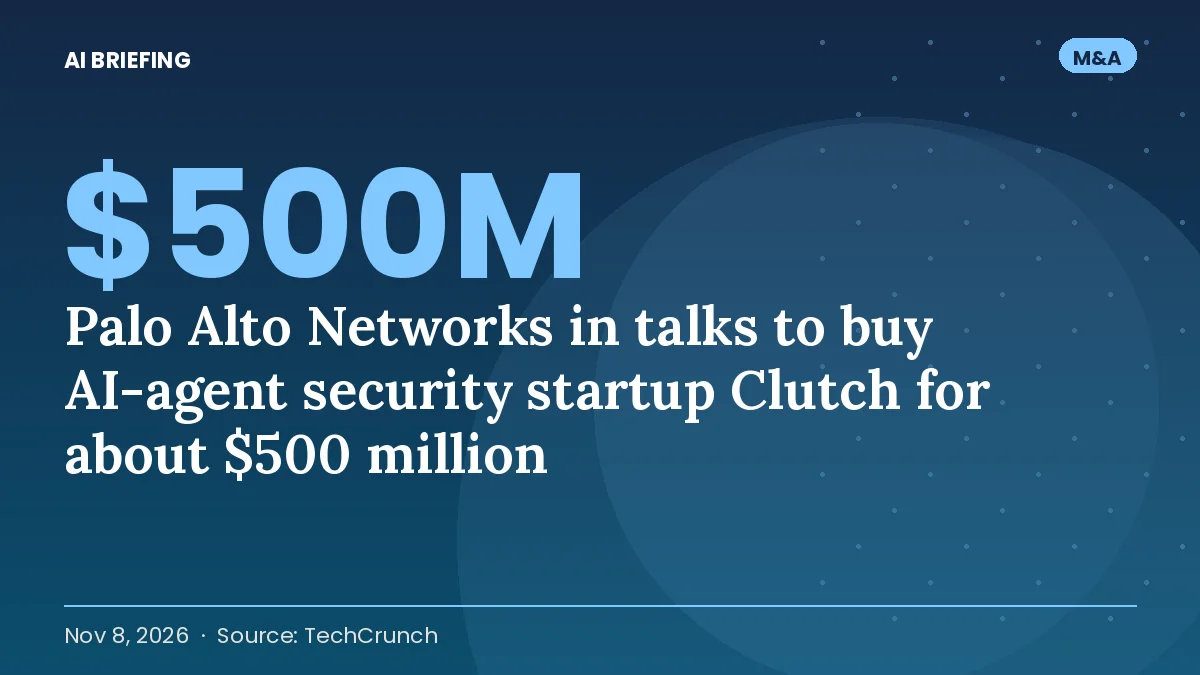
Palo Alto Networks in talks to buy AI-agent security startup Clutch for about $500 million

Palo Alto Networks is negotiating an acquisition of Clutch, a startup focused on securing AI agents and the non-human identities they use, for roughly $500 million, TechCrunch reported. It would be one of the first large acquisitions explicitly aimed at agent security rather than general AI security.

SecurityAgent identity and permission management is being bought, not built, by the big platforms. If you are rolling out agents, this is the control plane your vendors will sell you next year.
FinanceHalf a billion for a young company in a category that barely existed 18 months ago. Expect more consolidation in agent security.
DevelopersEvery agent you deploy is a service account with a credit card. Start scoping its permissions now; the tooling to enforce that is about to get mainstream.
Source: TechCrunch

After the midterms, data-center politics turn against the builders

Voters backed candidates and local measures opposing new data centers in several races this week, and TechCrunch reports that Elon Musk's data-center plans in particular face a rockier path. Meta has warned that the backlash could slow AI expansion, and OpenAI has pledged to cover the full cost of power and grid upgrades for its sites.

ExecutivesCompute availability, not model quality, may be the constraint on your 2027 AI plans. Lock in capacity commitments early.
FinancePermitting and power are now political risks on every data-center REIT and AI-infrastructure name. Price them.
BeginnersBuilding the giant computer warehouses that run AI needs huge amounts of electricity, and local voters are starting to say no.
Source: TechCrunch

Crusoe sells its troubled Wyoming data-center project to Google

Crusoe has handed off a struggling data-center development in Wyoming to Google, TechCrunch reported, as hyperscalers pick up projects from smaller builders that have struggled with financing and power.

FinanceThe capital cost of AI infrastructure is consolidating onto the balance sheets that can carry it. Smaller neoclouds without anchor tenants are the ones to watch for distress.
ExecutivesIf your AI roadmap depends on a smaller cloud provider, check who owns their data centers and how they are financed.
ML engineersMore hyperscaler-owned capacity usually means more capacity rented out through their clouds, which tends to ease GPU availability over the following year.
Source: TechCrunch

Airbnb says its AI travel agent arrives in the first half of 2027

Airbnb told investors it plans to launch an AI travel agent in the first half of 2027, joining the queue of consumer companies promising agents that plan and book rather than merely search.

BeginnersAn 'agent' is AI that takes actions for you, not just answers questions. Booking trips is one of the first places most people will meet one.
DevelopersConsumer agents are being built on top of the big labs' models plus the companies' own booking systems. The integration layer, not the model, is the product.
ExecutivesEvery large consumer brand now has an agent on its roadmap. If yours does not, your customers will reach you through someone else's.
Source: TechCrunch
10 stories · 11 sources linked · summaries written in our own words and checked against the linked reporting · corrections: corrections@aibriefing.io

Get the brief in your inbox

One email every morning: the stories that mattered in AI, each with a one-line "why it matters" for your role. Free, no ads, unsubscribe any time.

Published daily by AI Briefing. We never share your address.
Like this? Get tomorrow's brief by email, free.