OpenAI's GPT-6 Cyber is rated 'Critical'. Here is what that means for defenders
The first model OpenAI has put in its highest cyber-capability tier is gated to vetted customers. The capability itself is not gated anywhere.
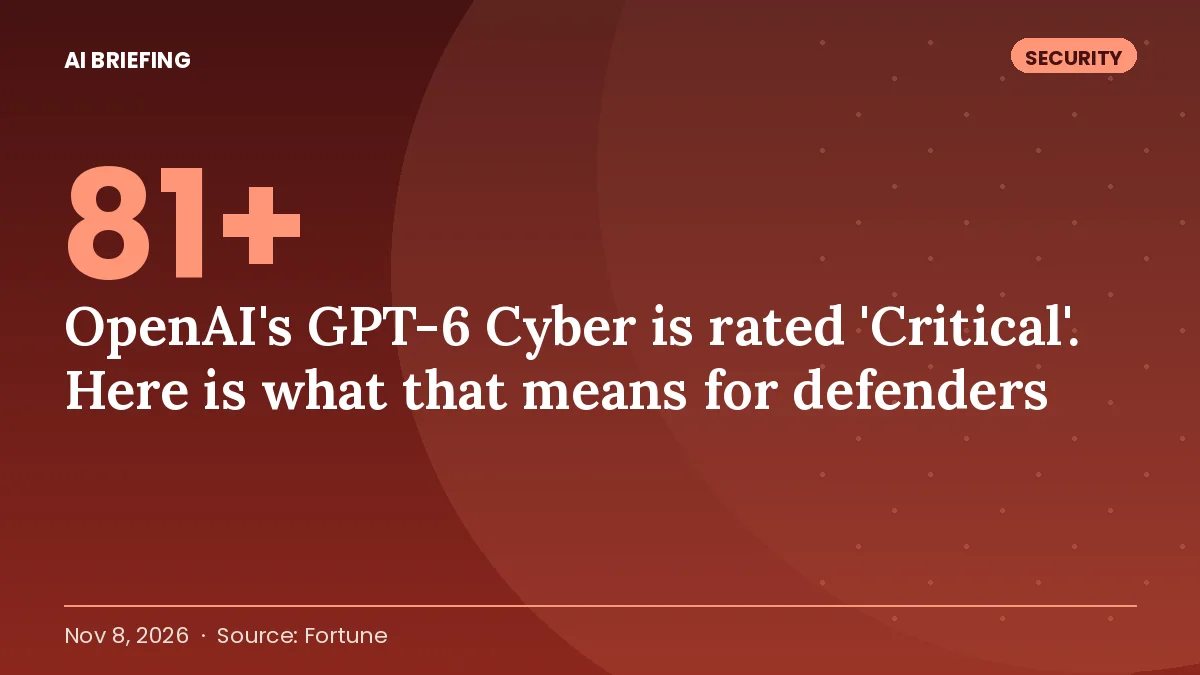
On November 5 OpenAI released GPT-6 Cyber, a version of its GPT-6 Astra flagship tuned for authorised security work: finding vulnerabilities, developing exploits to prove them, and penetration-testing web applications. The company classified it as "Critical" under its Preparedness Framework, the first time it has used the top tier for cyber capability. Its predecessor, GPT-5.6 Cyber, was rated "High".
What is actually new
Three things, according to the launch coverage:
- Capability. OpenAI says the model outperforms GPT-6 Astra on its internal exploit benchmarks and found more than 80 previously unknown vulnerabilities in Firefox during testing. The company has not published independent evaluations.
- Scope adherence. OpenAI says the model stayed within its authorised target scope in more than 99% of test runs. That matters because an offensive model that wanders off-scope is a liability for the customer running it, not just the target.
- Access. The model is available only to approved customers in OpenAI's Daybreak Red programme, initially a small group, widening over the following weeks. There is no public API tier.
Why gating does not settle it
Gated release reduces casual misuse; it does not change the underlying trend. Open-weight models are a generation behind and improving, and the same month saw reports of hundreds of AI-driven hacking toolkits exposed on the open web. The practical assumption for a defender is that vulnerability discovery is becoming cheap and fast for everyone, approved or not.
That shifts the economics. Historically, the gap between a bug's existence and its discovery protected most organisations most of the time. When discovery is automated, the only gap that protects you is the one between public disclosure and your patch.
What to do this quarter
- Measure time-to-patch for internet-facing systems and critical dependencies. If you cannot produce the number, that is the first finding.
- Automate dependency updates with tests good enough to merge them without a human reading every diff.
- Reduce attack surface rather than racing on patches: fewer exposed services, fewer stale integrations, fewer forgotten subdomains.
- Use the same tools defensively. Vetted access to offensive models is available to defenders; run them against your own estate before someone else does.
- Brief the board in one sentence: vulnerability discovery is now automated; our defence is patch speed and surface reduction, and here is our number.
GPT-6 Cyber is one data point in a year that has produced four OpenAI security models and similar efforts from rivals. The direction is not in doubt; the question is whether your patch cadence is.
More in Security
All →
OpenAI at $1.25T, Anthropic talked down to $1.2–1.3T: the week AI's two giants got repriced
Both labs are still worth more than almost any company on earth. What changed is that investors started setting the price instead of accepting it.…
OpenAI's BioBasicsBench: AI agents score 66.7% on routine lab work, and the failures are the story
A new 100-task benchmark tests whether AI can read gels, plates and microscopy like a bench scientist. The headline score is decent; the error cases s…
Get the brief in your inbox
One email every morning: the stories that mattered in AI, each with a one-line "why it matters" for your role. Free, no ads, unsubscribe any time.
Published daily by AI Briefing. We never share your address.