DevelopingThe FAA grounded every US departure for five hours, three days after its $875 million SMART AI tool went to all 22 centres: what is known, what is not
Officials blame legacy telecom hardware and the vendor denies any link, but the homeland security secretary would not clear the system, and the episode is a preview of how every AI-adjacent failure will now be argued.
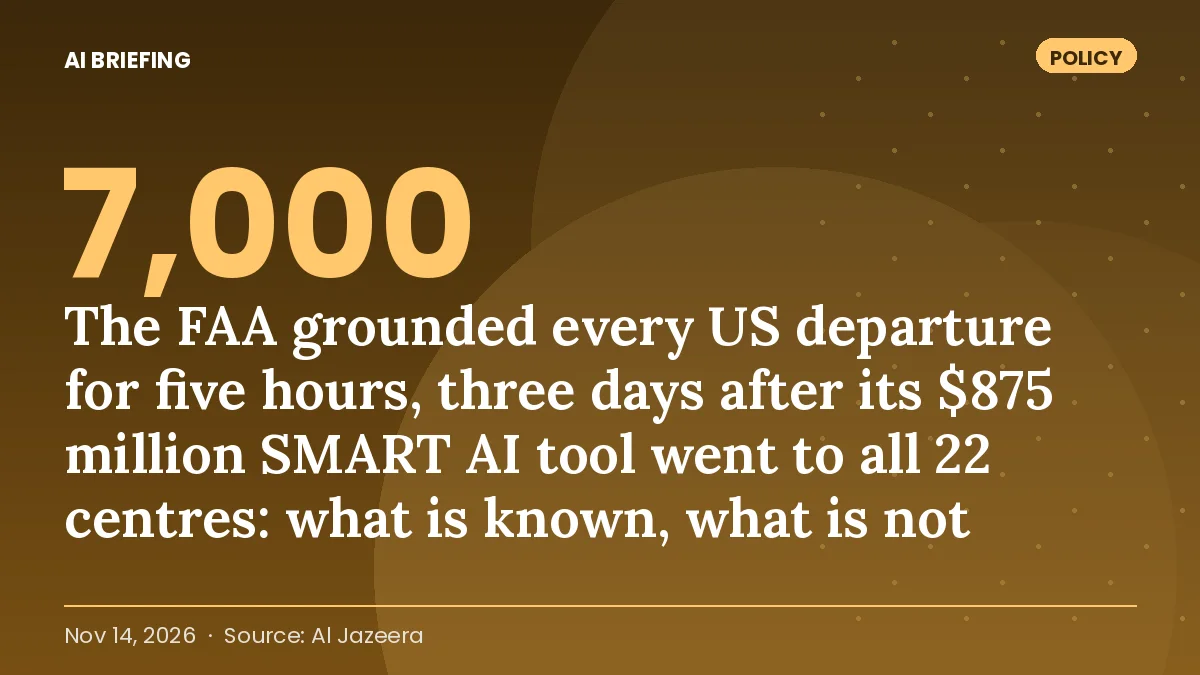
At some point on Friday afternoon the Federal Aviation Administration stopped every departing flight in the United States. The ground stop lasted roughly five hours, delayed or cancelled about 7,000 flights according to FlightAware figures cited by Al Jazeera, and was the first nationwide halt since a NOTAM database failure in January 2023; before that, the only comparable event was September 11, 2001. Transportation Secretary Sean Duffy described a communication issue affecting all 22 Air Route Traffic Control Centers, and officials later attributed it to overloaded legacy telecom switches and routers that produced inconsistent data between facilities.
Why AI is in the story
Three days earlier, on November 10, the FAA had extended SMART, the Strategic Management of Airspace, Routes and Trajectories tool, from the Washington-area airports where it launched on September 21 to all 22 en-route centres. SMART is built by Air Space Intelligence under a 12-year contract worth about $875 million. It fuses roughly 200 live data streams, including airline schedules, weather, airport capacity and airspace constraints, and produces routing and scheduling recommendations that FAA specialists review and local managers decide whether to adopt. It is advisory. It does not control aircraft, and it reportedly runs on infrastructure separate from the STARS and ERAM systems involved in Friday's failure.
The proximity was enough. By Friday evening Air Space Intelligence posted that the stop was not based on or a result of SMART or its integration with the FAA. Homeland Security Secretary Markwayne Mullin, asked directly, said investigators were looking at it and that 'you can't rule out anything at this point'. Former DOT inspector general Mary Schiavo told CNN she did not know whether the two were linked but called the timing too much of a coincidence. No technical readout has been published.
The history that makes this harder
SMART arrived with a trust deficit. On October 13 more than two dozen House members, led by Alexandria Ocasio-Cortez and others, asked the FAA to pause the tool until it explained how it had been tested in severe weather and equipment outages, what input controllers had, and how the evaluation period would be judged. Controllers told Congress they had little to no involvement in its design and feared it could produce hallucinated safety data. The FAA's position throughout has been that humans remain in charge. Congress approved $12.5 billion for air traffic modernisation last year and the administration has asked for a further $30.1 billion; the telecom gear that officials now blame is part of what that money is meant to replace.
The counter-argument
Everything public points to old hardware, not new software. The failure mode described, inconsistent data from overloaded switches, is the kind of fault the FAA has suffered repeatedly without any AI in the loop, including the New York and Philadelphia ground stops in September. An advisory tool that cannot issue clearances is an unlikely cause of a radio-communications failure. The most likely finding is that SMART was irrelevant to the outage and highly relevant to the politics of it.
What to watch
The FAA's post-incident report, and specifically whether it states that SMART's data feeds were examined and excluded; a bare 'telecom outage' finding will not end the argument. Whether Duffy pauses the nationwide rollout voluntarily, as the October letter requested. Whether the House members who signed the October letter get the hearing they asked for. And for anyone deploying AI into critical operations: the lesson is not that the tool failed, it is that the operator could not immediately prove it had not.
The story so far
- Nov 13, 2026 Four nonprofits sue OpenAI, Anthropic, Google, Meta and SpaceX to halt frontier AI development under California's public…
- Nov 12, 2026 New York opens RAISE Act registration: $500 million revenue, 10^26 FLOPs, 72-hour incident reports and a January 1 deadl…
- Nov 10, 2026 Australia's AI safety regulator: mandatory incident reporting, penalties and model evaluation after the Medicare breach
- Nov 9, 2026 The PATIENT AI Act draft: a third-party FDA review path and a Medicare pathway, comments due December 1
Key terms in this story
- Evaluation (eval) A test set with known-good answers used to measure a model or system on your own tasks.
More in Policy & regulation
All →
Beijing promises countermeasures to the remote-access chip rule, Malaysia tells data centres to comply, and Trump meets Xi on Thursday. What tomorrow's summit can and cannot change for AI buyers
The rule takes effect when it hits the Federal Register, expected this week, whatever is said in Shenzhen. The variables that remain are how China ret…
BIS's remote-access rule: a licence for any data centre giving China-linked firms more than 12 million TPP, five new licence countries, and 90 days to comply. What cloud buyers and exporters must do
The Commerce Department has extended chip export controls from the box to the rental contract, reaching data centres anywhere in the world that serve …

'National champions' and a Shenzhen summit: the US plans to package Nvidia, OpenAI, Anthropic, Microsoft and Amazon for export as Trump meets Xi on Thursday. What the week means for AI buyers
The Wall Street Journal reports Commerce will name more than two dozen firms whose bundled chips, models and cloud get federal financing and fast expo…
Get the brief in your inbox
One email every morning: the stories that mattered in AI, each with a one-line "why it matters" for your role. Free, no ads, unsubscribe any time.
Published daily by AI Briefing. We never share your address.